Navigating benefits is no easy feat. HR and compensation professionals have the challenging task of designing a comprehensive and rewarding benefits package. Although health care will continue to be the primary concern for employers and employees alike, other benefits like employee leave practices and retirement are just as important to consider when planning a well-rounded employee benefits package.
As such, ERI Economic Research Institute proudly presents its 2025 Benefits Benchmarking Survey. The focus of this survey report is to offer insight into valuable survey data to benchmark an organization’s benefits practices with those of other employers in the external marketplace. Having the ability to accurately benchmark employer-provided employee benefits will help HR and compensation analysts evaluate and improve the effectiveness of their overall compensation and benefits strategy and provide an edge over competing organizations.
ERI’s 2025 Benefits Benchmarking Survey provides a comprehensive analysis of employee benefits, offering detailed data cuts for general benefits, medical benefits, life and disability insurance, employee leave practices, retirement, and executive prerequisites. This survey also contributes employee benefits information to the robust database provided in ERI’s Assessor Platform, allowing compensation analysts to more accurately benchmark and plan benefits packages.
In this specific article, we will look at the trends and data in employee leave practices as collected by ERI Economic Research Institute for the 2025 Benefits Benchmarking Survey and how employers might administer time off for employees.
ERI Economic Research Institute’s Survey Methodology
ERI’s questionnaires were designed and distributed for this eighteenth edition of the Benefits Benchmarking Survey in October 2024. Participation was solicited from employers in the public, private, and nonprofit sectors, as well as government entities in the United States. Data input was collected in the period from October 1, 2024, to February 3, 2025. The requested effective date of benefits data was January 1, 2025.
Eighty-eight (88) U.S. organizations contributed data to the survey. Characteristics of participants varied greatly and are illustrated in the “Characteristics of Participating Organizations” section of the survey. Seventeen (17) industry groups are represented, including nonprofit organizations and government entities.
The Importance of Employee Leave Practices
Employees everywhere face the difficult task of balancing work duties and obligations with their personal lives. As work environments become more fast-paced and demanding, the effects don’t go unnoticed—that is to say, the correlation between an employee’s mental health and their workplace has never been more apparent. The U.S. Department of Health and Human Services reports the following findings on workplace mental health and well-being:1
- 76% of U.S. workers reported at least one symptom of a mental health condition.2
- 81% of workers reported that they will be looking for workplaces that support mental health in the future.3
With numbers like these collected from the most recent few years alone, employers are aware that employee leave benefits are essential to attract and retain top talent, ensure employee wellness, avoid burnout, and improve productivity. How companies administer time off for employees can get difficult, but as employees increasingly value a healthy work-life balance, this process requires careful decision-making.
A crucial part of that process requires careful consideration of a specific organization’s standards and goals, analysis of competitive and evolving market data, and employee performance and feedback. This is what makes ERI’s market data indispensable when it comes down to reliable survey results, allowing analysts to accurately benchmark internal practices against local market practices to better inform benefits, such as time off plans.
Understanding Time–Off Systems: Traditional vs. Bank (PTO)
Most employers administer time off based off two approaches: a traditional paid time-off system or a bank paid time-off (PTO) system.
A traditional paid time-off system typically separates time off into different categories consisting of vacation, sick time, bereavement, personal leave, and holidays. Usually, each type of leave will have a different policy regarding the use, in addition to having a specific number of hours or days off for each category.
Alternatively, a bank paid time-off (PTO) system provides a bank of hours that consolidates various types of leave (e.g., vacation, sick, and personal leave) into a pool of eligible time off. Compared to a traditional system, this plan does not separate paid leave into distinct and separate categories; instead, it consolidates all time off into a bank of hours or days. This plan essentially allows employees to use time as needed rather than assigning a certain number of days to sick time, vacation, etc.
As to which of the two systems would be a better model for administering time off, that is dependent on an organization’s specific goals and employee needs.
Which Plan Is More Popular?
Besides the clear differences that distinguish the two systems of time off from one another, there are particular aspects of each that may make one more attractive than the other to an organization.
For instance, a bank PTO system is intrinsically flexible as opposed to the categorical structures of a traditional system. This might make a bank PTO system the more enticing path for employees who are encouraged by a healthy work-life balance and employers who want a simpler and more straightforward method of administering leave, such as a startup firm or small business. Larger, highly regulated, or public-sector firms may prefer the clear categorization and compliance assurance of the traditional paid time-off system.
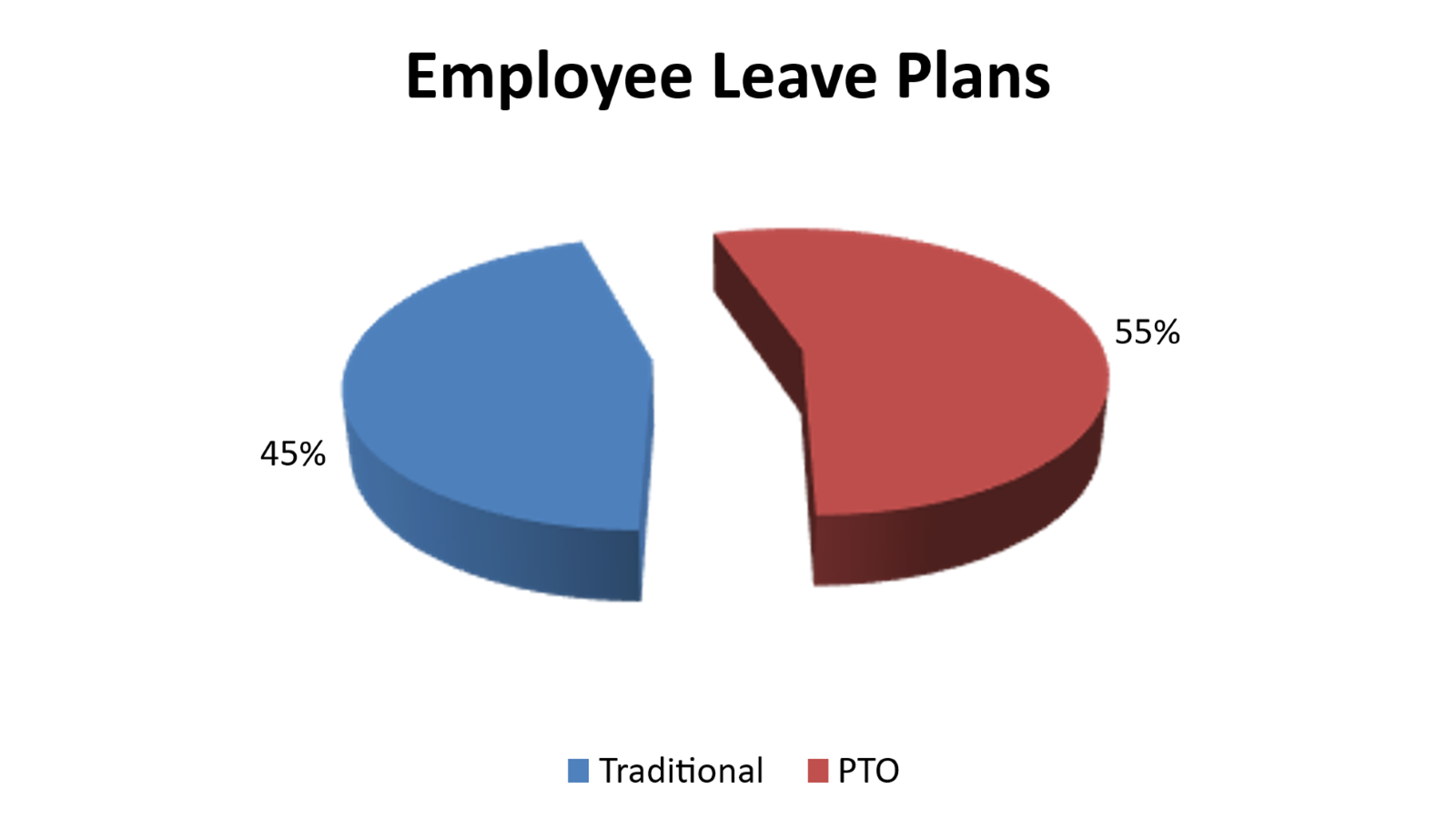
When it comes down to the survey data, ERI found that fifty-five percent (55%) of respondents used a banked paid time-off (PTO) system that combines all or part of paid leave into one pool, compared to the forty-five percent (45%) of respondents who used traditional leave plans that typically consist of vacation, sick time, bereavement, personal leave, holidays, and floating holidays. Ease of leave administration was the most common reason given for using a pooled-leave system.4
Using Data to Benchmark Leave Benefits
Besides understanding and selecting a leave system that best fits a particular organization, designing and updating a leave plan is conducive to creating a comprehensive and attractive benefits package. This begins by benchmarking internal practices against the market, allowing HR and analysts to identify flaws or internal shortcomings as it applies to leave practices and, in turn, improve them to create a competitive and effective benefits package.
As part of a thorough and inclusive leave system, HR and compensation professionals must pay attention to the details. Important elements that contribute to an attractive leave system for employees include the handling of unused time at the end of a cycle or separation, hours for jury duty, the number of days or hours granted or accrued at milestones, incorporating an inclusive variety of holidays, etc.
Paying attention to these details and how your organization compares to competitors is key to identifying and rectifying shortfalls, a critical step in ensuring a well-rounded package. For example, when handling unused vacation time at the end of a cycle in a traditional plan, ERI’s survey found that forty-two percent (42%) of respondents administered a 100% rollover, thirty-two percent (32%) a partial rollover, and twenty-six percent (26%) forfeited.4
When looking at the benchmark data, analysts would want to ensure that their handling of unused vacation time falls in a range that is not only comparable with current market practices but also responsive to employee needs and concerns, while also satisfying an organization’s metrics and goals. For instance, the popularity of a 100% rollover of unused vacation might demonstrate company flexibility and ultimately boost employee retention; however, PTO hoarding could become an issue without appropriate rules or limits.
Current benchmark data, such as that provided in ERI’s 2025 Benefits Benchmarking Survey, can be used to create and update an effective leave plan that satisfies employee expectations, meets budgetary requirements, and achieves organizational goals for a comprehensive employee benefits package. Benefits survey data should inspire HR and compensation professionals to think critically and strategically about their practices, allowing them to create more competitive and data-driven benefits packages tailored to organizational needs.
ERI Economic Research Institute can provide HR and compensation professionals with the latest and most accurate data available. Using data-driven surveys like our annual Benefits Benchmarking Survey, benchmarking leave plans and other benefits becomes both efficient and effective. What’s more, the 2025 Benefits Benchmarking Survey contributes data to the Benefits solution in ERI’s Salary Assessor, which includes additional sources to form an extensive benefits survey database, facilitating more precise and informed benchmarking and analytics. ERI’s Assessor Platform gives analysts immediate online access to a robust database, consisting of compensation and benefits surveys vetted by our data scientists for accuracy, to assist in both benchmarking and comprehensive compensation management. Through ERI’s trusted and reliable Assessor Platform, HR and compensation professionals can optimize data and extract value to inform more productive and meaningful decision making as it applies to benefits planning.
Sources:
- Office of the Surgeon General. “Workplace Mental Health & Well-Being.” U.S. Department of Health and Human Services, 24 Jan. 2025, www.hhs.gov/surgeongeneral/reports-and-publications/workplace-well-being/index.html.
- “2021 Mental Health at Work Report.” Mind Share Partners, 2021, www.mindsharepartners.org/mentalhealthatworkreport-2021.
- American Psychological Association. “Workers appreciate and seek mental health support in the workplace.” 2022 Work and Well-being Survey, Jul. 2022, www.apa.org/pubs/reports/work-well-being/2022-mental-health-support.
- ERI Economic Research Institute. “2025 Benefits Benchmarking Survey.” ERI Salary Surveys, Apr. 2025, www.erieri.com/salarysurveys/benefits.