A geographic pay differential refers to the percentage or dollar difference in market pay for the same or comparable jobs across locations. These differences reflect variations in local labor supply, employer demand, and competition for workers.
Compensation professionals use geographic pay differential data to develop and adjust salary structures that align with local labor market rates. This helps organizations attract and retain employees while managing compensation costs.
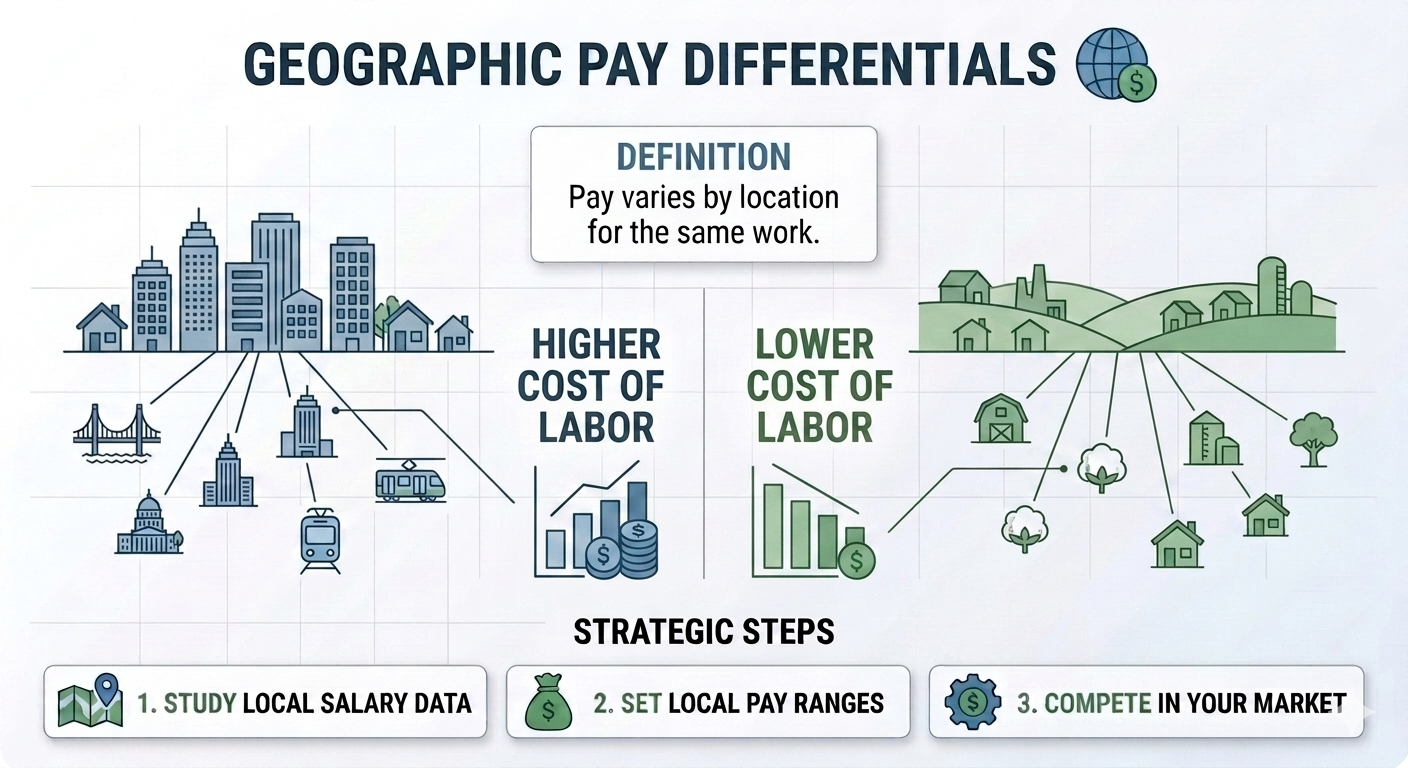
The geographic pay differential can be significant depending on the market rate for the base and target locations.
Why Do Geographic Pay Differentials Matter?
Geographic pay differentials matter because they enable organizations with employees across varying locations to remain competitive for local talent, reduce employee turnover, and manage compensation costs.
If compensation is too far below the market rate:
- Higher employee turnover: Employees may leave for employers offering higher pay for similar work.
- Difficulty attracting qualified talent: Below-market salary ranges can make job offers less appealing and reduce the number of qualified candidates willing to accept them.
If compensation is too high above the market rate:
- Less efficient use of the compensation budget: Overspending in lower-paying markets leaves fewer resources available for locations or jobs where higher pay is needed.
- Greater risk of pay compression: Offering above-market starting salaries to new hires can narrow the pay gap between employees and their supervisors.
|
ERI’s Compensation Best Practices Survey found that, of the 158 participating organizations with a national or international scope, 81% accounted for geographic pay differentials. |
What Factors Affect Geographic Pay Differentials?
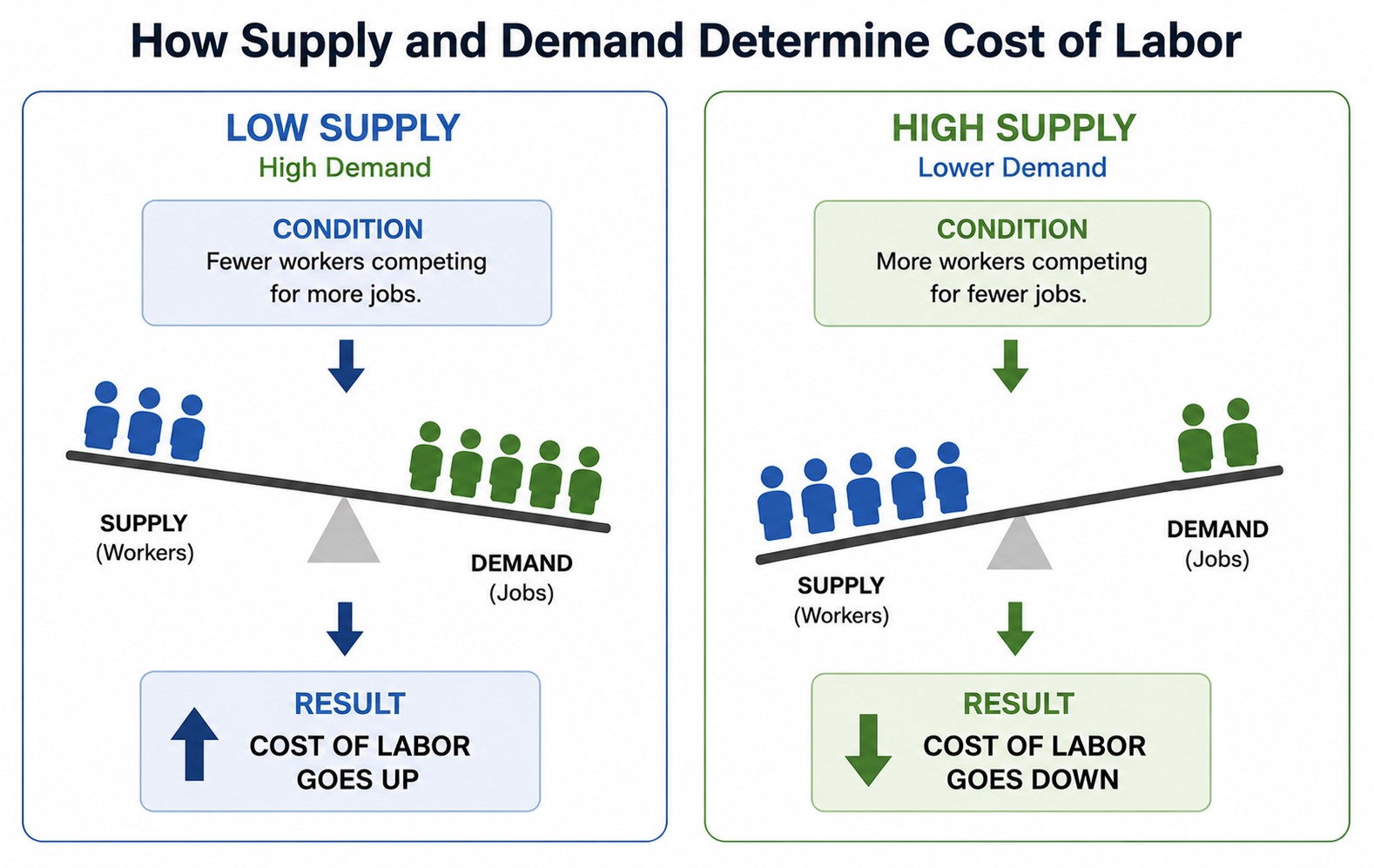
Geographic pay differentials are primarily based on differences in the market rate across locations. Each market rate is determined by local supply and demand for labor. Employers in different cities, states, or regions may face varying levels of competition for workers, differing supplies of qualified candidates, and varying concentrations of industries and occupations.
When the supply of qualified workers is low, but employer demand is high, competition drives the cost-of-labor rate up, and vice versa.
Local labor laws, union agreements, commuting patterns, and the size of the area used for comparison can also affect geographic pay differences.
How to Calculate Geographic Pay Differentials
Companies calculate geographic pay differentials by comparing the cost of labor in a target location with the cost of labor in a base location.
Use the formula below to calculate the geographic differential:

Compensation professionals can use geographic pay differential data to configure salary ranges for their employees at branch office locations.
For example, if the market rate variance of a salary range in your target location is 10% higher than your base location, then you can adjust that pay range accordingly:
| Range Point | Base Location Rate | Target Location Rate Adjusted by +10% |
| Minimum | $50,000 | $55,000 |
| Midpoint | $60,000 | $66,000 |
| Maximum | $70,000 | $77,000 |
Example of how a base salary structure range can be adjusted by a 10% geographic differential
How to Create a Geographic Salary Structure
A common way to create geographic salary structures is to adjust your base location’s salary structure based on the overall geographic differential of your branch location.
Here are the basic steps in creating geographic salary structures:
- Establish your base market (headquarters).
- Establish your geographic level (city/neighborhood, state, or regional).
- Calculate the geographic differentials and assign branches to tiers.
- Adjust pay grades according to their assigned differentials.
Design your geographic salary structures at the city, state, or regional level compared to your base market. This way, you can create your branch location’s salary structures by simply applying the differential to your base salary structure.
The Four Basic Steps for Creating Geographic Salary Structures
1. Establish Your Base Market
Your base market is the labor market in your base location (e.g., headquarters). This market will serve as the benchmark for calculating cost-of-labor geographic differentials for other locations. You can alternatively use the national market as your base market.
2. Establish Your Geographic Level
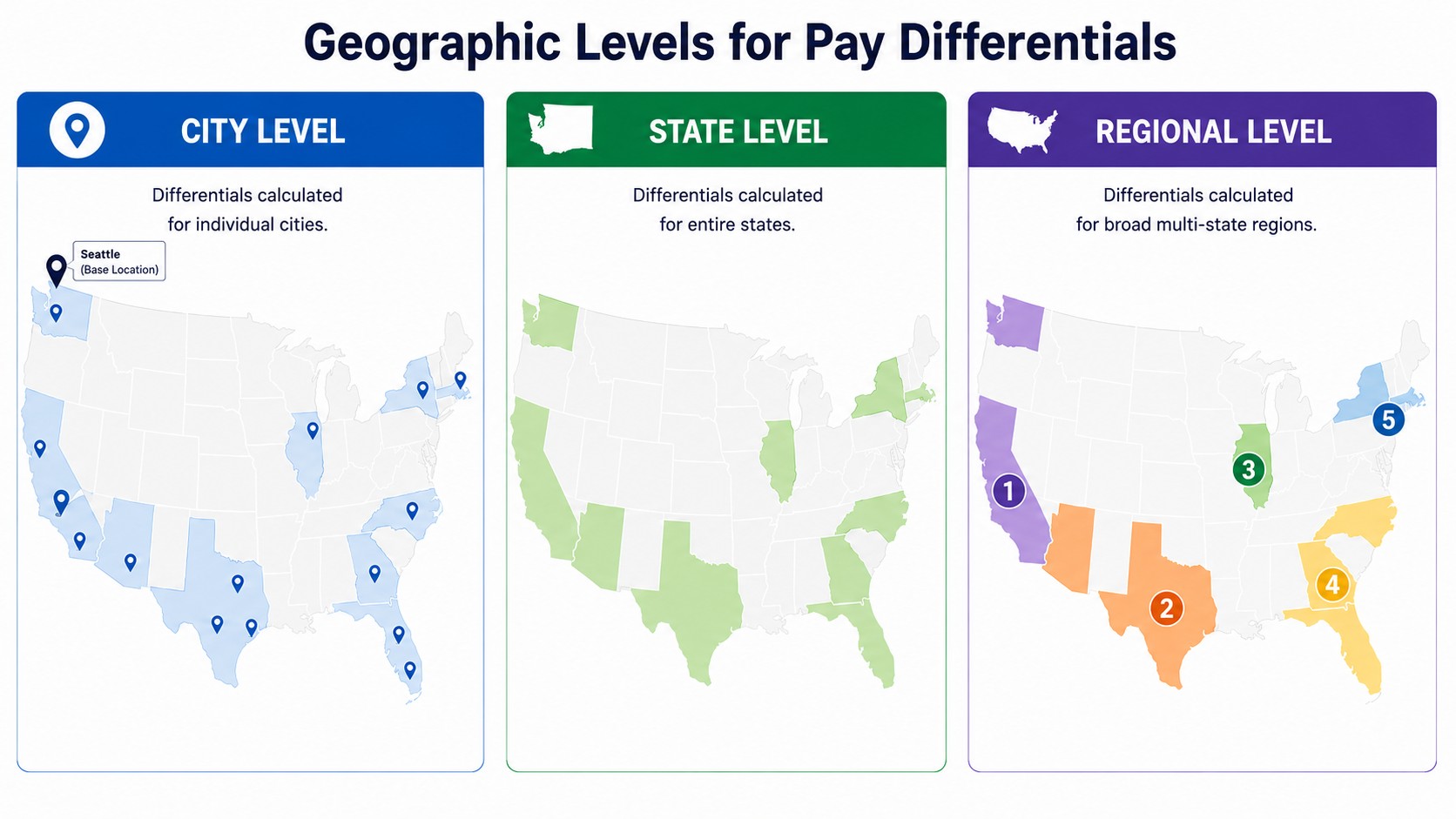
The geographic level is the specific area used to calculate a pay differential against your base location. Decide which you will use as a basis for calculating the differentials from your base location.
Types of Geographic Levels
City Level
Compensation professionals often calculate labor market differentials at the city or neighborhood level. This provides the greatest precision out of the three options as different cities or neighborhoods within the same state can have widely varying differentials.
Example Using Two Cities in the State of California:
At a salary level of $72,000, San Bernardino’s cost-of-labor rate is 82.4% of San Francisco’s cost-of-labor rate. This represents a -17.6% geographic differential.

State Level
Statewide labor market data are used to calculate one differential for all branch locations within the state. While geographic pay differentials by state are simpler to administer, accuracy may not be as precise when branches are in cities with market rates substantially above or below the statewide level.
Regional Level
You may group locations into multi-state regions, such as the Midwest or Pacific Northwest, and calculate one differential for each region. While this offers the greatest simplicity to manage, it combines vast metropolitan hubs with small rural markets. This can result in paying too much in some locations and too little in others compared to the local cost of labor.
3. Calculate Each Geographic Differential and Assign Them to Your Geographic Salary Structure Tiers
Create your geographic salary structure by finding the differentials of your branch locations, establishing tiers in 10% increments according to the rounded percentages (e.g., 80%, 90%, 100%, 110%, 120%), and assigning the branches to those tiers.
First, calculate the geographic differential as a percentage of the base location for each branch by dividing the labor market rate for the branch location by the base location’s salary, and then multiplying the result by 100.

Then, round the percentage to the nearest 10%. Establish your geographic salary structure tier increments based off those branch locations’ differentials and assign each branch location to the corresponding salary structure tier.
Example Using the City Level:
Calculate Geographic Differentials:
-
- Base location (Seattle, WA) annual base salary: $144,000
- Branch location (Columbus, OH) annual base salary: $118,852
Calculate the branch location’s base salary as percentage of the base location’s base salary:
$118,852 ÷ $144,000 ≈ 0.825
0.825 x 100 = 82.5%
The geographic differential as a percentage of the base location of Columbus, OH, in Seattle, WA is 82.5%.
Establish Tiers:
You can simplify administration by rounding to the nearest 10%.
If your differentials look like this:
78.3%, 83.7%, 86.2%, 93.6%, 96.8%, 103.4%, 106.7%, 113.1%, 116.4%, 123.8%
You can create tier increments like this:
80%, 90%, 100%, 110%, 120%
For the example of Columbus, OH, the differential of 82.5% would be rounded to 80%.
Assign:
Next, assign the Columbus, OH, branch to the 80% geographic salary structure tier.
4. Adjust Pay Grades According to the Assigned Geographic Differential
Finally, increase or decrease each pay grade according to the percent difference of the geographic salary structure.
Adjust Branch Location Salaries:
Adjust the salary ranges in the Columbus, OH, branch to be 80% of your base location’s ranges for the same pay grades. So, a pay range with a midpoint of $50,000 from your base location would be calculated accordingly for the branch location:
-
- Minimum: $40,000 × 0.80 = $32,000
- Midpoint: $50,000 × 0.80 = $40,000
- Maximum: $60,000 × 0.80 = $48,000
For a step-by-step breakdown of this process, see ERI’s How to Design a Geographic Salary Structure.
Cost of Labor vs. Cost of Living
Cost of labor reflects prevailing salary rates across different geographic labor markets, while cost of living reflects the price of a market basket of housing, goods, and services for each location. It is advisable to base your employees’ compensation on the cost of labor rather than the cost of living. Cost-of-labor differentials are used to ensure that compensation reflects the labor market supply and demand in specific locations, aligning pay with the market value of the job rather than funding the personal lifestyle choices of the employee.
Although they may seem similar, cost of labor and cost of living are two distinct metrics, so basing your employees’ pay on one rather than the other can generate very different results.
Example:

The cost-of-living differential between these two cities is 39.4%:
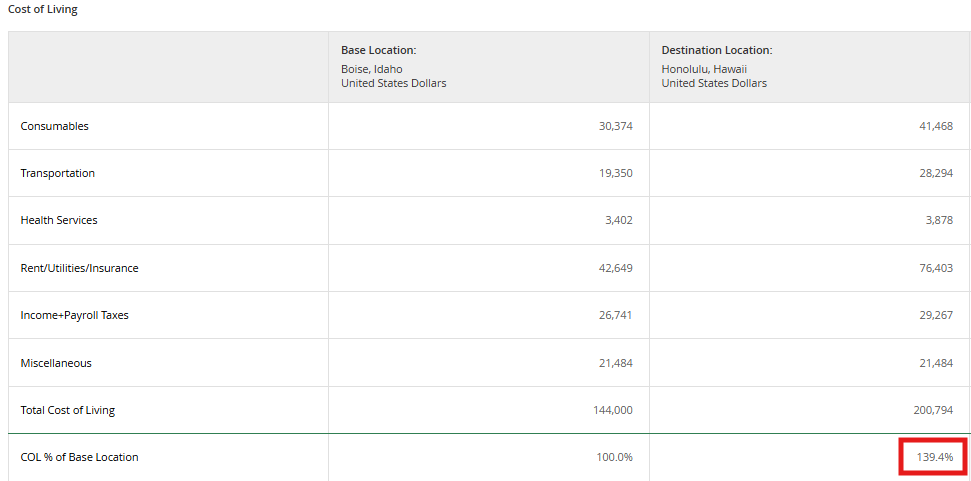
Consider this scenario. An employer paying employees in Boise, ID, at the $144,000 salary level decides to base their employees’ salaries in Honolulu, HI, on the cost of living rather than the cost of labor (the market rate):
-
- $155,287 (based on cost of labor)
- $200,794 (based on cost of living)
→ +29.31% difference
That employer would be paying 29.31% higher than the local labor market if they base this pay adjustment on cost of living rather than cost of labor.
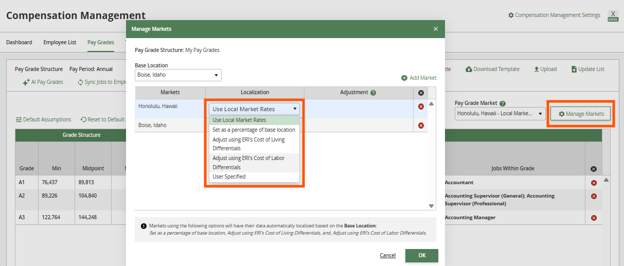
While applying cost-of-labor differentials is recommended, the Pay Grades feature in ERI’s Compensation Management platform enables you to apply either cost of labor or cost of living, at your discretion, or simply use the local market rates of each distinct location selected.
| Use ERI’s Geographic Assessor to calculate geographic salary differentials, determine cost-of-living differentials, and keep track of local labor laws, such as minimum wage rates and FLSA overtime exemption thresholds. |
Is a Geographic Differential the Same as a Cost-of-Living Adjustment?
A geographic pay differential is not the same as a cost-of-living adjustment (COLA). A geographic pay differential is a salary variance reflecting local labor-market rates, whereas a cost-of-living adjustment is a pay modification, which is calculated based on the local price of everyday goods and services.
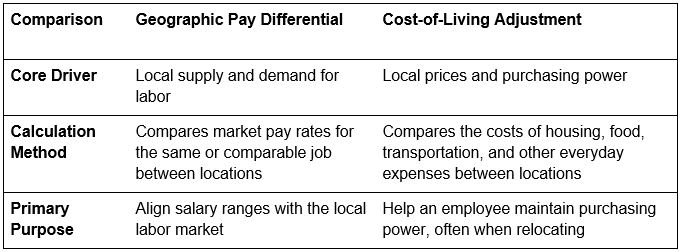
While cost of living may affect compensation in limited cases, ERI’s Compensation Best Practices Survey found that employers more often rely on local labor market rates when setting pay across locations. Cost-of-living data are commonly used when evaluating relocation assistance rather than establishing ongoing salary structures. When relocating an employee to a higher cost-of-living location, ERI typically recommends a temporary cost-of-living allowance, which is separate from base pay and reduces over a specified period of time.
Read ERI’s Cost of Labor vs. Cost of Living blog post to learn more.
Conclusion
Geographic pay differentials are used to align salary structures in branch locations, as well as pay for remote employees, with the labor market rate for each location when that location’s market rate differs from your base location’s pay rate.
Inaccurate salary structures can increase turnover, weaken competitiveness, create legal risk, and cause compensation costs to exceed budget. Verified geographic pay data help ensure that salary structures remain aligned with current local labor markets.
|
ERI’s Distance Learning Center provides an array of continuing education courses for compensation professionals who want to further their knowledge or earn HRCI and SHRM recertification credits. Consider these courses that specifically address geographic pay differentials: |