In the last three years, since the introduction of generative artificial intelligence (GenAI) with the release of ChatGPT in November 2022, there has been much speculation about the impact of artificial intelligence on employment. Machine learning (ML), a branch of artificial intelligence (AI), is rapidly reshaping the job market, making some jobs obsolete while also creating new AI jobs in high demand. To stay competitive in the ever-changing tech industry, employees are increasingly gaining new skills and certifications specifically related to machine learning. With these upgrades to their resumes, employees are aiming for new and expanded roles that involve studying and developing statistical algorithms so that computers can learn from data without requiring explicit programing for individual tasks. Machine learning is at the forefront of AI innovation, and the job market is quick to respond.
With datasets updated at least every six weeks, ERI is constantly researching current compensation trends in the labor market, including the emergence of new skills and certifications in the technology sector. To help our customers make the most accurate and up-to-date adjustments to their internal jobs, here is the machine learning skills list that will be added to ERI’s robust compensation database in the July 1, 2026, release:
| A/B Testing ML |
| Active Learning |
| Agentic RAG |
| AI Benchmarking |
| Amazon SageMaker |
| Apache Airflow ML |
| Apache MXNet |
| ARIMA Forecasting |
| Azure Machine Learning |
| Azure Machine Learning (ML) |
| Bayesian Networks |
| BentoML Serving |
| Bias Mitigation |
| CatBoost |
| Causal Inference |
| Chroma DB |
| Cloud-Based ML Platforms |
| Confidence Calibration |
| Contrastive Learning |
| CUDA Programming |
| Customer Churn Modeling |
| Data Augmentation |
| Data Labeling |
| Data Sheets |
| Databricks Mosaic AI |
| DBSCAN Clustering |
| Decision Trees |
| Demand Forecasting |
| Differential Privacy |
| Diffusion Models |
| Dimensionality Reduction |
| Direct Preference Optimization |
| Document Intelligence |
| Drift Detection |
| DVC Data Versioning |
| Dynamic Pricing |
| Embedding Models |
| Experiment Tracking |
| Face Recognition |
| FAISS Indexing |
| Feast Feature Store |
| Feature Stores |
| Federated Learning Engineering |
| Federated Privacy ML |
| Fraud Detection ML |
| Generative Adversarial Networks |
| Google Vertex AI |
| Gradient Boosting |
| Graph Embeddings |
| Haystack NLP |
| Hybrid Search |
| Hyperparameter Tuning |
| Image Annotation |
| Instruction Tuning |
| JAX Framework |
| K-Means Clustering |
| Kubeflow |
| LightGBM |
| LlamaIndex |
| LLM Evaluation |
| LoRA Fine-Tuning |
| Milvus |
| ML Business Insights |
| ML Model Deployment |
| ML Model Development |
| MLflow |
| Model Cards |
| Model Monitoring |
| Model Pruning |
| Model Quantization |
| Model Risk Management |
| Multimodal RAG |
| NumPy |
| NVIDIA NeMo |
| NVIDIA RAPIDS |
| OCR Modeling |
| On-Device ML |
| ONNX Runtime |
| OpenCV |
| Pandas DataFrames |
| PEFT Methods |
| pgvector |
| Pinecone |
| Polars DataFrames |
| Pose Estimation |
| Principal Component Analysis |
| Prophet Forecasting |
| Qdrant |
| QLoRA Adapters |
| Quantum Machine Learning (ML) |
| RAG Pipelines |
| Random Forests |
| Ray Distributed Compute |
| Recommender Systems |
| Reinforcement Learning Human Feedback |
| RLHF Training |
| Seldon Core |
| Semantic Search |
| Spark MLlib |
| Speech-to-Text |
| Support Vector Machines |
| Survival Analysis |
| Tecton Feature Store |
| TensorRT Optimization |
| Text-to-Speech |
| Time Series Modeling |
| Tiny ML |
| Triton Inference Server |
| Variational Autoencoders |
| Vision Transformers |
| vLLM Serving |
| Voice Cloning |
| Weaviate |
| Weights & Biases |
| Whisper STT |
| XGBoost |
| YOLO Object Detection |
To learn more about skills and certifications related to artificial intelligence, but not those specific to machine learning (ML), read Emerging AI Skills in Demand in 2026 and AI Certifications Shaping the Tech Workforce.
How Is Pay Adjusted for ML Skills?
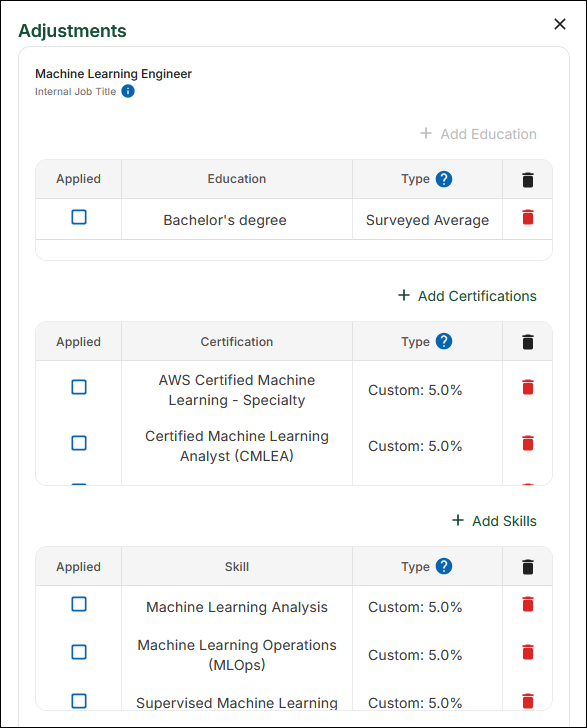
New skills and certifications often come with pay premiums, as reflected in the adjustments feature in ERI’s Assessor Platform. Use this feature to customize an internal job title with specific adjustments, including education, skills, certifications (including security clearance), shift work, and direct oversight. The platform allows you to stack up to three skills and three certifications per job. Each skill or certification may be classified as follows:
- Premium (associated with a fixed salary increase % adjustment),
- Fundamental (associated with a 0% adjustment), or
- Custom (associated with a salary increase % adjustment that can be customized by the user).
To learn more about the skills and certifications related to machine learning in ERI’s compensation database or using the adjustments feature in the Assessor Platform, contact us or sign up for a guided tour.