











Benchmark a Wide Range of Roles with Confidence
ERI provides reliable arts, entertainment, and recreation compensation data for employers with seasonal, venue-based, specialized, and mixed workforces. Match unusual job titles to relevant benchmark jobs, establish market-aligned pay, compare locations, and identify employee compensation that may be misaligned internally or with the market.
- Plan compensation budgets before peak seasons and major event schedules create a compressed hiring window.
- Apply a consistent compensation strategy across creative, technical, guest-facing, operational, and leadership employees with different schedules and pay arrangements.
- Prioritize adjustments where market gaps or pay compression could hinder seasonal hiring, experienced-worker retention, or appropriate supervisor differentials.

How It Works



Arts, Entertainment, and Recreation Sub-Industries

Performing Arts and Live Entertainment

Museums and Cultural Institutions

Sports Organizations and Venues

Amusement Parks
Performing Arts and Live Entertainment
Museums and Cultural Institutions
Sports Organizations and Venues
Amusement Parks
Compensation Solutions for Arts, Entertainment, and Recreation Employers

Make Data-Driven Pay Decisions as Seasons and Events Change
Use ERI’s real-time entertainment industry salary market data to keep pay rates aligned with changing hiring conditions during peak seasons, event schedule changes, new programs, and shifts in local labor demand. Refine pay by industry, location, experience, shift differentials, skills, and certifications to attract and retain the right talent throughout the year.

Price Specialized Jobs with Reliable Market Data
Benchmark specialized entertainment roles with market data that reflects each role’s duties and responsibilities. Use ERI’s Hybrid Job tool to combine and weight relevant benchmark jobs based on the position’s mix of responsibilities, creating a customized benchmark that better reflects the role.

Set Consistent Pay Across Venue Locations
Pay for venue and location-based employees can vary significantly by labor market. Use ERI’s Geographic Assessor to compare the cost of labor by cities, counties, metropolitan regions, or postal code. Establish geographic pay differentials that help keep compensation structures consistent across venues, facilities, and markets.
Venue-based work makes labor markets central to pay decisions. Use ERI’s Geographic Assessor to compare the cost of labor between locations and apply consistent geographic differentials to salary structures.

Maintain Pay Relationships During Peak Hiring
Seasonal employee compensation can shift quickly during peak and event-day hiring, narrowing pay gaps between new hires, returning employees, and supervisors. Workforce Insights help you identify pay compression internally and market variance externally.

Review Wage Requirements Across a Mixed Workforce
Hourly, tipped, salaried, and union-represented employees may be subject to different wage and overtime requirements. Review current and scheduled minimum wage rates and use our AI FLSA Status tool to help evaluate whether employees should be classified as exempt or nonexempt.

Set Leadership Pay for Organizations of Every Scale
Leadership responsibilities and compensation can differ for single-site venues, nonprofit cultural institutions, and large entertainment or recreation organizations. Use ERI’s Executive Compensation Assessor to benchmark executive compensation packages, including salary, bonuses, long-term and non-equity incentives, stock and option awards, pensions, and other compensation.
The Show Must Go On
Use Cases by Function

HR and Compensation Teams

Finance Teams

Compliance and Legal

Union Negotiations
Feature Highlights for Arts, Entertainment & Recreation


Arts, Entertainment, and Recreation Industry Job Titles
- Museum Director
- Art Gallery Director
- Chief Curator
- Curator
- Assistant Museum Curator
- Historic Sites Administrator
- Visitor Services Manager
- Archivist
- Historian
- Tour Guide
- Zookeeper
- Zoologist
- Horticulturist
- Stage Manager
- Booking Manager
- Event Manager
- Special Events Manager
- Ticketing Manager
- Theatre Technician
- Stage Technician
- Lighting Technician
- Event Technician
- Audio Visual Technician
- Costume Designer
- Choreographer
- Playwright
- Composer
- Actor
- Dancer
- Musician
- Singer
- Literary Agent
- Booking Agent
- Business Agent
- Coach Professional Athletes
- Athletic Trainer
- Sports Announcer
- Player Personnel Analyst
- Athlete Manager
- Horse Trainer
- Jockey
- Ticketing Coordinator
- Ticket Taker
- Amusement Park Manager
- Amusement Park Worker
- Amusement Park Attendant
- Ride Operator
- Recreation Supervisor
- Bowling Alley Manager
- Casino Manager
- Gaming Supervisor
- Dealer Supervisor
- Pit Boss
- Casino Dealer
- Slot Machine Attendant
- Cage Cashier
- Fitness Center Administrator
- Health & Fitness Supervisor
- Personal Trainer
- Fitness Instructor
- Lifeguard
Compensation Professionals in Arts, Entertainment, and Recreation FAQ
How can an organization benchmark seasonal or event-day jobs? 

Organizations should benchmark seasonal and event-day jobs against comparable roles in the same industry and local labor market, then select a market percentile based on the role’s required skills, schedule, labor supply, hiring timeline, budget, and compensation strategy. When setting an event staff hourly rate, employers may target a higher percentile for difficult-to-fill positions during compressed hiring periods. ERI provides market data ranging from the 10th to the 90th percentiles, helping organizations establish pay at their desired market position.
How can ERI benchmark specialized roles with unusual or inconsistent job titles?
ERI helps organizations match internal positions with benchmark jobs based on responsibilities, skills, and job level rather than title alone. We can assist your job matching with:
- Personal review by our trained compensation analysts.
- AI-powered job matching tools, with AI Job Evaluation providing supporting justification for the recommended match.
- A user-friendly interface to identify relevant benchmark jobs quickly and accurately.
Once you match your internal jobs to the appropriate ERI benchmark jobs, you can set pay for your workforce according to your organization’s market positioning philosophy.
How should organizations benchmark jobs with hourly, per-session, commission, and incentive-based pay?
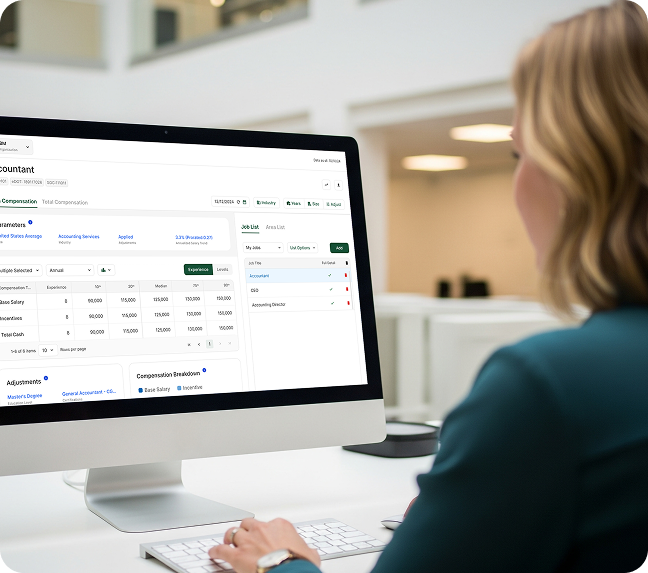
Organizations should benchmark jobs with different pay structures by converting compensation to a common basis and evaluating guaranteed and variable pay separately. Use the stated hourly rate for hourly jobs. For per session work, calculate an effective hourly rate based on all required working time, including preparation, setup, cleanup, and follow-up. For commission- and incentive-based jobs, compare both base pay and target total cash compensation rather than focusing only on the commission rate or incentive percentage. ERI’s Salary Assessor helps organizations match positions to benchmark jobs based on their duties and responsibilities and analyze base salary, incentive, and total cash compensation at selected market percentiles. Users can refine the data by location, industry, experience, skills, and other factors, select an hourly or annual pay period, and compare their actual salary, incentive, or total cash compensation with ERI’s market estimates.
How can organizations use ERI data for union and non-union employees?
Compensation for union-represented employees must comply with applicable collective bargaining agreements (CBAs). ERI’s comprehensive market data can provide an external reference when reviewing negotiated wage schedules or preparing union negotiations. Organizations can also use the data to benchmark comparable nonunion positions and evaluate alignment between the two employee groups.
What are the current IATSE (International Alliance of Theatrical Stage Employees) rates?
IATSE wage rates vary by local union, location, employer, and job classification. Employers should consult the applicable agreement or local rate sheet, then use external compensation data — such as ERI’s market benchmarks — to compare negotiated rates with the broader labor market.