When it comes to providing employees with a comprehensive total compensation package, offering an array of diverse options, acknowledging employee expectations, and setting realistic goals all work to help HR and compensation professionals plan a competitive and attractive benefits package. Benefits packages often play a principal role in attracting and retaining top talent and even boosting employee productivity and morale.
This makes staying on top of evolving industry standards and practices a necessity when designing and updating benefits plans. With that said, ERI Economic Research Institute proudly presents its 2025 Benefits Benchmarking Survey. The focus of this survey report is to offer insights into valuable survey data used to benchmark an organization’s benefits practices with those of comparable employers in the external marketplace.
Access to accurate and fully vetted market data will help HR and compensation analysts productively evaluate and improve the effectiveness of their overall compensation and benefits strategy and provide an edge over competing organizations.
This survey provides a comprehensive analysis of employer-provided employee benefits. ERI’s Benefits Benchmarking Survey also contributes information to the robust database provided in ERI’s Assessor Platform, allowing compensation analysts to more accurately benchmark and plan benefits packages.
In this specific article, we will look at the trends and practices in employer-sponsored health plans, as surveyed by ERI Economic Research Institute for the 2025 Benefits Benchmarking Survey, and how employers might approach various aspects of health care benefits.
Survey Methodology
ERI Economic Research Institute is the publisher of the 2025 Benefits Benchmarking Survey. In addition to a comprehensive analysis of health care benefits, this eighteenth edition of the survey includes sections on life and disability insurance, paid time off, retirement, and executive prerequisites.
Questionnaires were designed and distributed for this eighteenth edition of the Benefits Benchmarking Survey in October 2024. Participation was solicited from employers in the public, private, and nonprofit sectors, as well as government entities in the United States. Data input was collected in the period from October 1, 2024, to February 3, 2025. The requested effective date of benefits data was January 1, 2025.
Eighty-eight (88) U.S. organizations contributed data to the survey. Characteristics of participants varied greatly and are illustrated in the “Characteristics of Participating Organizations” section of the survey. Seventeen (17) industry groups are represented, including nonprofit organizations and government entities.
In accordance with our objective to publish only the most accurate and representative information possible, each data submission was thoroughly reviewed by our experienced research staff before it was included in the survey. Areas in question were reconciled with participants before inclusion.
Factors to Consider When Planning Health Benefits
Planning health benefits is no easy feat. On top of being complex and manifold, navigating health care will continue to be the primary and most expensive benefit for most organizations. According to ERI’s data from the 2025 Benefits Benchmarking Survey, the average monthly employee cost for Preferred Provider Organization (PPO) plans for employee-only coverage was $144.89, up from $120.47 in 2024 but still lower than $159.94 in 2015. The employer cost for employee-only coverage for Preferred Provider Organization plans equaled eighty-one percent (81%), down from eighty-three percent (83%) in 2024.
Despite its costs and complexity, employer-sponsored health plans are a continued staple in any competitive benefits package that will ultimately impact the recruitment and retention of employees. In addition, health benefits are one of the most examined details of a benefits package, with many current and prospective employees prioritizing affordable and diverse plans over other benefits.
When incorporating medical insurance into a comprehensive benefits package, there are multiple factors to consider to ensure a straightforward and effective administration of health benefits. Here are a few issues to keep in mind:
- Staying compliant with state and federal regulations (such as the employer mandate under the Affordable Care Act)
- Providing diverse options for health insurance plans and coverage
- Evaluating monthly costs (premiums) for offered insurance plans and their shared costs between employers and employees
- Whether to offer different plans based on bona fide employee classifications (full-time vs. part-time employees)
- Size and scope of an employer’s workforce
- Eligibility requirements for new employees
- Integration with current HR and payroll systems
- Enrollment periods
- Carrier reliability and reputation
Although these are just a few points, considering these details is crucial when it comes to creating a benefits plan, especially medical and other types of health insurance. For instance, employers with a larger employee group can potentially negotiate lower premiums, more favorable coverage options, and greater flexibility in customizing medical insurance plans. ERI’s 2025 Benefits Benchmarking Survey found that the average employer cost for an employee-only Health Maintenance Organization (HMO) plan varies by organization size. An organization with 50-99 employees paid a monthly cost of $560.08 as opposed to the $452.08 that an organization with 500-900 employees had to pay. Specificity matters when creating the best and most affordable medical plan for employees, and HR and compensation professionals must be as meticulous as possible when benchmarking and planning benefits.
Offering Diverse Options of Health Benefits Plans
As mentioned, employer-sponsored health benefits generally include multiple plan options. Here are the most common types of medical coverage offered, as reported in ERI’s 2025 Benefits Benchmarking Survey:
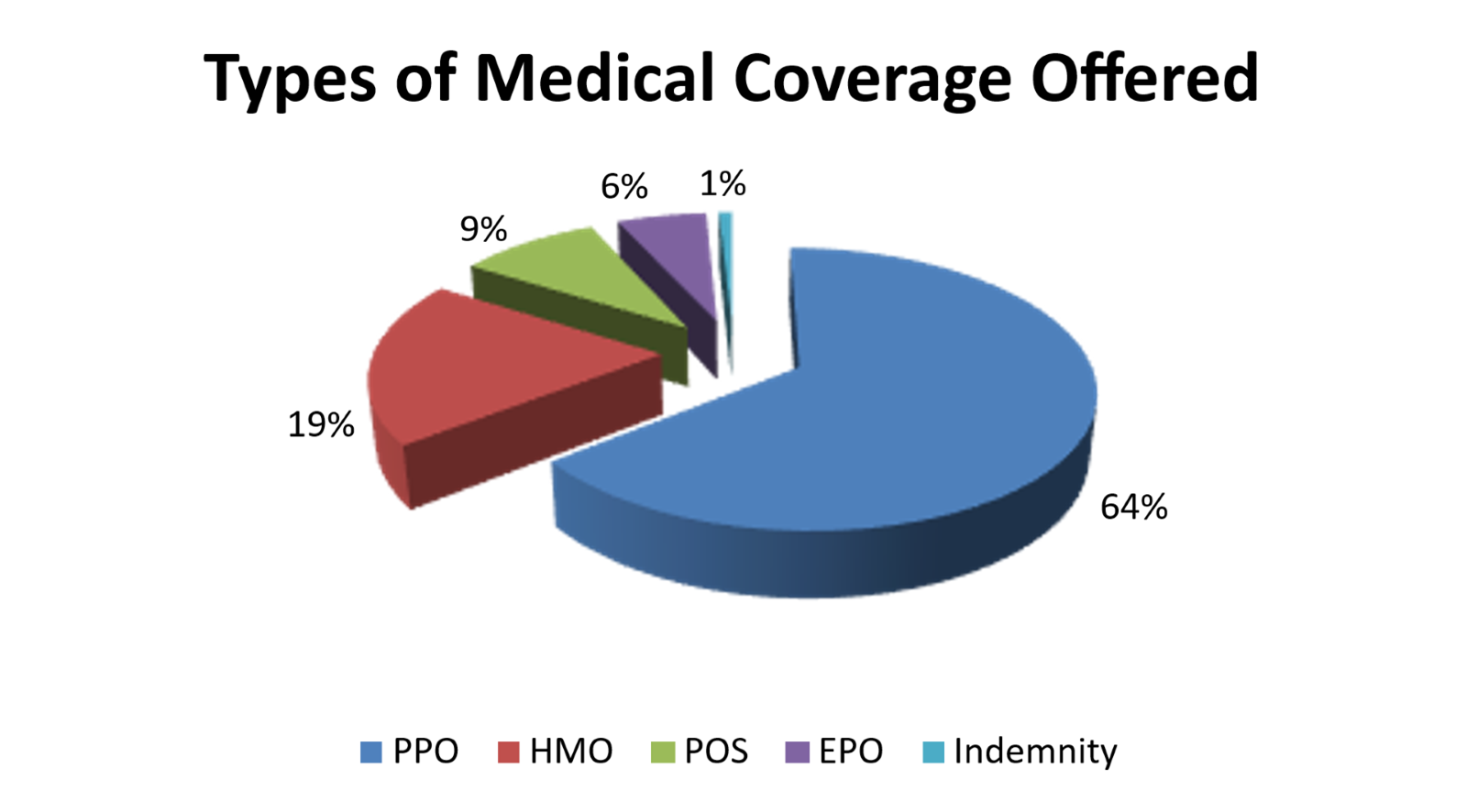
- Preferred Provider Organization (PPO) – A group of physicians, dentists, hospitals, and other practitioners that contracts with employers, unions, or third-party administrators to provide employees with services at competitive rates. Employees have the ability to choose among physicians within the PPO arrangement. If the employee chooses to use a physician from outside the PPO network, then benefits are still paid, but the employee will typically have to pay a higher percentage of the cost. This is the most popular plan, with 64% of respondents offering PPO plans.
- Health Maintenance Organization (HMO) – An organized system for the delivery of comprehensive health care services to a voluntarily enrolled population for a fixed, pre-negotiated payment. This is the second most popular plan offered by survey participants, with 19% offering this type of coverage.
- Point of Service Plan (POS) – A type of managed care medical plan where the level of benefits received depends on how an employee elects to receive care at the “point of service” that care begins. For example, if care begins with the primary care physician in the network, then benefits would be higher than if care were received outside the network. This is the third most popular, with 9% of respondents offering this type of plan.
- Exclusive Provider Organization (EPO) – An alternative delivery system, composed of self-funded medical plans which resemble an HMO or a PPO. Participants are usually required to use only providers that are part of the system. The fourth most common plan, 6% of respondents reported offering this plan.
- Indemnity Plans – Medical plans that allow the participants the maximum amount of choice in selecting doctors, hospitals, and other providers of benefits. This is an insurance program that pays medical providers for services performed and defines the maximum amounts that will be paid for covered services. This is one of the least common plans, with only 1% of survey respondents offering the plan.
Using ERI’s Benefits Benchmaking Benefits Survey
The importance of benchmarking internal organization practices with market practices cannot be stressed enough, especially as it applies to creating and updating health benefits plans. To ensure the affordability, quality, and competitiveness of an organization’s health benefits packages, staying up to date with the latest data through reliable surveys, such as ERI ’s Benefits Benchmarking Survey, is a necessity.
By benchmarking practices against ERI survey results, HR and compensation professionals will be able to identify a plan’s strengths or areas that must be addressed. Besides identifying an organization’s benchmarking goals and selecting the metrics to pay attention to, analyzing and interpreting the data as it applies to an organization’s particular situation is crucial. For example, in the 2025 Benefits Benchmarking Survey, ERI found these annual in-network deductibles for a PPO medical plan, as reported by all U.S. survey participants:
| 25th Percentile | Median | 75th Percentile | Average |
|---|---|---|---|
| $750 | $1,500 | $3,000 | $1,925.99 |
In interpreting the data to inform an organization’s internal practices, an HR and compensation professional could begin by asking whether their offered health plans have high out-of-pocket costs compared to ERI’s data. Then, as one common way to mitigate those high costs, employers could potentially offer a Health Savings Account (HSA) to incentivize employees to use those plans, particularly if employers also contribute to employees’ HSAs.
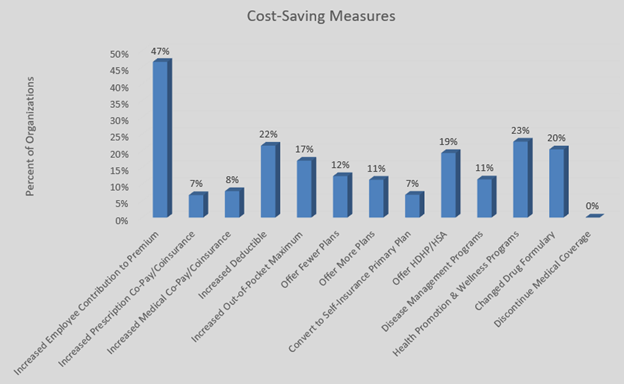
Additionally, from the angle of employer costs, there are various cost-saving measures that organizations can take to mitigate expensive medical plans while ensuring the affordability and quality of coverage of those plans. In the chart below, ERI data found that 47% of respondents increased employee contributions to premiums and 23% took the initiative to invest in health promotion and wellness programs to reduce expenses.
This is what makes ERI’s survey results indisputable. ERI’s survey data can be used to inform internal organization practices, enabling benefits administrators to develop data-driven solutions that align plans with market standards and address areas for improvement. Below is a sample of additional data insights provided in ERI’s 2025 Benefits Benchmarking Survey to assist HR and compensation professionals with health benefits benchmarking:
- Employee vs. employer costs by plan
- High deductible vs. standard deductible plans
- Co-payments
- Out-of-pocket maximums
- Prescription drug plans
- Mental health services provisions
- Disease management programs
Through reliable surveys like our annual Benefits Benchmarking Survey, benchmarking benefits can be a straightforward process that forms the foundation of an organization’s employee benefits plan. Besides providing current and accurate survey results, ERI’s Assessor Platform offers a streamlined solution to make benchmarking data efficient and effective. ERI’s Assessor Platform gives HR and compensation professionals immediate access to a robust database, consisting of compensation and benefits surveys vetted by PhD-level data scientists for accuracy. Data from the 2025 Benefits Benchmarking Survey also contributes to the Benefits solution in ERI’s Salary Assessor, providing benefits benchmarking analytics online. Optimize and analyze valuable data to inform your decision making as it applies to benefits planning using ERI’s trusted and reliable database today!
Sources:
ERI Economic Research Institute. “2025 Benefits Benchmarking Survey.” ERI Salary Surveys, Apr. 2025, www.erieri.com/salarysurveys/benefits.