
Looking to Benchmark Pay?
STANDARD ERROR
The standard error is the standard deviation of the distribution of the sample statistic.
Example: A population has a mean of 6. You would expect that samples taken from this population would also have means of 6. However, that is rarely the case. The means of the samples taken from this population will vary due to sampling errors. Standard error is a measure of the expected variation of the sample mean around the true mean of the population.
Standard error is defined as:

| S | standard error |
| s | standard deviation |
| n | sample size |
Consider the dataset below. Drawing different samples from this dataset would give you different means and different standard deviations.
| Employee | Base Salary* |
|---|---|
| A | $85,397 |
| B | $108,396 |
| C | $119,037 |
| D | $120,064 |
| E | $190,972 |
| F | $103,873 |
| G | $93,835 |
| H | $97,734 |
*The numbers used are for illustration purposes only.
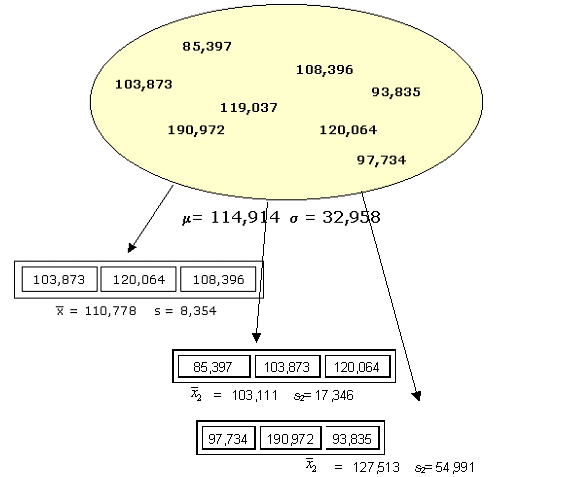
Different samples lead to different statistics.
When relying on salary survey data to set pay, you must ask:
- Does this survey report a standard error?
- If so, how large is the standard error?
The standard error answers the question: "Do you expect that there will be a large amount of variation between this sample mean and the means of other samples of the same size taken from this population?"
In general...
The smaller the sample size and the larger the population variance, the larger the error will be.