What Is a Salary Survey and How Do I Choose the Right One?

Salary surveys can support your pay strategy to ensure that employees are fairly and competitively compensated. But what exactly is a salary survey? How can you choose the right one? This blog will provide a comprehensive overview to help inform your decisions when choosing the best salary survey for your organization.

What Is a Salary Survey?

A salary survey summarizes the statistical results for benchmark jobs based on a questionnaire collected from a broad number of employers to support in making informed compensation decisions. These surveys provide salary benchmarks for compensation levels, helping organizations ensure that their pay structures are market competitive and internally equitable. Organizations use salary surveys to benchmark compensation in order to attract and retain top talent while ensuring internal equity and compliance with legal standards.

Why Are Salary Surveys Important?

Salary surveys are useful for organizations of all sizes, locations, and industries. Salary surveys are a critical tool to accomplish the following:

  • Implement informed compensation decisions
  • Resolve compensation issues
  • Analyze pay trends
  • Establish job worth hierarchies
  • Develop an annual salary plan
  • Set your salary increase budget and salary structure movement
  • Identify competitive pay practices
  • Ensure legal compliance
  • Monitor internal equity
  • Defend current pay practices
  • Gain market intelligence

What Can Be Accomplished Using Quality Salary Surveys?

The right salary surveys can help an organization to accomplish its short- and long-term objectives. Consider these factors that make salary surveys so important:

  1. Market Competitiveness: In a competitive job market, offering salaries that are aligned with industry standards is vital. Salary surveys provide the data needed to determine competitive pay levels, helping to attract and retain qualified employees.
  2. Internal Equity: Salary surveys help maintain fairness within an organization by ensuring that employees in similar roles are compensated equitably. This can reduce turnover and increase job satisfaction.
  3. Budget Planning: Accurate salary data aids in budgeting when determining the true cost of an employee. This allows organizations to allocate resources more effectively.
  4. Compliance: Purchasing salary surveys from reputable sources ensures that you are pricing competitively, while also maintaining compliance according to the Safe Harbor Guidelines set by the U.S. Department of Justice and the Federal Trade Commission (FTC).
  5. Strategic Planning: Salary surveys provide accurate salary data necessary for long-term planning and alignment with business goals.

How Do You Obtain Salary Survey Data?

Acquiring high quality and reliable salary survey data is critical to establishing a market-competitive compensation plan. Here are some common sources of salary survey data:

  1. Government Agencies: Public sector salary data are often available through government databases, such as the Bureau of Labor Statistics (BLS) in the United States. Although at no cost, government salary surveys are often conducted infrequently, which can result in outdated information that may not accurately reflect current market conditions.
  2. Online Salary Survey Databases: ERI’s Assessor Platform offers an extensive salary survey database. Our database consists of benefits and compensation surveys vetted by our data scientists to ensure maximum accuracy. You can run unlimited salary reports with data for 39,800+ jobs, 1,100+ industries, and 10,400+ global locations.
  3. In-House Surveys: Some organizations conduct their own salary surveys, especially if they operate in a niche industry or region. While they may be useful, in-house surveys often rely solely on the organization’s internal data, which may not provide the comprehensive view necessary to accurately evaluate market rates or industry standards. It is also important that these surveys are compliant with the FTC Survey Safe Harbor Guidelines.
  4. Industry and Job Function Salary Surveys: Acquiring industry- or job-specific salary surveys from a reputable source is an excellent way to obtain valuable compensation data for your organization. ERI’s Salary Surveys offer an in-depth analysis of compensation trends, featuring 20 industry-focused and 8 job function surveys, as well as a benefits benchmarking survey. With a broad selection of surveys, ERI can meet the unique needs of your organization.

Choosing the Right Salary Survey

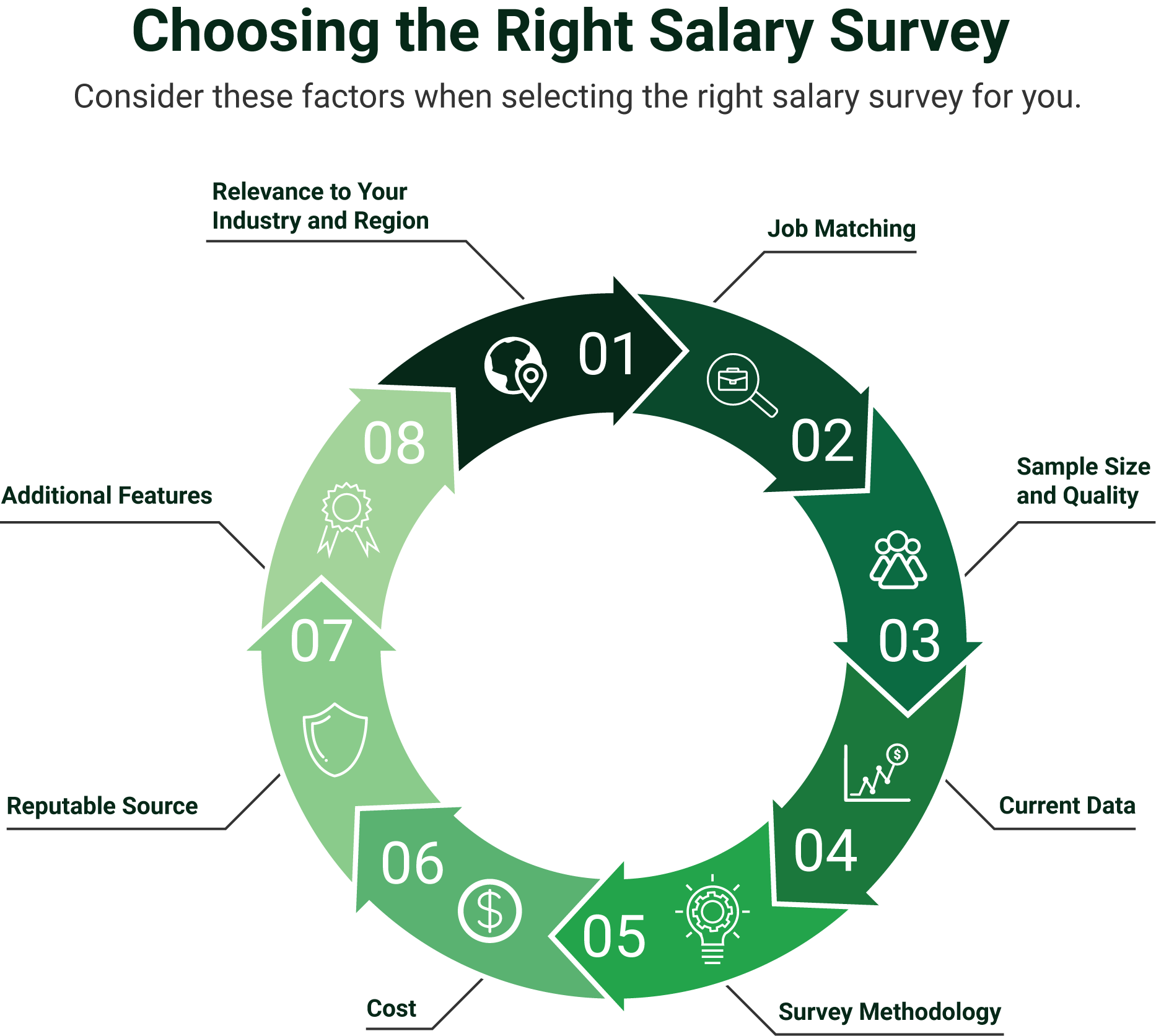
Selecting the right salary survey involves several considerations to ensure that the data are relevant, accurate, and useful for your specific needs. Here are some key factors that you should consider when choosing a salary survey:

  1. Relevance to Your Industry and Region: Choose surveys that include market data on your specific industry and geographical location. Compensation levels can vary significantly between industries and regions, so it is crucial to select a survey that aligns with your organizational context.
  2. Job Matching: Verify that the survey includes job matches for your organization’s specific jobs. Accurate job matching is crucial for obtaining relevant data.
  3. Sample Size and Quality: Consider the sample size and quality of the survey. A larger sample size generally provides more reliable data. Additionally, the survey should include data from similar organizations in terms of size or scope, such as revenue, budget, assets, or number of employees. The higher the management job, the more likely size will be used in the market pricing process.
  4. Current Data: Compensation trends can change rapidly. Choose surveys that are updated regularly to ensure that you have the most current compensation survey data available.
  5. Survey Methodology: Understand the methodology used to collect and analyze the data. Reliable surveys use rigorous data collection and validation methods to ensure accuracy.
  6. Cost: Consider your budget when selecting a salary survey. While some surveys are available for free, they may not be reliable and accurate. Although others may come at a significant cost, they tend to be more dependable. Weigh the benefits of the data against the expense to make your decision.
  7. Reputable Source: Research the reputation of the salary survey provider. Established and reputable vendors are more likely to produce reliable and accurate salary data.
  8. Additional Features: Some surveys offer additional features, such as customizable reports, data visualization tools, and access to compensation consultants. These features can add value and enhance your compensation planning process.


Choosing the Right Salary Survey

Integrating Salary Survey Data into Compensation Planning

Once you have selected the right salary survey, the next step is integrating the data into your compensation planning process. These are some best practices to consider:

  1. Data Analysis: Analyze the survey data to identify trends and benchmarks. Look for patterns in pay levels, increases, and other compensation components.
  2. Job Matching: Job matching procedures should be implemented each time that a salary survey is purchased. Ensure accurate job matching by comparing your organization’s job descriptions with those in the survey. Adjust data as needed to account for differences in responsibilities and qualifications.
  3. Benchmarking: Use the survey data to benchmark your current base salaries against the market. Identify any gaps or discrepancies and develop a plan to address them.
  4. Salary Structures: Use the survey data to design or adjust your salary structures. Establish salary ranges, pay grades, and progression paths based on market benchmarks.
  5. Communication: Communicate the findings and any resulting changes to your stakeholders, including senior management, HR teams, and employees. Transparency is critical to gaining buy-in and maintaining trust.
  6. Continuous Monitoring: Compensation planning is an ongoing process. Continuously monitor the market and update your data and pay structures as needed to stay competitive.

How Does ERI Use Salary Survey Data?

ERI’s salary survey database uses a high volume of data to ensure that it is as statistically reliable as possible. Here are the salary data points collected and used by our data scientists to create our compensation database:

  • General and Industry-Specific Surveys: ERI utilizes industry salary survey data to help benchmark pay by industry. Our Assessor Platform combines information from both general and industry-specific surveys and allows you to specify the industry for any job title.
  • Geographic-Specific Market Data: ERI’s unique survey database allows customers to match their benchmark jobs based on the desired competitive market location, whether it is national, regional, state, metro, or city. Geographic differentials in ERI’s Geographic Assessor complement job-based market data in the Salary Assessor for managing geographic-specific compensation plans.
  • Executive Rewards: Learn about the most common executive rewards that are not traditionally part of a standard compensation package. Keep up with trends to attract and retain top executive talent while keeping total compensation in line with other companies.
  • Global Pay Data: If your organization operates on a global scale, you can find competitive compensation rates around the world for a particular job title using our international survey database.
  • Shift Differential Data: ERI’s Assessor Platform makes it easy to see how a particular shift can affect pay and helps you quickly analyze shift differentials to accurately benchmark compensation.

Try a demo of ERI’s Assessor Platform to see how you can utilize our salary survey data and compensation software in your salary planning process.

How to Determine the True Cost of an Employee

The true cost of an employee includes all costs associated with hiring and retaining an employee. Understanding the total compensation of an employee goes beyond just the salary figure. Accurately determining this cost is essential for budgeting, financial planning, and making informed decisions about hiring and compensation. 

Components of a Total Compensation Package 

An employee’s total compensation package includes all monetary and non-monetary compensation and benefits that an employee receives. Knowing everything that goes into your employee’s total compensation package can help you retain employees and streamline your compensation planning. Let’s look at some examples of what is typically included in a total compensation package. 

Salary

The first component of employee cost is the base salary or wage. This is the amount agreed upon during the hiring process. However, when calculating the cost of an employee, organizations are responsible for other expenses that extend far beyond the base salary:

Incentives

Employers frequently provide incentive pay to employees to encourage performance. Types of incentives may include bonuses, long-term incentives, options, equity payments, and other incentive programs can add to the overall cost.

Taxes 

Organizations are responsible for paying employer payroll taxes. This includes Social Security, Medicare, federal and state unemployment taxes, and any local taxes. These are mandatory and vary depending on the country and state. 

Benefits 

Benefits can be a significant expense for some organizations, but it is crucial to offer. According to the Affordable Care Act, employers with 50 or more full-time employees, including full-time equivalent employees, must provide health insurance. Although health insurance is the most popular benefit offered, a range of benefits should be added to complete your total rewards package. Consider these additional benefits:  

  • Retirement contributions 
  • Health, dental, and vision insurance 
  • Workers’ compensation insurance 
  • Maternal/paternal leave 

Paid Time Off (PTO) and Holidays 

Paid leave policies are a significant part of employee compensation. Employees receive a predetermined number of PTO days that can be used for holidays not celebrated by the company or for personal time. Paid time off usually increases the longer an employee remains with the organization. In addition to PTO, include public holidays, when employees are paid but do not work, in the overall cost. 

Perks

Offering additional employee perks will make your organization competitive and attract top talent. Consider these perks:

  • Professional development: Training programs, certifications, and other professional development opportunities are costs that employers may cover. 
  • Miscellaneous benefits: These might include transportation allowances, meal subsidies, gym memberships, employee discounts, hybrid work options, and more. 

Factors That Can Affect an Employee’s True Cost 

Several factors can affect an employee’s actual cost, including location, organization size, and recruiting costs, among others. At the same time, market trends in your specific industry may impact an employee’s total compensation. It is important to understand these factors to accurately calculate an employee’s cost. 

Location 

The employee’s geographic location must be considered since the cost of labor may vary significantly from one location to another. You may have employees working in multiple states or even countries, as well as remote employees. For instance, imagine your employer has its headquarters in San Francisco, California, and is opening an office in Dacula, Georgia. With the assumption that labor rates vary between these two locations, your employer will need to evaluate the cost of labor in Dacula, Georgia, to know the typical pay of employees in this new labor market. With the help of ERI’s Assessor Platform, organizations can analyze the cost of labor across multiple cities worldwide and adjust their compensation strategies accordingly to effectively compete for talent. 

Market Trends 

Understanding market trends within your industry is necessary to stay competitive. Compare your organization’s current compensation practices against industry benchmarks and competitor data to identify areas for improvement. Using various resources, such as compensation surveys, market reports, and reliable online databases relevant to your industry and geographical location, will help with this process. Consider using ERI’s compensation planning software to find market rates for jobs by location, industry, experience, organization size, and shift type

Organization Size 

Organization size has a significant impact on an employee’s true cost. Usually, larger companies provide employees with more benefits and perks as an incentive, meaning employees have a higher total cost. ERI’s Assessor Platform allows you to customize compensation analyses by organization size, which may be measured by revenue, assets, fiscal year budget (FYB), or number of employees. 

Recruiting Costs 

Finding the right employee for a role requires significant recruitment investments, whether you are using internal or external resources. These include the costs of recruiting staff and hiring managers for their time spent finding the ideal candidate. Consider these additional recruiting costs: 

  • Job advertisements  
  • Business promotion events, such as job fairs  
  • Recruiting software, such as applicant tracking systems  
  • Background checks  
  • Relocation costs  
  • Referral bonuses to existing employees    

Onboarding Costs 

After an employee is hired, they need to be equipped with the knowledge to contribute to their new role. Consider the resources and time that it will take for the new employee to settle into their new role. The average time for new hires to reach full productivity ranges from three to six months, which could potentially impact your team’s output or lead to a decrease in earnings. 

Overhead Costs 

Overhead costs are the expenses that a company needs to pay outside of labor costs. This can include building costs, property taxes, utilities, and office supplies, for example. To figure your overhead cost per employee, divide your total annual overhead costs by the number of employees. 

Turnover Rate 

Companies with higher turnover rates have higher overall employee costs because they are forced to invest in recruitment and onboarding costs more frequently. 

How To Calculate the Cost of an Employee 

There are multiple ways to calculate the true cost of an employee. One way to find out the actual employee cost is to add up all the costs incurred. 

Step 1: Calculate Base Salary and Wages 

Start by calculating the employee’s gross salary. For hourly employees, multiply their hourly rate by the number of hours worked per week and then by the number of weeks worked per year to get their annual salary. 

Annual Salary = Hourly Rate × Hours per Week × Weeks per Year 

Step 2: Add Payroll Taxes 

Calculate the employer’s portion of payroll taxes. In the United States, this typically includes the following: 

  • Social Security: 6.2% of the employee’s salary up to the wage base limit 
  • Medicare: 1.45% of the employee’s salary (and an additional 0.9% for high earners) 
  • Federal Unemployment Tax (FUTA): 6% on the first $7,000 of wages 
  • State Unemployment Tax (SUTA): This varies by state. 

Step 3: Include Benefit Costs 

Add the annual cost of the various benefits provided, including the employer’s contributions to health insurance premiums and retirement plans. Include any additional costs for other benefits and perks, such as professional development, bonuses, and other miscellaneous benefits. 

Step 4: Factor in Paid Time Off and Holidays 

Calculate the cost of any paid time off, including vacation days and sick leave, as well as public holidays. PTO cost can be computed as a percentage of annual salary based on the number of days provided. 


Employee Cost Example Calculation

Let’s put this all together with a hypothetical example: 

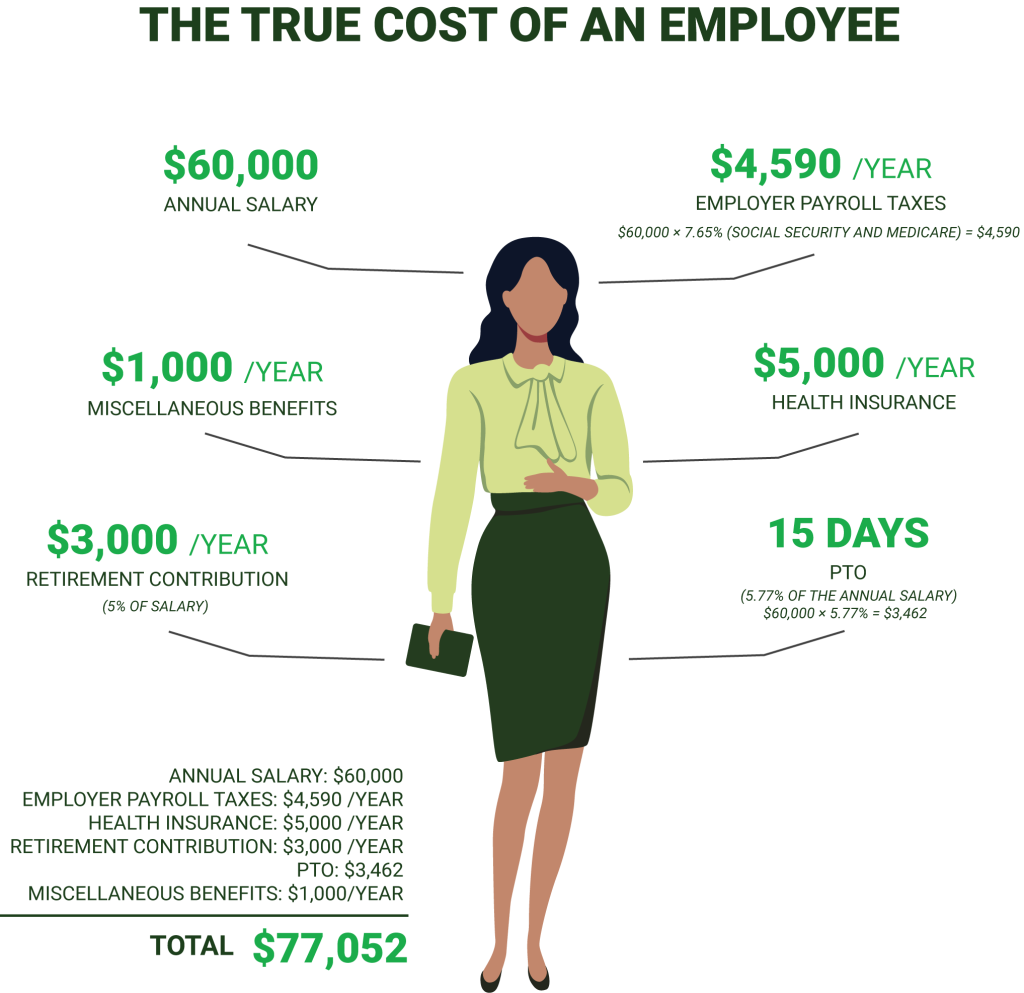
  • Annual Salary: $60,000
  • Employer Payroll Taxes: 7.65% (Social Security and Medicare)
    $60,000 × 7.65% = $4,590 per year
  • Health Insurance: $5,000 per year
  • Retirement Contribution: $3,000 per year (5% of salary) 
  • PTO: 15 days (5.77% of the annual salary)
    $60,000 × 5.77% = $3,462
  • Miscellaneous Benefits: $1,000 per year

Total Cost = $60,000 + $4,590 + $5,000 + $3,000 + $3,462 + $1,000 
Total Cost = $77,052 

Thus, the true cost of this employee is $77,052 per year, significantly higher than the base salary of $60,000. 


How Much Does an Employee Cost? 

The typical cost for an employee is between 1.25 and 1.4 times the base salary. This rate includes costs for base salary, employment taxes, and benefits. When using this estimate as a guide, you can get the minimum and maximum cost for each employee.  

Minimum cost of an employee = base salary x 1.25 

Maximum cost of an employee = base salary x 1.4 

For instance, if you hire a new employee with a base salary of $60,000, based on the calculations, the true cost of this employee is between $75,000 and $91,000. This formula gives employers an initial estimate of the real costs of employees, but the number can be tailored based on other factors determined by the employer. 

Why Use ERI? 

Manually calculating the true cost of each employee can be time-consuming and prone to errors, especially in larger organizations with many employees and complex benefits packages. ERI’s Assessor Platform can assist with this process, ensuring accuracy and saving valuable time. The Assessor Platform includes these valuable tools: 

  • Employee cost calculator: You can benchmark base salary, incentive, long-term incentive, and total cash at various percentiles. 
  • Customizable inputs: The Assessor Platform allows you to customize compensation rates based on experience, organization size, shift differentials, skills, education, certifications, and other factors to ensure that the calculation reflects your specific circumstances. 
  • Reporting and analytics: Generate detailed reports and analytics to understand trends, calculate budget impacts, and forecast future costs. 
  • Scenario planning: Run different scenarios to see how changes in benefits, salaries, or employee numbers may impact overall costs. 

Fastest Growing Jobs in the Technology Industry

In the fast-paced world of technology, the computer-related industry is constantly evolving, and the demand for skilled professionals continues to surge. For compensation professionals navigating this dynamic terrain, staying on top of the most in−demand tech jobs is paramount. As organizations strive to maintain a competitive edge, understanding the compensation benchmarks for these roles becomes indispensable. In this blog, we will delve into some of the most sought−after tech positions and how compensation planning software can aid in optimizing remuneration strategies.

Most In-Demand Tech Jobs

Based on ERI’s Assessor Platform, the fastest growing job in the technology and computer-related industry between the second quarter of 2023 and the second quarter of 2024 was a Field Service Engineer. This job’s average salary grew 7.20% during that time. The Field Service Engineer position requires traveling to client’s sites to create, install, and/or repair technology-related equipment.  

Following close behind, a Quality Assurance Programmer (or QA Programmer) saw a 7.18% growth in average salary. This role is responsible for ensuring that a product meets quality requirements before its launch. They do this by monitoring every stage of the product development process and suggesting corrections that range from basic product necessities to feature improvements and optimizations.

Job TitlePercent Change
Field Service Engineer7.20%
Quality Assurance Programmer7.18%
Web Content Administrator7.16%
Computer Security Specialist7.15%
Web Developer7.12%
Computer Network Analyst7.06%
Network Communications Technician7.06%
Programming Supervisor7.03%
Computer Peripheral Equipment Operator7.01%
Technical Editor7.00%
Technical Writers Supervisor6.95%
Government Sales Supervisor6.91%
Tape Librarian6.91%
Systems Analyst6.87%
Data Entry Operator6.83%
Computer Processing Scheduler6.71%
Applications Programming Supervisor6.66%
Technical Writer6.60%
Technical Illustrator6.59%
Database Design Analyst6.57%
Computer Hardware Engineer6.50%
Computer Programmer6.32%
Computer Information Scientist6.30%
Computer Operator5.97%
Computer Security Coordinator5.75%
Computer Software Engineer5.68%
Cash Register Servicer5.58%
Data Recovery Planner5.54%
Test Data Acquisition Technician5.34%
Data Examination Clerk4.94%
Quality Assurance Supervisor IT4.90%
Technical Publications Manager4.82%
Web Administrator4.75%
Computer Software Developer4.57%
Archivist4.24%
Computer Programmer Lead4.22%
Webmaster4.17%
Supervisor Operating Systems Programming3.68%
Programmer Engineer3.64%
Research & Development Supervisor (Technical)3.35%
Applications Programming Manager3.27%
Systems Analysis Manager3.14%
Data Entry Supervisor3.14%
Data Control Clerk3.08%
Supervisor Field Services3.03%
Systems Analyst Lead3.03%
Business Systems Analyst2.94%
Call Center Representative (Complex Calls)2.93%
IT Consultant2.87%
Supervisor Help Desk2.84%
Librarian Technical2.82%
Field Service Technician2.80%
Research & Development Manager (Technical)2.74%
Supervisor Computer Operations2.64%
Software Design Supervisor2.43%
Call Center Representative (Specialized Calls)2.23%
Database Administrator2.07%
Software Design Director1.99%
Research & Development Director1.88%
Data Entry Operator Lead1.74%
Systems & Programming Manager1.70%
Programmer Analyst1.56%
Computer Systems Hardware Analyst1.56%
Operating Systems Programmer1.55%
Systems & Programming Director1.40%
Systems Analysis Supervisor1.25%
Network Control Supervisor1.22%
Computer Maintenance Technician0.96%
Computer Operations Manager0.91%
Network Control Technician0.90%
Software Design Manager0.88%
Systems Analysis Director0.88%
Computer Technical Support Specialist0.77%
Computer Service Representative0.76%
Computer Operations Director0.68%
Programming Director0.61%
Network Control Manager0.61%
Computer Services Manager0.40%
Data Control Supervisor0.26%

Why Use ERI in Your Compensation Planning?

Now that you know which tech jobs are in demand, how can you ensure that you are hiring qualified candidates to stay competitive? One way is to conduct a compensation analysis and offer a competitive total compensation package. ERI’s Assessor Platform provides HR professionals with data-driven insights to improve their compensation strategies and help make better business decisions. Use our Assessor Platform and compensation analysis tools to properly set wages, determine the cost of labor, and develop lasting pay structures. Streamline your compensation management, determine competitive salary levels, compare employee salaries with market benchmarks, and more with instant access to employer-reported compensation survey data online. With reliable and current data, you get valuable insights into your compensation strategy and make cost-effective decisions to retain top talent.

Understanding and Leveraging Percentiles in Salary Survey Data

Accurate data and insights form the foundation of effective salary surveying and benchmarking strategies. Percentiles are a key component of salary survey data, and a compensation team’s methodology for using this salary survey data can greatly affect compensation outcomes. This blog is dedicated to demystifying the role of percentiles in salary surveys, emphasizing their critical role in shaping fair and competitive compensation strategies. 

What Are Percentiles? 

Percentiles offer a measure that indicates the relative standing of a salary within a broader salary range. By arranging salaries from lowest to highest, percentiles reveal what proportion of salaries falls below a particular value. For example, the 25th percentile marks the salary below which 25% of observations lie, offering insights into what we typically see as entry-level or less experienced compensation for a given data cut. As a further example, around the 75th percentile (and above) typically reflects the compensation of a more experienced employee, providing a benchmark of top-tier salaries to effectively compete for top candidates. 

Figure 1. Salary Percentile Distribution: This sample pay distribution illustrates a range of salaries across the market, delineated by key percentiles. The median represents the middle point of reported market salaries; the 25th percentile and below represent entry-level or less experienced workers; and the 75th percentile and above represent high salary thresholds that typically reflect workers with extensive skills and experience.

The practice of reporting salary survey data by percentiles is driven by the need for a nuanced understanding of salary distributions. Unlike mean salaries, which can be skewed by outliers, salary percentiles paint a detailed picture of salary variability and market competitiveness. Percentiles data offer a comprehensive view of salary distributions that go beyond the mean or median pay estimates. The granularity provided by a broad range of percentiles allows organizations to align their compensation strategies with market realities, ensuring that they can attract and retain job candidates by looking at the full range of the market rather than just the average compensation. 

Utilizing Salary Percentiles for Compensation Planning

Utilizing percentiles enables organizations to accurately position themselves within the competitive labor market. Salary percentiles are vital in identifying whether an organization’s pay scales are aligned with their market, whether current wages require adjustment to secure talent, or if an organization is positioned as a market leader in compensation. 

In the context of salary increments, percentiles function as a comparative guide. Identifying positions or employees whose compensation falls below the desired percentile allows for targeted adjustments, aligning salary structures with market trends and organizational objectives. For example, getting a market index based on the 50th percentile, particularly for executive titles which are typically surveyed by the median, allows organizations to mathematically calculate whether their internal salary is 100% matched to the market, in which case, they would receive a market index of 1 within ERI’s Assessor Platform. Otherwise, organizations can see if they fall below or above the median market index in order to make adjustments to a pay package. 

Figure 2. The market index is a ratio of your internal salary to the reported market median (or mean). A market index of 1 means that your internal job’s salary is in line with the mean salary of the survey job. Values above 1 indicate that the employee’s salary is above the reported market median. Values below 1 indicate that the current salary is below the market median. The actual salary of this sample employee indicates that their salary of $500,000 is 14% above the market median of $436,761.

Additionally, percentiles are crucial in developing and establishing salary ranges that promote internal equity. For example, setting the minimum pay for an internal position based on the market rate at the 25th percentile, while setting the maximum pay for the position near the market’s 75th percentile, allows for a structured progression that is competitive and equitable. Fairness and transparency in compensation planning help employees appreciate the market relevancy of salaries. Establishing a company’s pay grades relative to specific percentiles aids in maintaining consistency across roles and experience levels. A minimum-maximum approach is instrumental in defining pay grades, enhancing the clarity and consistency of compensation policies. When using percentile data to adjust pay grades, it is important to establish a baseline and then monitor the market’s movement. If, for example, the 50th percentile for a position increases due to market trends, then an organization may decide to adjust its median pay accordingly. 

To tailor salary data to unique organizational needs when specific data points are missing, percentiles can be a powerful tool. For example, when adapting roles beyond standard survey levels (which may only provide Level 1 to Level 3), organizations might align a hypothetical Level 4 position with the 90th percentile of a Level 3 benchmark, reflecting the heightened expertise and experience expected at Level 4. This approach is similar to the previously discussed method of looking to lower percentiles for less experienced employees, and higher percentiles for compensating extensively skilled employees. This allows for flexibility in compensation planning, enabling firms to match their specific circumstances with broader market data. 

The Importance of Understanding Percentiles

A thorough understanding of percentiles and how percentiles work in compensation planning transforms their complexity into a compelling strategic tool. This depth and granularity in analyses equips organizations to make well-rounded compensation decisions that balance market competitiveness with internal fairness. Organizations may develop flexible compensation structures that can adapt to insights derived from percentile analyses. This flexibility allows for responsive adjustments to emerging trends and competitive pressures. To effectively use percentiles, HR professionals should conduct a thorough compensation market analysis, considering factors such as industry, geographic location, and job function. This comprehensive approach ensures that percentile-based benchmarks are accurately aligned with the organization’s specific circumstances.

Key Takeaways

The application of percentiles in salary survey data is a practice that underpins effective compensation strategies. By offering detailed insights into salary distributions, percentiles enable HR and compensation professionals to make informed decisions that align with both market conditions and organizational goals. As organizations strive to navigate the complexities of compensation planning, the strategic use of percentiles will continue to be an invaluable asset, ensuring that compensation practices are not only competitive but also equitable and transparent.  

This blog is designed to enhance the toolkit of HR professionals, equipping them with strategies for benchmarking salaries and formulating compensation plans. Beyond integrating insights from percentile data, it is important for strategies to also reflect external influences, such as economic changes, regulations affecting wages and equity, and industry developments. By integrating a comprehensive approach to percentile data, organizations can drive continued success and employee loyalty.  

How to Master Compensation Benchmarking

You may know how much each employee is earning within your organization, but do you understand how that compensation compares to the industry standard? Organizations strive to attract, retain, and motivate top talent; however, determining what constitutes competitive compensation can be challenging without the right tools and data. This is where compensation benchmarking emerges as an indispensable practice for HR professionals.

What Is Compensation Benchmarking?

Compensation benchmarking involves a datadriven process that compares an organization’s compensation practices against industry standards and competitor data to ensure fairness and competitiveness. Factors that influence compensation benchmarking include industry, organization size, geographic location, job responsibilities, and more. Overall, it enables organizations to gauge where they stand in the market regarding employee compensation while maintaining pay equity and adhering to applicable laws and regulations.

Why Is Compensation Benchmarking Important?

Compensation benchmarking is essential because it provides you with datadriven pay comparisons to identify gaps and inconsistencies in your current compensation practices. This will help you make informed decisions in your compensation plan and achieve these goals:

  • Attract Top Talent: Competitive compensation packages are crucial for attracting skilled professionals. Most candidates compare multiple job openings and apply to those that are best suited to them, considering better compensation, flexible work environments, or improved benefits. If you want to attract the ideal candidate, stay ahead of the curve by practicing compensation benchmarking. 
  • Retain Employees: Staying up to date with benchmarking data can help you spot pay discrepancies and maintain pay equity across your organization. Offering fair and transparent compensation can increase employee engagement, satisfaction, and loyalty, ultimately reducing turnover rates. 
  • Stay Compliant: Benchmarking compensation helps organizations maintain compliance with legal and regulatory requirements. Stay compliant with Fair Labor Standards Act (FLSA) overtime exemption requirements and view unique exempt and non-exempt provisions for 28,000 jobs using ERI’s Occupational Assessor.

What Are the Sources of Compensation Benchmarking Data? 

In the process of matching job descriptions and comparing compensation at your organization to market rates in your industry, there are several sources you can use to gather data:

  • Salary Surveys: Salary surveys report data collected from comparable organizations on the mean or median salary for a particular job title. Salary surveys can include additional compensation data, such as incentive or variable pay. Participating organizations often report their geographic region, size, and industry so that survey data are relevant. ERI publishes compensation and benefits surveys for the United States and Canada, including numerous industry-specific and job function surveys published annually with data from for-profit and nonprofit organizations. 
  • Compensation Planning Software: Salary survey databases, such as ERI’s Assessor Platform, allow users to properly set wages, determine the cost of labor, develop lasting pay structures, benchmark compensation, and more. Our Assessor Platform provides a higher-level analysis of the extensive salary survey database mentioned above. This source includes compensation and benefits data analyzed and vetted by our data scientists to benchmark salaries with maximum accuracy. 
  • Government Agencies: Some governmental agencies collect and publish salary data for specific industries and regions. The U.S. Bureau of Labor Statistics (BLS) has wage data by occupation for the nation, regions, states, and more. 
  • Professional Networks: HR professionals often share compensation data and insights through professional networks and associations. 

How to Benchmark Compensation

  1. Audit current job roles and responsibilities: The first step in compensation benchmarking is to clearly define all the existing jobs in your organization using accurate job titles and job descriptions. Job titles may have different responsibilities across the market, so it is important to carefully define the job description so that you can properly match each job to an industry equivalent.

  2. Identify Relevant Data Sources: Next, choose credible sources of compensation data that align with your budget and goals. Using free sources from government agencies, for example, can be beneficial when you are on a tight budget. However, these sources provide only general and often conservative estimates of market pay and can be more time-consuming to analyze. For accurate compensation data tailored to your organization, use salary benchmarking tools, such as ERI’s Assessor Platform, to find competitive market rates for jobs by location, industry, experience, and organization size. Use ERI’s cloud-based platform to customize compensation rates based on shift work, skills, education, and certifications (including security clearances).

  3. Select Benchmark Jobs: Once you choose your data source, match jobs in your organization to benchmark jobs in your industry. Since similar job titles can have distinct roles across industries, use job responsibilities, rather than job titles alone, to identify benchmark jobs. ERI’s Assessor Platform includes detailed job descriptions written by ERI researchers and job matching tools to help you benchmark jobs accurately.
  1. Analyze Data: Once you have gathered all the salary benchmarking data, compare your organization’s compensation practices with current market rates to identify gaps and areas for improvement. ERI’s Assessor Platform allows you to benchmark base salary, incentive, long-term incentive, and total cash at various percentiles.
  1. Implement Changes: Use benchmarking insights to adjust compensation structures and policies as needed. Whether that means refining your current salary bands, adjusting starting offers, or changing salary structures all together, compensation benchmarking will provide you with the data you need to manage compensation strategically. When implementing your decisions, be transparent and clearly communicate changes to your employees.

  2. Monitor and Review: Compensation benchmarking should be monitored and reviewed periodically to ensure that you are staying on top of market trends. Keep records of changes that were made and continue to reassess compensation practices to ensure competitiveness.

Best Practices in Compensation Benchmarking 

To effectively analyze compensation benchmarks, it is important to consider these best practices: 

  • Regular Updates: Keep compensation data up to date to reflect changing market conditions. 
  • Consistency: Ensure consistency in job matching and data analysis methodologies. 
  • Broad Data Pool: Utilize data from diverse sources to obtain a comprehensive view of the market. 
  • Customization: Tailor benchmarking analyses to your organization’s specific needs and requirements. 
  • Legal Compliance: Adhere to legal and regulatory requirements when gathering and utilizing compensation data. 
  • Communication: Communicate compensation decisions transparently to employees to foster trust and engagement. 

Compensation benchmarking is a vital practice for HR professionals seeking to design competitive and equitable compensation structures. Leverage ERI’s compensation tools to navigate the complexities of salary benchmarking and ensure all employees are fairly compensated. Try a free demo and see how our Assessor Platform can help you benchmark pay across specific industries and geographic locations. With the insights gained from compensation benchmarking, organizations can optimize their salary planning strategies to drive employee satisfaction and organizational success

How Minimum Wage Laws Impact Your Starting Salary

How Minimum Wage Laws Impact Your Starting Salary

If you have ever worked in a minimum wage position in different states or even in various cities, you would have noticed differences in the compensation amounts. In this article, we will explore the various aspects of state minimum wages in the United States and how your location and occupation affect your starting wage. 

State Minimum Wage Laws

While there is a federal minimum wage mandated by the Fair Labor Standards Act (FLSA), currently $7.25 per hour, individual states have the authority to set their minimum wage rates to suit their needs. Some states have not increased their state minimum wage for over a decade, whereas others have raised their rates regularly to better reflect the local cost of living. 

As of 2024, 20 states have not increased their wages for ten or more years: 

  1. Alabama 
  2. Georgia 
  3. Idaho 
  4. Indiana 
  5. Iowa 
  6. Kansas 
  7. Kentucky 
  8. Louisiana 
  9. Mississippi 
  10. New Hampshire 
  11. North Carolina 
  12. North Dakota 
  13. Oklahoma 
  14. Pennsylvania 
  15. South Carolina 
  16. Tennessee 
  17. Texas 
  18. Utah 
  19. Wisconsin 
  20. Wyoming 

On the other hand, 22 states increased their minimum wage rates at the start of the 2024 calendar year.1 Here are the new rates compared to the previous year: 

State 2024 Minimum Wage 2023 Minimum Wage

Alaska

$11.73

$10.85 

Arizona

$14.35

$13.85 

California

$16.00

$15.50 

Colorado

$14.42

$13.65 

Connecticut

$15.69

$15.00

Delaware

$13.25

$11.75

Hawaii

$14.00

$12.00

Illinois

$14.00

$13.00

Maine

$14.15

$13.80

Maryland

$15.00

$13.25

Michigan

$10.33

$10.10

Minnesota

$10.85

$10.59

Missouri

$12.30

$12.00

Montana

$10.30

$9.95

Nebraska

$12.00

$10.50

New Jersey

$15.13

$14.13

New York (NYC, Long Island, and Westchester)

$16.00

$15.00

New York (remainder of state)

$15.00

$14.20

Ohio

$10.45

$10.10

Rhode Island

$14.00

$13.00

South Dakota

$11.20

$10.8

Vermont

$13.67

$13.18

Washington

$16.28

$15.74

Regional and Industry Differences 

Even within states and counties, there can be variations in minimum wage rates due to specific regional disparities, such as cost of living, industry or occupation of the employee, or even city borders. 

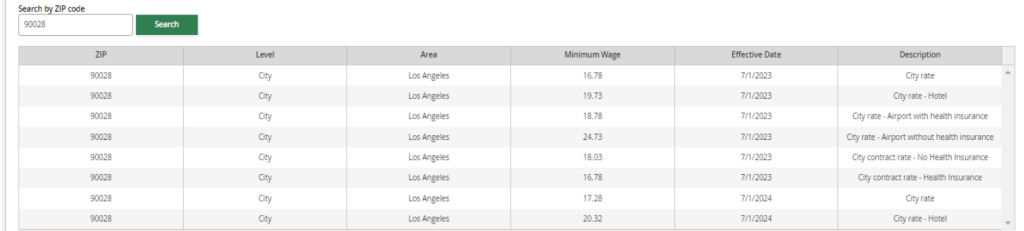
Consider the city of Los Angeles, for example, where pocket areas are subject to their own laws since they are not considered part of the city.  For a visual example of the outliers, you can see the unhighlighted areas that are not considered part of L.A.


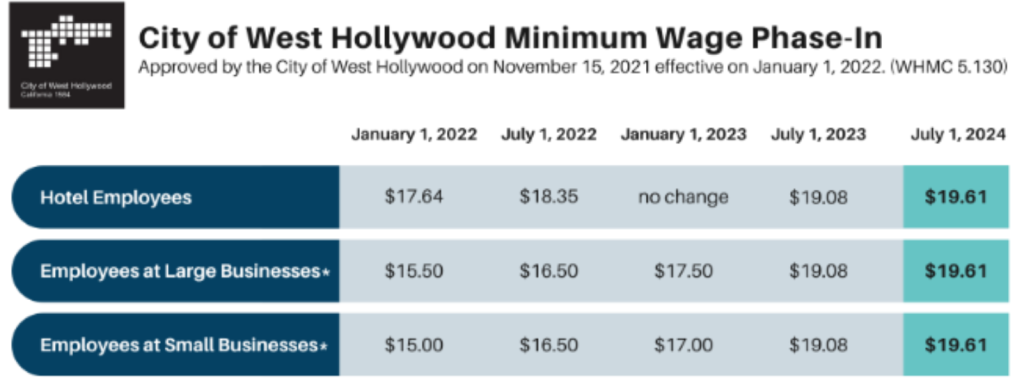
A prominent example is West Hollywood, given its unique position of being surrounded by Los Angeles territory. In West Hollywood, all employees have starting rates of $19.08 for all occupations (as of July 1, 2023).


https://www.weho.org/business/operate-your-business/minimum-wage


For comparison, we can see that the lowest possible starting minimum wage is $16.78 for the city of Los Angeles (as of July 1, 2023). 


In addition to the base minimum wages displayed on the charts, there are different starting wages for certain industries, as well as specific exceptions, based on the laws of their respective jurisdiction.  

Indexing to Inflation 

Some states have implemented policies where their minimum wage is indexed to inflation, ensuring that it keeps pace with the cost of living as it rises over time. To be more specific, these states adjust and raise minimum wage accordingly based on the year-over-year increases in the Consumer Price Index (CPI). This methodology has been adopted by 19 states and Washington, D.C:

  1. Alaska
  2. Arizona 
  3. Colorado 
  4. Connecticut 
  5. Florida 
  6. Maine 
  7. Minnesota 
  8. Missouri 
  9. Montana 
  10. Nebraska 
  11. Nevada 
  12. New Jersey 
  13. New York 
  14. Ohio 
  15. Oregon 
  16. South Dakota 
  17. Vermont 
  18. Virginia 
  19. Washington 
  20. Washington, D.C. 

Tipping Laws 

In some states, employers are allowed to pay a lower base wage to tipped employees (such as servers or waiters) so long as their total earnings (including tips) meet or exceed the regular minimum wage. These variations can influence the effective minimum wage rates for tipped employees in different states. 

For example, one of the best states for tipped employees is California, which allows them to combine their hourly base wage of $16 with their tips without the total amounts being capped. On the other hand, there are a handful of states that have their tipped wage start at a reduced minimum wage, such as the federal minimum of $2.13 per hour for tipped employees, and their remaining wages will be either covered by tips or the employer. Some of the states with unfavorable tipped worker minimum wage laws are Alabama, Georgia, Kansas, Mississippi, North Carolina, Texas, and Utah.

Final Thoughts

In conclusion, the minimum wage landscape in the United States is a complex web of state regulations, regional disparities, and industry-specific variations. While the federal minimum wage provides a baseline, individual states have the authority to set their own rates, leading to significant differences in compensation amounts across the country. Myriad factors, such as the cost of living, regional disparities, indexing to inflation, and tipping laws, further contribute to the variations in minimum wage rates. Understanding these factors is essential for individuals navigating the job market, as their location and occupation can significantly impact their starting wage and overall financial well-being. 

It is important to note that minimum wage laws are subject to change as state legislatures continue to debate and enact new policies. For the most up-to-date information on minimum wage rates in specific states, it is recommended to consult with official state labor department websites, reliable sources for labor law information, or ERI’s Geographic Assessor.


1 Twenty-two states will increase their minimum wages on January 1, raising pay for nearly 10 million workers. Economic Policy Institute. (n.d.). https://www.epi.org/blog/twenty-two-states-will-increase-their-minimum-wages-on-january-1-raising-pay-for-nearly-10-million-workers/  

2 Minimum wages for tipped employees. DOL. (n.d.). https://www.dol.gov/agencies/whd/state/minimum-wage/tipped 


How to Conduct a Compensation Analysis

It is important for compensation professionals to understand how their company approaches compensation and what it entails for their organization. With the cost of labor as one of the biggest expenses for any business, accounting for up to 70% of total business expenses, it is essential to conduct compensation analyses. Although the compensation analysis process can be complex, it is necessary to ensure fair compensation practices that will contribute to your overall compensation and employee retention strategy. 

What Is Compensation Analysis?

A compensation analysis is a systematic evaluation of an organization’s pay and benefits framework. It involves examining several factors, such as industry benchmarks, job roles, experience levels, and geographical considerations, to determine the competitiveness and fairness of employee compensation packages. By conducting a comprehensive compensation analysis, you can ensure that compensation practices align with internal and external market standards, comply with regulatory requirements, and support your talent acquisition and retention goals. 

Why Is a Compensation Analysis Important? 

A comprehensive compensation analysis enables you to ensure that your organization is financially responsible to your employees and overall business operation. A compensation analysis can contribute to the following goals:

  • Ensure Pay Equity and Fairness: A well-executed compensation analysis helps organizations ensure pay equity among employees based on their skills, experience, and contributions. This helps identify any disparities or inequities in pay across different roles, departments, or demographic groups, allowing organizations to address any potential issues of discrimination or bias. 
  • Ensure Legal Compliance: When you review your compensation analysis, this is your chance to review any updates on pay laws. Review federal laws and regulations, such as the Fair Labor Standards Act (FLSA), the Employee Retirement Income Security Act (ERISA), and the Equal Pay Act, to lay the groundwork for fair pay. Along with federal laws, do not overlook state-level laws, which can introduce additional requirements that need to be incorporated into your policies and compensation practices. Our Assessor Platform can help you stay on top of changing minimum wage and FLSA requirements with alerts that ensure that you are always legally compliant. 
  • Cost Optimization: Conducting a compensation analysis allows organizations to identify inefficiencies in their pay structures and make adjustments to optimize costs. A compensation analysis report can ensure that compensation aligns with market rates and employee performance, helping companies allocate their resources more effectively and achieve better return on employee investment.  
  • Improved Employee Satisfaction: When employees feel that they are fairly compensated for their contributions, they are more likely to be satisfied with their jobs and remain loyal to the organization. A comprehensive compensation analysis helps identify areas for improvement, leading to higher employee satisfaction and retention rates. 

Benefits of Conducting Compensation Analysis 

Performing a compensation analysis can benefit your organization in several ways: 

  • Data-Driven Insights: Compensation analysis provides data-driven insights into market trends, competitor practices, and internal pay disparities. This enables informed decision-making and ensures that compensation strategies are aligned with organizational goals. 
  • Salary Benchmarking: Compensation analysis helps you understand how competitive an organization’s pay structure is compared to industry standards and competitors. By offering competitive salaries and benefits, companies can attract and retain top talent. Fair compensation can also boost employee morale, motivation, and job satisfaction, leading to increased productivity and lower turnover rates. 
  • Strategic Decision-Making: Compensation analysis provides valuable insights that inform strategic decision-making related to workforce planning, budget allocation, and performance management. By understanding how compensation impacts employee performance and organizational outcomes, companies can make more informed decisions that drive business success. 

How to Do a Compensation Analysis

These steps are critical in the process of conducting a compensation analysis: 

1. Define Objectives and Scope: Before conducting a compensation analysis, clearly define the objectives and scope of the study. Determine what aspects of compensation you will be analyzing and the specific goals you aim to achieve. Different goals require varying approaches that contribute to the overall compensation analysis. For example, if you want to understand the cost of labor per employee, you may want to conduct a job analysis to provide an accurate picture of your organization’s job hierarchy and compensation allocation. On the other hand, if you are looking to understand why employees leave your organization, conduct employee engagement surveys. 

2. Gather Current Data: Collect relevant data from internal sources, such as HR records and payroll systems, and external sources, such as industry surveys and compensation databases. Ensure that the data are accurate, up-to-date, and representative of your organization’s workforce and industry. A few important sources of data are defined below. 

Data Definition
Job Descriptions It is important to have an up-to-date job description for every job within the organizationIt should explain the job’s placement within the organization and outline the essential duties and typical functions performed by the employee.
Compensation Policies  This includes information on compensation policies that are followed when conducting a compensation analysis. Also, gather data from the employees’ point of view in understanding these policies, such as the employee handbook.  
Salary Benchmark Gather data that includes pay structures for all employees that compare internal pay data to the external market.
Employee Information Organize your employee information, such as location, working hours, work experience, and performance.

3. Job Evaluation: Evaluate job roles within your organization to establish a systematic framework for comparing positions based on relevant factors, such as skill requirements, responsibilities, and market demand. Use job evaluation methodologies, such as job grading or point-factor analysis, to assign relative values to distinct roles. 

4. Salary Benchmarking: Compare your organization’s compensation practices against industry benchmarks and competitor data to assess competitiveness and identify areas for improvement. Utilize compensation surveys, market reports, and online databases to gather benchmarking data relevant to your industry and geographical location. For a more in-depth analysis, consider using ERI’s compensation planning software to streamline your compensation strategy, get data on the market, and customize compensation based on your needs.  

5. Analysis and Interpretation: Analyze the data collected to identify trends, patterns, and disparities in compensation across various job roles, departments, and demographic groups. Look for outliers or anomalies that may indicate areas where adjustments are needed to ensure fairness and competitiveness. 

6. Develop Recommendations: Based on the findings of your analysis, develop actionable recommendations for adjusting compensation practices to align with market trends, address internal inequities, and support organizational objectives. Consider myriad factors, such as budget constraints, employee preferences, and regulatory requirements, when formulating recommendations.  

7. Communicate Results: Decide how you will communicate your analysis and recommendations to key stakeholders, managers, and employees. Consider including only necessary information, such as past challenges, the current situation, and improvement recommendations. No matter how you decide to present your findings, whether it is through a PowerPoint presentation, a Word document, or an Excel spreadsheet, make sure that the results are easy for others to understand. 

8. Implement and Monitor: Implement the recommended changes to your compensation practices and monitor their impact over time. Track key metrics, such as employee turnover rates, satisfaction scores, and recruitment outcomes, to evaluate the effectiveness of your compensation strategies and make further adjustments as needed.

Why Use ERI?

The purpose of conducting a compensation analysis is to get data-driven insights into your compensation strategy that will help HR professionals make better business decisions. You can conduct your analysis using Excel; however, this is a laborious manual process and is prone to human error. Instead, use our Assessor Platform and compensation analysis tools to properly set wages, determine the cost of labor, and develop lasting pay structures. You can streamline your compensation management, determine competitive salary levels, compare employee salaries with market benchmarks, and more with instant access to employer-reported compensation survey data online. With reliable and current data, you can get better insight into your compensation strategy and make cost-effective decisions to retain top talent.  

Top 10 Compensation Best Practices

Best Compensation Practices and Mistakes to Avoid

Amid the 2020 pandemic, more than 50% of the U.S. workforce leaned towards “quiet quitting,” according to this Gallup study. Quiet quitting occurs when people are doing the bare minimum required at work and are detached from their job. How can employers combat quiet quitting and keep employees engaged? Consider adjusting your current compensation practices to create compensation packages that employees value and keep them engaged and motivated. Let’s learn how you can adopt the top 10 best compensation practices to keep up with the changing market and attract talent, as well as look at some common mistakes that employers make. 

TOP 10 BEST COMPENSATION PRACTICES

Consider using these best practices to adjust or design your compensation plan: 

1. Identify Company Goals 

To start your compensation strategy, look at your company’s long-term goals and evaluate how they relate to your compensation plan. For example, if your goal is to reduce employee turnover, then you may want to conduct employee engagement surveys to get direct input for what is important to your employees. If employees value flexible work schedules or more paid time off (PTO) days, then you can adjust your compensation package to include more PTO days to increase employee satisfaction. On the other hand, if your goal is to increase sales by 5%, then your compensation strategy may be different. You may want to include a bonus at the end of the year for employees that reach a certain key performance indicator (KPI) as an incentive. No matter what the company goals are, it is key to adjust your compensation plan accordingly. 

2. Conduct a Market Analysis and Benchmark 

Conducting a thorough market analysis and benchmarking will help ensure that your organization remains competitive in attracting and retaining talent. By benchmarking salaries and benefits against similar roles in the market in your industry, you can make informed decisions to remain competitive while managing costs effectively. Consider relevant factors, such as years of experience, skills, location, shifts, and more. Find out how the position plays a role within your organization and how it compares to positions in similar organizations within the same industry and size. 

One way to conduct a market analysis is through analyzing salary survey data. Salary surveys are questionnaires collected from multiple employers on the mean or median salary for a particular job title within a specific industry and geographic location. These surveys are used to decide the proper compensation for employees at a specific company. For a more in-depth analysis, consider using ERI’s compensation planning software to streamline your compensation strategy. Get in-depth data on the market and customize compensation based on your needs.  

4. Have Specific and Measurable Data  

While having specific and measurable data for compensation planning may seem obvious, it can be overlooked. Having specific data, such as performance-based compensation, market analyses, cost-of- living estimates, budgets, and more, can help you evaluate the value of a particular employee and job. Specific and measurable data will serve as important points of reference when making a compensation strategy. Explore common compensation terms and formulas to help you set pay that is fair, competitive, and aligned with organizational goals. 

5. Performance-Based Compensation 

Performance-based compensation aligns employee efforts with organizational goals, fosters a culture of accountability and meritocracy, and incentivizes high performance. This can be in the form of promotion, bonus, recognition, or other perks that your company can offer. For instance, if employers offer an 8-12% cash bonus based on yearly performance, then employees have the incentive to work harder to earn that bonus, benefiting both the company and employees. Utilize performance management systems integrated with compensation planning software to establish clear performance metrics, track employee contributions, and administer rewards fairly and transparently. 

6. Implement Pay Equity and Adhere to Legal Regulations 

With the rise of pay transparency, especially in social media where younger generations are more vocal about openness and trust regarding pay practices, it is important to adopt pay transparency practices to ensure pay equity and fairness, helping to maintain employee satisfaction and minimize legal risks. Pay equity should be considered and evaluated internally and in comparison to the market. Regularly audit your compensation practices to identify and rectify any disparities, ensuring that all employees are fairly compensated for their contributions.  

7. Employee Development and Career Progression 

Including employee development and career progression in your compensation planning demonstrates a commitment to nurturing talent and fostering long-term engagement. Integrating career development opportunities into the compensation framework, such as training programs and mentorship initiatives, can motivate employees to enhance their skills and contribute to overall organizational growth. 

8. Compliance and Risk Management

Staying on top of legal and regulatory requirements is essential for mitigating compliance risks and avoiding costly penalties. ERI’s compliance tools can provide valuable resources and guidance to remain vigilant about changes in labor laws, tax regulations, and industry standards that may impact compensation practices. 

9. Communication and Transparency 

Having open and effective communication channels, such as town hall meetings, employee surveys, and one-on-one discussions, can provide opportunities for feedback and address any concerns related to compensation. Being transparent and providing employees with outlets to discuss any concerns will help mitigate any misunderstandings and ensure trust. 

10. Continuous Evaluation and Adjustment 

Be proactive and continuously evaluate and adjust compensation practices to remain competitive and compliant. Conducting regular reviews, employing feedback mechanisms, and promoting collaboration with cross-functional teams can facilitate ongoing improvements and ensure alignment with business objectives. 

COMMON MISTAKES IN COMPENSATION PLANNING

You may be making some unintentional mistakes in your compensation planning strategies that are preventing you from getting the results you need. Here are a few common compensation mistakes that you should learn to avoid: 

Using a One-Size-Fits-All Approach 

As the workforce becomes more complex and competitive, our employee base grows more diverse, and a universal approach will not be effective for everyone. Every company is unique in size, culture, and goals, among other things. Consider moving away from a one-size-fits-all approach, such as the bell curve approach, which may not be the best fit in the modern workforce. Instead, evaluate several factors, such as individual performance, market trends, and organizational goals, to see how they fit into your compensation strategy. 

Relying Only on Monetary Incentives

While competitive salaries and bonuses are essential components of compensation packages, relying solely on monetary incentives can be a short-sighted approach in today’s workforce. Employees are increasingly prioritizing non-monetary benefits, such as flexible work arrangements, professional development opportunities, and a positive company culture.

Neglecting Market Research

Failing to understand industry benchmarks, regional salary trends, and competitors’ compensation practices can result in offering either insufficient or overly generous compensation, both of which can negatively impact employee morale and retention. Use online tools, such as ERI’s Assessor Platform, to conduct thorough market analyses and ensure that your compensation plans remain competitive and attractive to top talent. 

Disregarding Legal and Regulatory Requirements

There are myriad laws and regulatory requirements to consider when building your compensation plan. To start, familiarize yourself with these critical federal laws: the Fair Labor Standards Act (FLSA), the Employee Retirement Income Security Act (ERISA), and the Equal Pay Act. These regulations lay the groundwork for fair pay, employee classification, and essential benefits provisions. However, it is important not to overlook state-level laws, which can often introduce additional requirements that need to be incorporated into your policies and compensation practices. Our Assessor Platform can help you stay on top of changing minimum wage and FLSA requirements with alerts that ensure that you are always legally compliant. 

Poor Communication

Employees may feel undervalued or demotivated if they do not understand how their compensation is determined or the rationale behind certain decisions. As compensation professionals, you should be transparent about your compensation practices, clearly outlining the criteria used to determine pay and providing opportunities for employees to ask questions or seek clarification.

Failing to Regularly Review Your Compensation Plan

In compensation planning, it is common to say,If it’s not broken, don’t fix it. However, to stay competitive, you should review your current compensation plan at least once a year or anytime it makes sense within your organization. For instance, if there is a big shift to increase the workforce within your organization or expand into the global market, it is important to review your overall compensation strategy.

Applying compensation best practices is important to attract, retain, and motivate your employees to perform their best in today’s competitive market. It can be confusing and difficult to implement all the best practices in your compensation planning. However, ERI’s compensation planning software can help you benchmark salaries, merit increases, and incentives, as well as evaluate pay equity, to achieve your long-term business goals.

How to Design a Total Rewards Strategy

Designing a Total Rewards Program to Retain Top Employees

We all know that attracting top talent and retaining the best employees is vital for your business to grow and have long-term success. With everyone competing for top talent, it is important to make your organization stand out and appeal to the right employees. One way to do this is to design a robust total rewards program that attracts, retains, and motivates employees to do their best 

A total rewards program refers to the complete package of both monetary and non-monetary compensation and benefits that an organization can offer to their employees in exchange for their skills, expertise, and contributions. Some incentives that you can offer employees include competitive compensation, career growth opportunities, benefits, work-life balance, and a positive work environment.  

Benefits of Building a Total Rewards Compensation Package 

Providing a competitive total rewards package heavily influences whether a potential employee takes the job or not. Building a robust total rewards package has many benefits: 

  • Attract highly qualified employees: When an employee decides whether to accept a new job, they look not only at compensation, but also at the benefits, development, and work environment offered. A total rewards package that meets the needs of employees will appeal to a broader demographic and lead you to the right hire. 
  • Stay competitive: A robust total rewards package makes organizations more competitive within their industry, allowing them to find the best employees.  
  • Cultivate a positive and engaged workplace: An effective total rewards package enables an organization to improve business performance by building a motivated and engaged workforce. Employees are more likely to stay long-term and do more for the company if they feel like they are recognized and valued. 
  • Reduce recruitment and training costs: The more robust your rewards package is, the more you can attract highly qualified employees, reducing the need for additional recruitment efforts and initial training. 
  • Maintain a high employee retention rate: With careful planning, an effective total compensation package can reduce turnover. When a compensation package is up to an employee’s standards, the employee is more likely to stay at the company longer. 
  • Remain flexible: One benefit of building your own rewards program is that it can be completely customized to your organization’s needs, and benefits can vary depending on employees. For instance, earning a commission does not apply to all roles. Usually someone on the sales team may earn commission if they make a sale. 

What to Include in Your Total Rewards Package

An employee total rewards package is the combination of both monetary and non-monetary compensation and benefits. Customize the package based on your organization’s goals and employee’s needs. It can include a combination of the following 

Benefits 

According to the Affordable Care Act, if you are an employer with more than 50 or more full-time employees, including full-time equivalent employees, you are required to provide health insurance.  While health insurance is the most popular benefit, providing a range of benefits is an effective way to retain employees.  

  • Dental Insurance  
  • Vision Insurance  
  • Life Insurance  
  • Paid Time Off  
  • Disability Insurance  
  • Employee Assistance Program  
  • Paternal/Maternal Leave 
  • Health Reimbursement Arrangement (HRA)

Perks

Since the pandemic, people are seeking job opportunities that have a good work-life balance. Including perks such as flexible schedules, remote work options, or more unique perks, such as employee discounts and free meals, will attract more candidates and encourage motivated employees. 

  • Flexible Work Schedule 
  • Work-from-Home Options  
  • Employee Discounts 
  • Wellness Programs 
  • Gym Membership 
  • Free Snacks or Meals
  • Pet Insurance
  • Daycare
  • Ergonomic Workstations 

Recognition and Rewards  

Employees want to feel valued and appreciated. Providing awards and employee recognition programs that fit your organization can be an effective way to give back to your employees.  

  • Employee of the Month  
  • Performance Awards  
  • Long-Service Awards 
  • Promotions 
  • Verbal Appreciation 

Non-Monetary Compensation 

Providing opportunities for employees to gain professional growth through continued education and proper training is a valuable way to grow the company. Employees can learn current trends and best practices that can help the company succeed. 

  • Training and Development  
  • Career Growth Opportunities 
What to Include in Your Total Rewards Package

Implement a Total Rewards Strategy 

1. Assess Your Organization’s Needs 

Before designing a total rewards program, you need to understand your organization’s goals and objectives. Conduct a comprehensive analysis to identify key factors, such as business goals, industry benchmarks, employee demographics, budget, and competitor practices. To streamline the compensation portion of your program planning, ERI can help you properly set base pay, bonuses, and commissions, as well as analyze pay equity, all within our Assessor Platform. 

 2. Conduct Stay Interviews and Gather Employee Feedback 

Conduct stay interviews or employee engagement surveys to understand employees’ needs and increase retention. Discuss with your employees all areas of your total rewards package, including compensation, benefits, development, and work environment. Develop questions that will help you understand what will help your employees stay motivated and engaged. 

3. Design a Total Rewards Strategy

Once you know your goals and gather feedback, it is time to evaluate your current benefits and rewards program to help create a total rewards strategy. Find out what is currently working and what is not to allow areas of improvement. When deciding which benefits to include in your total rewards package, consider your budget, goals, and employee’s needs. Ensure that your total rewards strategy has good ROI over the long term, but also keep in mind that you can update your strategy as needed. 

4. Communication and Education

After developing the total rewards program, execute a comprehensive communication plan to educate managers and employees about the program’s components, their value, and how they can be utilized. Use multiple channels, such as town hall meetings, intranet portals, and personalized benefit statements, to ensure maximum reach and engagement. 

5. Ongoing Success and Evaluation

To ensure that your total rewards program has lasting success, set key performance indicators (KPIs) aligned with your program objectives and regularly assess and evaluate their impact. You can monitor metrics, such as employee satisfaction, turnover rates, productivity, and overall organizational performance, to gauge the program’s success and identify areas for future improvement. 

Why Use ERI in Your Total Rewards Strategy? 

Designing a robust total rewards program can seem daunting, but it is important in the process of attracting, motivating, and retaining top talent. By understanding the concept of total rewards, aligning them with organizational needs, and leveraging ERI’s compensation planning software, you can create an effective program for your organization. To streamline the compensation portion of your program planning, we can help you properly set base pay, merit increases, and incentives, as well as evaluate pay equity, using ERI’s Assessor Platform. 

Employee Engagement Survey

The Importance of Employee Engagement Surveys

In the modern workforce, it is important to align employee salaries with the overall culture and structure of an organization to maintain a motivated and engaged workforce. Employers must stay on top of the changing workforce, learn what employees value in a company, and implement those changes to retain top talent. One way to do this is to conduct employee engagement surveys to allow your employees to provide honest feedback about the company, work, and team anonymously.  

What Are Employee Engagement Surveys? 

Employee engagement surveys are structured assessments conducted within an organization to gauge the level of engagement, satisfaction, and commitment that employees have towards their work and organization. They provide organizations with honest insights into the collective sentiment and experiences of their workforce. When organizations conduct engagement surveys, employees will know that their opinions are valued.  

The Benefits of Employee Engagement Surveys 
Conducting employee engagement surveys serves many benefits to your whole organization:  

  • Provide Employees with a Voice: These surveys act as a platform for employees to candidly voice their opinions, concerns, and suggestions, fostering a culture of open and transparent communication within the organization. If employees know that they are being heard and can voice their ideas or concerns, they are more likely to stay at a company longer. 
  • A Guide for Organization Improvement: By actively seeking feedback, organizations can pinpoint specific areas that require attention and improvement. This feedback leads to meaningful improvements in work conditions, ultimately boosting overall employee satisfaction. 
  • Track Employee Feedback Over Time: Regular administration of employee engagement surveys allows organizations to track employee dedication and enthusiasm over time. This provides valuable insights into the effectiveness of interventions and initiatives aimed at improving employee engagement. 
  • Keep Leadership Accountable: Senior management and HR are responsible for taking action to shape the entire company culture. Conducting an engagement survey lets leadership know where to target their efforts and improve the company.  

How to Build an Effective Employee Engagement Survey 

To maximize the benefits of this survey, organizations should consider these overall best practices: 

  • Have Clear Objectives: Define specific goals and outcomes for the survey to ensure that results are aligned with organizational objectives. What do you hope to achieve with the survey? Are you focusing on overall engagement, specific aspects like job satisfaction or compensation, or a combination of factors? Having clear goals will guide the entire process. 
  • Provide Anonymity and Confidentiality: To obtain honest and open feedback, it is essential to ensure that responses are kept anonymous and confidential. Employees should feel comfortable sharing their thoughts without fear of any consequences. 
  • Prepare Well-designed Questions: Questions should be clear, concise, and designed to collect actionable data regarding issues that you are aiming to improve. Try to ask open questions that allow employees to elaborate and not just provide simple “yes” or “no” answers. 
  • Communicate Progress: Transparency in sharing survey results and taking concrete action based on feedback demonstrates a commitment to continuous improvement and reinforces employee trust. 
  • Implement Follow-up Actions: Utilize survey results to develop actionable strategies for improvement. When actions are taken, employees will feel valued and appreciated. 
  • Conduct Surveys Frequently: The appropriate frequency of surveys depends on your organization’s needs and the time it takes to implement changes based on survey feedback. Some organizations conduct them annually, while others opt for quarterly or semi-annual surveys.  


Types of Employee Engagement Survey Questions to Ask 

There are many types of questions to ask during an employment engagement survey. Figure out which questions relate to your company and what you are trying to improve. Questions can fall into various categories:  

  • Employee satisfaction  
  • Team culture and work relationship  
  • Management and leadership 
  • Growth and development  
  • Employee wellbeing 
  • Diversity, equity, and inclusion 
  • Compensation 
  • Open-ended questions
Types of Employee Engagement Survey Questions

Now that you know what types of questions to ask, here are some specific examples of employee engagement survey questions to get you started.  


Employee Satisfaction Questions 

Having satisfied employees means that employees are eager to come to work and go beyond their set responsibilities. It is important for employees to feel appreciated for their work so that they continue to do their best and help the company grow. Here are some questions to ask to learn more about employee satisfaction:  

  • How to do feel about your workload? 
  • Would you recommend this workplace to your friends and why?
  • How do you feel about working with your team? 
  • Is the work you do meaningful? 
  • Do you feel appreciated for the work that you do? 

Team Culture Questions 

Most of us spend considerable time collaborating with our coworkers. It is important to create a positive and engaging work environment to increase employee retention. To learn how to improve team culture, consider the following questions: 

  • How do you feel about your company’s mission, vision, and values? 
  • What are some issues regarding company culture that we can improve? 
  • Is your team able to communicate effectively with other teams to accomplish a task?  
  • Do you feel like you are part of a supportive team? 

Management and Leadership Questions

Fostering an open employee and manager relationship is one of the most important ways to keep satisfied employees. A manager is the gateway for an employee’s satisfaction because they have a leading role in career growth, salary, and everyday work life. A good manager wants to see an employee succeed and continue to contribute to the whole company. According to Gallup’s State of the American Manager report, one in two employees have left a job to get away from a manager and improve their overall life. To gain insight on how to improve management skills, ask these questions:  

  • Do you feel that your manager communicates clear goals to you and your team? 
  • Does your manager give actionable feedback on a regular basis? 
  • Do you feel that your supervisor and company are invested in your success? 
  • Can you have open and honest conversations with your superiors or HR about any concerns or issues you may have? 
  • What do you like or dislike about the management style of your superiors?  

Growth and Development Questions 

It is important to have options for employees to advance their careers through promotions and new opportunities. If employees do not see any potential in career growth, they may not stay long and will seek new opportunities. Make sure that employees are in roles where they can grow and learn new skills. You can ask the following questions: 

  • Do you see a clear path for career advancement? 
  • Do you have the tools to be successful at your job? 
  • What resources do you need to excel in your position? 
  • Do you see yourself working here in the next year? 
  • Have you had a meaningful conversation with your manager about your career development? 
  • Is your work positively challenging? 

Employee Wellbeing Questions 

An employee’s wellbeing can often be overlooked, especially in remote work situations. It can be difficult to detect issues such as burnout, exhaustion, and poor mental health. Keeping an eye on an employee’s wellbeing will help prevent any surprises if an employee decides to quit. To get an idea of how your employees are doing, ask these questions:  

  • Does our company foster a comfortable and supportive workplace environment? 
  • Does your work allow you to have a healthy work-life balance? 
  • Do you have a manageable workload? 
  • What type of work schedule fits with your lifestyle (e.g., work from home, hybrid, etc.)? 

Diversity, Equity, and Inclusion Questions 

We work with people from diverse backgrounds, and organizations should understand how diversity, equity, and inclusion play a role in the workforce. Organizations should identify any issues that employees are facing, such as gender pay gap and inequality in the workforce, and address them properly. Here are some important questions to ask: 

  • Do you think that the company is comprised of a diverse workforce? 
  • Is there equitable access to resources and opportunities? 
  • Do you believe the hiring process is fair and unbiased? 
  • How effective are the organization’s diversity and inclusion policies?
  • What improvements or changes can we make to foster a diverse, equal, and inclusive environment? 

Compensation Questions 

As an HR professional, you need to make sure that employee’s salaries are continuously competitive with the market and updated as roles change and grow. Use ERI’s Assessor Platform to help with the compensation planning process. Employees will stay motivated if they feel like they are adequately compensated. If employees can see that there is the potential to earn more benefits, such as holiday bonuses or merit increases, then they will work harder and stay longer. Use the following questions as a guide to your compensation planning:  

  • Are you satisfied with your current compensation and benefits? 
  • What changes to your compensation do you feel like you deserve based on your contribution? 
  • What additional compensation and/or benefits would you like to see? 
  • How does our compensation compare to that of other companies in our sector? 
  • Can you discuss compensation openly with your superior?  

How to Conduct an Employee Engagement Survey 

There are many tools available to conduct an employee engagement survey online. Using an online tool makes it easy to analyze employee feedback and encourages a high participation rate because it is easily accessible. Most organizations use electronic surveys because they are more efficient, faster, and use fewer resources. However, if you have employees without access to online tools, then distribute the survey in an alternative format, such as a printable form. Keep in mind the importance of structuring your survey to maintain anonymity.  

Why Use ERI? 

The purpose of employee engagement surveys is to provide insight into strategic imperatives in today’s competitive workforce and help HR professionals make better business decisions. By actively engaging employees through structured surveys and ensuring fair compensation, a positive work environment, and career growth, organizations can tap into the true potential of their employees, driving success. The purpose of employee engagement surveys is not just conducting them as a formality, but taking actions based on the response and valuable feedback to foster a positive workplace environment and grow the company. 

When building your employee engagement survey, it is important to be prepared with the right questions and have an action plan when the results are compiled. ERI Economic Research Institute provides tools to easily benchmark salaries and stay up to date on compensation news to help with the salary planning side of your survey. ERI’s Salary Assessor provides a detailed platform to streamline compensation management, determine competitive salary levels, compare employee salaries with market benchmarks, and more with instant access to employer-reported compensation survey data online. More specifically, our Salary Assessor assists with the following tasks in compensation management:  

  • Write accurate job descriptions 
  • Track hot jobs 
  • Define pay grade structures 
  • Plan merit increases and incentives 
  • Track employee and company performance
  • Analyze pay equity for protected groups, such as gender, disability, race, etc. 
  • Monitor internal compensation using compression checks and peer analysis 
  • Communicate the salary planning process effectively 

With reliable and current data, you can then provide your employees with better insight into their compensation and be prepared to answer any questions during the employee engagement survey process.