
How to Master Compensation Benchmarking

You may know how much each employee is earning within your organization, but do you understand how that compensation compares to the industry standard? Organizations strive to attract, retain, and motivate top talent; however, determining what constitutes competitive compensation can be challenging without the right tools and data. This is where compensation benchmarking emerges as an indispensable practice for HR professionals.

What Is Compensation Benchmarking?

Compensation benchmarking involves a datadriven process that compares an organization’s compensation practices against industry standards and competitor data to ensure fairness and competitiveness. Factors that influence compensation benchmarking include industry, organization size, geographic location, job responsibilities, and more. Overall, it enables organizations to gauge where they stand in the market regarding employee compensation while maintaining pay equity and adhering to applicable laws and regulations.

Why Is Compensation Benchmarking Important?

Compensation benchmarking is essential because it provides you with datadriven pay comparisons to identify gaps and inconsistencies in your current compensation practices. This will help you make informed decisions in your compensation plan and achieve these goals:

  • Attract Top Talent: Competitive compensation packages are crucial for attracting skilled professionals. Most candidates compare multiple job openings and apply to those that are best suited to them, considering better compensation, flexible work environments, or improved benefits. If you want to attract the ideal candidate, stay ahead of the curve by practicing compensation benchmarking. 
  • Retain Employees: Staying up to date with benchmarking data can help you spot pay discrepancies and maintain pay equity across your organization. Offering fair and transparent compensation can increase employee engagement, satisfaction, and loyalty, ultimately reducing turnover rates. 
  • Stay Compliant: Benchmarking compensation helps organizations maintain compliance with legal and regulatory requirements. Stay compliant with Fair Labor Standards Act (FLSA) overtime exemption requirements and view unique exempt and non-exempt provisions for 28,000 jobs using ERI’s Occupational Assessor.

What Are the Sources of Compensation Benchmarking Data? 

In the process of matching job descriptions and comparing compensation at your organization to market rates in your industry, there are several sources you can use to gather data:

  • Salary Surveys: Salary surveys report data collected from comparable organizations on the mean or median salary for a particular job title. Salary surveys can include additional compensation data, such as incentive or variable pay. Participating organizations often report their geographic region, size, and industry so that survey data are relevant. ERI publishes compensation and benefits surveys for the United States and Canada, including numerous industry-specific and job function surveys published annually with data from for-profit and nonprofit organizations. 
  • Compensation Planning Software: Salary survey databases, such as ERI’s Assessor Platform, allow users to properly set wages, determine the cost of labor, develop lasting pay structures, benchmark compensation, and more. Our Assessor Platform provides a higher-level analysis of the extensive salary survey database mentioned above. This source includes compensation and benefits data analyzed and vetted by our data scientists to benchmark salaries with maximum accuracy. 
  • Government Agencies: Some governmental agencies collect and publish salary data for specific industries and regions. The U.S. Bureau of Labor Statistics (BLS) has wage data by occupation for the nation, regions, states, and more. 
  • Professional Networks: HR professionals often share compensation data and insights through professional networks and associations. 

How to Benchmark Compensation

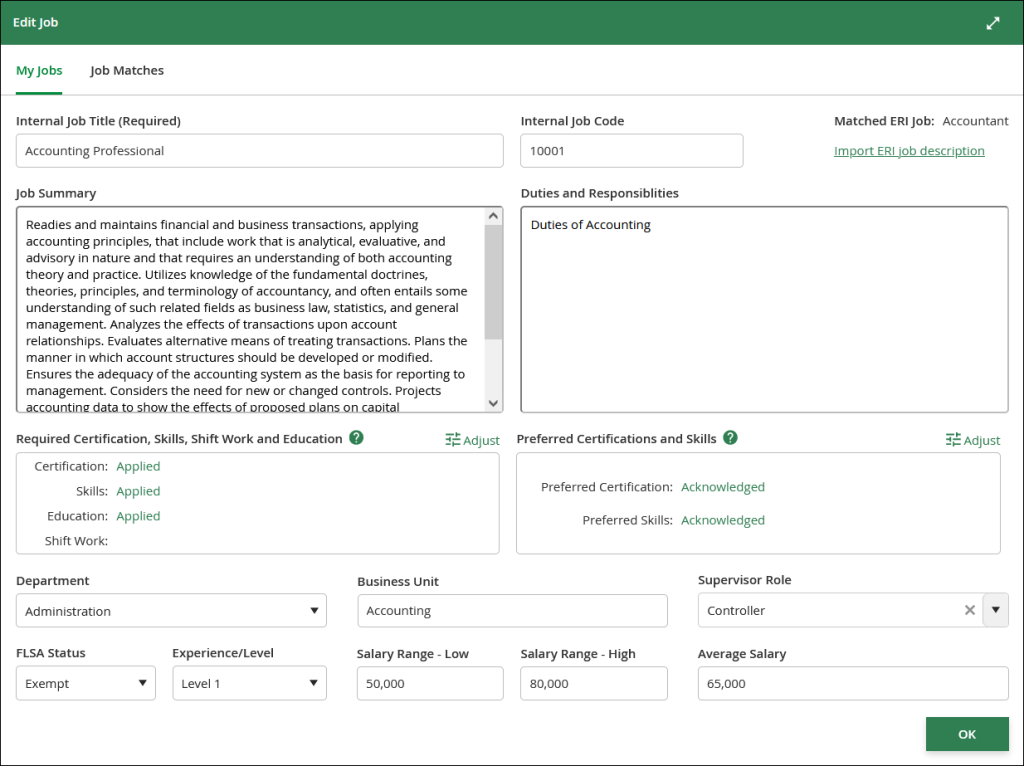
  1. Audit current job roles and responsibilities: The first step in compensation benchmarking is to clearly define all the existing jobs in your organization using accurate job titles and job descriptions. Job titles may have different responsibilities across the market, so it is important to carefully define the job description so that you can properly match each job to an industry equivalent.

  2. Identify Relevant Data Sources: Next, choose credible sources of compensation data that align with your budget and goals. Using free sources from government agencies, for example, can be beneficial when you are on a tight budget. However, these sources provide only general and often conservative estimates of market pay and can be more time-consuming to analyze. For accurate compensation data tailored to your organization, use salary benchmarking tools, such as ERI’s Assessor Platform, to find competitive market rates for jobs by location, industry, experience, and organization size. Use ERI’s cloud-based platform to customize compensation rates based on shift work, skills, education, and certifications (including security clearances).

  3. Select Benchmark Jobs: Once you choose your data source, match jobs in your organization to benchmark jobs in your industry. Since similar job titles can have distinct roles across industries, use job responsibilities, rather than job titles alone, to identify benchmark jobs. ERI’s Assessor Platform includes detailed job descriptions written by ERI researchers and job matching tools to help you benchmark jobs accurately.
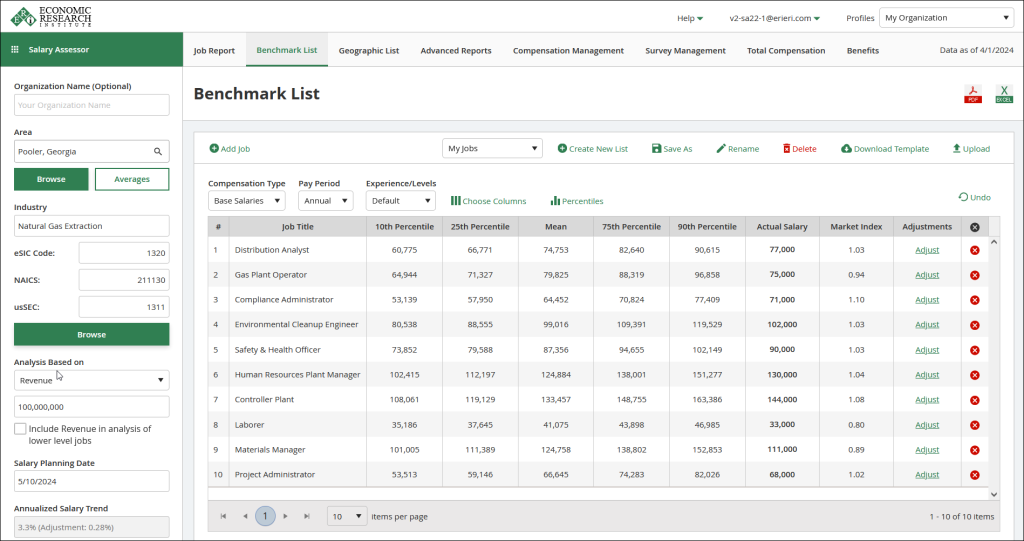
  1. Analyze Data: Once you have gathered all the salary benchmarking data, compare your organization’s compensation practices with current market rates to identify gaps and areas for improvement. ERI’s Assessor Platform allows you to benchmark base salary, incentive, long-term incentive, and total cash at various percentiles.
  1. Implement Changes: Use benchmarking insights to adjust compensation structures and policies as needed. Whether that means refining your current salary bands, adjusting starting offers, or changing salary structures all together, compensation benchmarking will provide you with the data you need to manage compensation strategically. When implementing your decisions, be transparent and clearly communicate changes to your employees.

  2. Monitor and Review: Compensation benchmarking should be monitored and reviewed periodically to ensure that you are staying on top of market trends. Keep records of changes that were made and continue to reassess compensation practices to ensure competitiveness.

Best Practices in Compensation Benchmarking 

To effectively analyze compensation benchmarks, it is important to consider these best practices: 

  • Regular Updates: Keep compensation data up to date to reflect changing market conditions. 
  • Consistency: Ensure consistency in job matching and data analysis methodologies. 
  • Broad Data Pool: Utilize data from diverse sources to obtain a comprehensive view of the market. 
  • Customization: Tailor benchmarking analyses to your organization’s specific needs and requirements. 
  • Legal Compliance: Adhere to legal and regulatory requirements when gathering and utilizing compensation data. 
  • Communication: Communicate compensation decisions transparently to employees to foster trust and engagement. 

Compensation benchmarking is a vital practice for HR professionals seeking to design competitive and equitable compensation structures. Leverage ERI’s compensation tools to navigate the complexities of salary benchmarking and ensure all employees are fairly compensated. Try a free demo and see how our Assessor Platform can help you benchmark pay across specific industries and geographic locations. With the insights gained from compensation benchmarking, organizations can optimize their salary planning strategies to drive employee satisfaction and organizational success


How to Conduct a Compensation Analysis

It is important for compensation professionals to understand how their company approaches compensation and what it entails for their organization. With the cost of labor as one of the biggest expenses for any business, accounting for up to 70% of total business expenses, it is essential to conduct compensation analyses. Although the compensation analysis process can be complex, it is necessary to ensure fair compensation practices that will contribute to your overall compensation and employee retention strategy. 

What Is Compensation Analysis?

A compensation analysis is a systematic evaluation of an organization’s pay and benefits framework. It involves examining several factors, such as industry benchmarks, job roles, experience levels, and geographical considerations, to determine the competitiveness and fairness of employee compensation packages. By conducting a comprehensive compensation analysis, you can ensure that compensation practices align with internal and external market standards, comply with regulatory requirements, and support your talent acquisition and retention goals. 

Why Is a Compensation Analysis Important? 

A comprehensive compensation analysis enables you to ensure that your organization is financially responsible to your employees and overall business operation. A compensation analysis can contribute to the following goals:

  • Ensure Pay Equity and Fairness: A well-executed compensation analysis helps organizations ensure pay equity among employees based on their skills, experience, and contributions. This helps identify any disparities or inequities in pay across different roles, departments, or demographic groups, allowing organizations to address any potential issues of discrimination or bias. 
  • Ensure Legal Compliance: When you review your compensation analysis, this is your chance to review any updates on pay laws. Review federal laws and regulations, such as the Fair Labor Standards Act (FLSA), the Employee Retirement Income Security Act (ERISA), and the Equal Pay Act, to lay the groundwork for fair pay. Along with federal laws, do not overlook state-level laws, which can introduce additional requirements that need to be incorporated into your policies and compensation practices. Our Assessor Platform can help you stay on top of changing minimum wage and FLSA requirements with alerts that ensure that you are always legally compliant. 
  • Cost Optimization: Conducting a compensation analysis allows organizations to identify inefficiencies in their pay structures and make adjustments to optimize costs. A compensation analysis report can ensure that compensation aligns with market rates and employee performance, helping companies allocate their resources more effectively and achieve better return on employee investment.  
  • Improved Employee Satisfaction: When employees feel that they are fairly compensated for their contributions, they are more likely to be satisfied with their jobs and remain loyal to the organization. A comprehensive compensation analysis helps identify areas for improvement, leading to higher employee satisfaction and retention rates. 

Benefits of Conducting Compensation Analysis 

Performing a compensation analysis can benefit your organization in several ways: 

  • Data-Driven Insights: Compensation analysis provides data-driven insights into market trends, competitor practices, and internal pay disparities. This enables informed decision-making and ensures that compensation strategies are aligned with organizational goals. 
  • Salary Benchmarking: Compensation analysis helps you understand how competitive an organization’s pay structure is compared to industry standards and competitors. By offering competitive salaries and benefits, companies can attract and retain top talent. Fair compensation can also boost employee morale, motivation, and job satisfaction, leading to increased productivity and lower turnover rates. 
  • Strategic Decision-Making: Compensation analysis provides valuable insights that inform strategic decision-making related to workforce planning, budget allocation, and performance management. By understanding how compensation impacts employee performance and organizational outcomes, companies can make more informed decisions that drive business success. 

How to Do a Compensation Analysis

These steps are critical in the process of conducting a compensation analysis: 

1. Define Objectives and Scope: Before conducting a compensation analysis, clearly define the objectives and scope of the study. Determine what aspects of compensation you will be analyzing and the specific goals you aim to achieve. Different goals require varying approaches that contribute to the overall compensation analysis. For example, if you want to understand the cost of labor per employee, you may want to conduct a job analysis to provide an accurate picture of your organization’s job hierarchy and compensation allocation. On the other hand, if you are looking to understand why employees leave your organization, conduct employee engagement surveys. 

2. Gather Current Data: Collect relevant data from internal sources, such as HR records and payroll systems, and external sources, such as industry surveys and compensation databases. Ensure that the data are accurate, up-to-date, and representative of your organization’s workforce and industry. A few important sources of data are defined below. 

Data Definition
Job Descriptions It is important to have an up-to-date job description for every job within the organizationIt should explain the job’s placement within the organization and outline the essential duties and typical functions performed by the employee.
Compensation Policies  This includes information on compensation policies that are followed when conducting a compensation analysis. Also, gather data from the employees’ point of view in understanding these policies, such as the employee handbook.  
Salary Benchmark Gather data that includes pay structures for all employees that compare internal pay data to the external market.
Employee Information Organize your employee information, such as location, working hours, work experience, and performance.

3. Job Evaluation: Evaluate job roles within your organization to establish a systematic framework for comparing positions based on relevant factors, such as skill requirements, responsibilities, and market demand. Use job evaluation methodologies, such as job grading or point-factor analysis, to assign relative values to distinct roles. 

4. Salary Benchmarking: Compare your organization’s compensation practices against industry benchmarks and competitor data to assess competitiveness and identify areas for improvement. Utilize compensation surveys, market reports, and online databases to gather benchmarking data relevant to your industry and geographical location. For a more in-depth analysis, consider using ERI’s compensation planning software to streamline your compensation strategy, get data on the market, and customize compensation based on your needs.  

5. Analysis and Interpretation: Analyze the data collected to identify trends, patterns, and disparities in compensation across various job roles, departments, and demographic groups. Look for outliers or anomalies that may indicate areas where adjustments are needed to ensure fairness and competitiveness. 

6. Develop Recommendations: Based on the findings of your analysis, develop actionable recommendations for adjusting compensation practices to align with market trends, address internal inequities, and support organizational objectives. Consider myriad factors, such as budget constraints, employee preferences, and regulatory requirements, when formulating recommendations.  

7. Communicate Results: Decide how you will communicate your analysis and recommendations to key stakeholders, managers, and employees. Consider including only necessary information, such as past challenges, the current situation, and improvement recommendations. No matter how you decide to present your findings, whether it is through a PowerPoint presentation, a Word document, or an Excel spreadsheet, make sure that the results are easy for others to understand. 

8. Implement and Monitor: Implement the recommended changes to your compensation practices and monitor their impact over time. Track key metrics, such as employee turnover rates, satisfaction scores, and recruitment outcomes, to evaluate the effectiveness of your compensation strategies and make further adjustments as needed.

Why Use ERI?

The purpose of conducting a compensation analysis is to get data-driven insights into your compensation strategy that will help HR professionals make better business decisions. You can conduct your analysis using Excel; however, this is a laborious manual process and is prone to human error. Instead, use our Assessor Platform and compensation analysis tools to properly set wages, determine the cost of labor, and develop lasting pay structures. You can streamline your compensation management, determine competitive salary levels, compare employee salaries with market benchmarks, and more with instant access to employer-reported compensation survey data online. With reliable and current data, you can get better insight into your compensation strategy and make cost-effective decisions to retain top talent.  

Calculate Holiday Pay

How to Calculate Holiday Pay

Holiday pay refers to pay on days established by law or custom for which workers receive pay while absent from work. Holiday pay can be received in different forms, such as fully or partially paid time off (most common for salaried employees), a bonus, or, most commonly, additional hourly pay for work performed on a holiday. The amount of holiday pay that an employee receives typically depends on their regular pay rate (hourly or salaried), employment contract, and applicable laws. Compensation professionals must consider holiday pay, in addition to base pay, bonuses, commissions, and other factors that contribute to the total compensation package, in the salary planning process.  

Develop a Holiday Pay Policy  

Not all businesses have the luxury of closing for the holidays. When planning your holiday pay policy, consider the following: 

Define Holidays   

The United States recognizes 11 standard federal holidays 

  • New Year’s Day – January 1
  • Martin Luther King’s Birthday – 3rd Monday in January 
  • Washington’s Birthday – 3rd Monday in February 
  • Memorial Day – last Monday in May 
  • Juneteenth National Independence Day – June 19 
  • Independence Day – July 4 
  • Labor Day – 1st Monday in September 
  • Columbus Day – 2nd Monday in October 
  • Veterans’ Day – November 11 
  • Thanksgiving Day – 4th Thursday in November 
  • Christmas Day – December 25

Employee Eligibility 

It is important to determine which employees will qualify for holiday pay. For instance, retailers like Target offered store employees and service center employees an additional $2 per hour for shifts during the holiday season to encourage employees to work.  

How to Determine Holiday Pay  

Organizations must first consider the budget allocated for holiday pay to determine how much employees will receive. Once the holiday pay budget is calculated, it is time to decide how employees will receive the holiday pay, including these options: 

  • Paid time off (PTO): Employees receive a predetermined number of PTO days that can be used for holidays not celebrated by the company or for personal time. 

  • Statutory holiday pay: Employers pay a set amount for designated holidays, regardless of whether the employee works or not. 

  • Time-and-a-half or double-time holiday pay: Employees receive a premium pay rate for working on holidays. 

How to Calculate Holiday Pay for Full-Time and Part-Time Employees 

Calculating holiday pay involves determining the employee’s regular hourly rate and applying any premium rates for work on holidays. To calculate holiday pay, follow these steps: 

1. Identify the employee’s regular hourly rate. If you have a full-time salaried employee, convert their annual salary to the hourly rate. The standard annual to hourly conversion rate is 2080 hours per year. Simply divide the annual salary by 2080 to arrive at the corresponding hourly rate.  

Hourly Rate for Salaried Employees = Annual Salary / 2080 

For example, if a salaried employee is paid $52,000 annually and works 40 hours per week, then their hourly rate is 52,000 / 2080 = $25 per hour. 


2. Determine any additional pay for overtime or shift differentials. For example, in the United States, holiday pay is typically 1.5 or 2 times the worker’s average hourly pay. 


3. Calculate the premium rate for working on a holiday, if applicable. 

Holiday Pay = Total Hours Worked on the Holiday x Adjusted Hourly Rate 

Let’s consider this holiday pay policy example to help illustrate the role of holiday pay in a total compensation package 

An hourly employee, Ann, with a regular pay rate of $20 per hour works 8 hours on a federal holiday. The company’s policy provides double-time pay for holiday work.

Calculation:  

Regular hourly rate: $20  
Double-time premium: 2x regular rate  
Total hours worked on holiday: 8  
Holiday Pay = Regular Hourly Rate × Double-Time Premium × Total Hours Worked  

$20 × 2 × 8 = $320 

Ann usually earns $160 on a normal workday. However, since she worked on a holiday, she will earn $320.  

The holidays are busy enough. Use ERI’s compensation planning software to help you determine holiday pay without the work of manual calculations and easily manage your employee payroll. Schedule a free demo to learn more about how we can help with your overall compensation management. 

Federal Holiday Pay and FLSA Rules 

The Fair Labor Standards Act (FLSA) governs federal labor laws in the United States, including regulations related to holiday pay. While the FLSA does not mandate holiday pay, it does provide guidelines for employers who choose to offer it. Compensation professionals should be aware of FLSA rules and how they may impact holiday pay practices within their organization. 

Accurately benchmarking compensation to factor in pay differentials, such as holiday pay, helps HR professionals plan business expenses and understand the actual cost of labor during different time periods. Visit ERI to learn more about how companies benchmark holiday pay and how to determine holiday pay when pricing roles. 

What Are the Different Types of Compensable Factors?

What Are the Different Types of Compensable Factors?

Creating an effective compensation strategy is vital for an organization’s ability to attract, motivate, and retain talent critical for business success. The strategy must deliver salary structures that result in external competitiveness and internal equity, while supporting business objectives. Job analysis is a key component in this endeavor; it is the process of gathering relevant information about a job, the essential functions, as well as the factors that influence successful performance, and its corresponding value based on the organization’s specific criteria. This criteria, compensable factors, is then used in establishing the hierarchy of jobs, as well as setting and reviewing salaries and structures, assessing competitive external market position, and conducting pay equity audits.

Compensable factors are simply job components that are used as a basis for assessing job value, usually based on the values and objectives of the organization. Typically, compensable factors include such job components as skill and relevant experience needed in order to perform a job, responsibility, direct reports, supervision received and exercised, working conditions, and impact of decisions. These factors are used to establish and compare job worth, resulting in a job hierarchy, which then provides the basis for setting a wage structure and compensation strategy. To facilitate comparison, compensable factors should be a common element in all jobs, definable and measurable, and vary across the organization.

The Equal Pay Act of 1963 defines the four most basic compensable factors as effort, skill, responsibility, and working conditions. This provides the basis for pay differentiation and evaluation of pay inequities.

  • Skill – This is the skill required for the job, not skills that the individual employee may have. Skill is measured by factors such as the experience, ability, education, and training required to perform the job.
  • Effort – This is defined as the amount of physical or mental exertion (degree and amount of concentration or the level and frequency of physical effort, as defined by the ADA) needed to perform a job.
  • Responsibility – This is defined as the number of direct reports, fiscal accountability, and the list of responsibilities of the position itself; the depth and importance of knowledge necessary to perform the work; or the required specialized or technical expertise.
  • Working Conditions – These are the overall environmental factors, such as location and hazards, as well as physical surroundings like temperature, fumes, and ventilation. What percentage of the time and how often is the employee exposed to these conditions?

Additional compensable factors may include the following:

  • Education – What is the minimum education required, not preferred, to do the job successfully in terms of formal schooling, training, certification, or knowledge of a specialized field? The minimum refers to the most basic level required to successfully perform the job duties.
  • Complexity – Does the job require independent judgment or initiative to make decisions? What is the impact of the decisions made in this role, consequence of error, and financial impact to the organization?
  • Supervision received – Does the role require hands-on supervision (i.e., review the work or outline specific methods or procedures)? This includes accountability, independence, and freedom to act or direct one’s own work.
  • Supervision exercised – What is the number of positions reporting, directly and indirectly? What is the level of authority for controlling policy decisions, costs, or work methods? What are the scope and impact across the organization?
  • Contacts – What internal and external contacts or interactions are required? With whom and at what level and frequency are these contacts needed?
  • Confidential data – To what extent is the incumbent responsible for confidential information? What would be the consequences of unwarranted disclosure? To what extent are integrity and discretion important?
  • Does the job entail required decision making and/or analytical skill?

The compensable factors are used for weighting and comparison and will support in managing pay equity and compression issues. For example, a new hire has ten years of relevant experience as an IT Programmer. Current incumbents in the position have fewer than three years of experience. With all other factors the same (for illustration purposes), one would expect to pay a higher salary to the incumbent with more experience. However, if the position requires a special skill set or is a “hot job” in the current market, it may be justification for paying more even with fewer years of experience in comparison.

Compensable factors are yet another tool in the HR arsenal and must be used judiciously and wisely, while being periodically reviewed. Any compensable factors used to differentiate pay must be based on bona fide occupational requirements and not organizational preferences. There must be a legitimate reason that is connected to the ability to do the job. An organization may prefer to hire only college graduates, but, if the minimum education required to do the job successfully is a high school diploma, then the company cannot legally differentiate based on that preference.

As with any tool, HR must work diligently to ensure fairness, equity, and consistency throughout the organization. Visit ERI for more information on how to benchmark pay and to find additional information on salary assessment.