Since 1989, ERI has utilized the latest technology and statistical methods to automate compensation tasks to save subscribers time and money. At ERI, our approach to artificial intelligence (AI) is rooted in practical solutions that solve real world challenges. We have initiatives in three areas: reducing time spent on repetitive tasks, improving data accuracy, and enhancing decision-making in complex compensation work.
Our philosophy is simple: AI should make professionals more effective and strategic. It should amplify expertise, ensure consistency, and uncover insights that would otherwise remain hidden in data. To this end, ERI has developed a suite of AI-powered features, including AI-Generated Job Descriptions, to help HR professionals efficiently and accurately manage compensation.
What Is a Job Description?
As defined in ERI’s guide, “How to Write Job Descriptions That Optimize Your Workforce,” a job description is a Human Resources instrument that explains the who, what, when, where, why, and how of a job. The job description explains a job’s placement within an organization and outlines the essential duties and typical functions performed by an incumbent. A thorough job description should answer these questions:
Who is this person within the organization?
Why does this job exist?
What duties does this job entail?
How are these duties performed?
When are these duties performed?
Where are these duties performed?
A job description traditionally begins with a job analysis, which entails researching and surveying a position to discover and extensively document facts about a job. The job analysis can also lead to gathering valuable data detailing the expected level of working knowledge, skills, and abilities required to perform the essential duties. The completed job description document serves as the official record for a job – the result of a thorough job analysis, discovering the technical aspects that characterize a role.
Why Are Job Descriptions Important?
The job content ascertained from a job analysis provides line of sight to specific job responsibilities, business context, and connections with other jobs. The end result is a job description, which HR and compensation professionals can use in various contexts. Whether the focus is employment law and compliance, organization culture, or total rewards and performance management, having knowledge and access to accurate, detailed job descriptions is essential.
Job descriptions are relied upon for myriad decisions, from setting performance standards, training plans, and career development plans to staffing decisions and organization development. These descriptions communicate the details of jobs to an array of important stakeholders. Most organizations collect job content information that explains the allocation of effort and time spent on specific duties and responsibilities. The use of this data has far reaching implications, such as recruitment, mentoring and coaching, organization effectiveness, compliance, and FLSA overtime exemption assignment, to name a few.
What Are the Benefits of AI-Generated Job Descriptions?
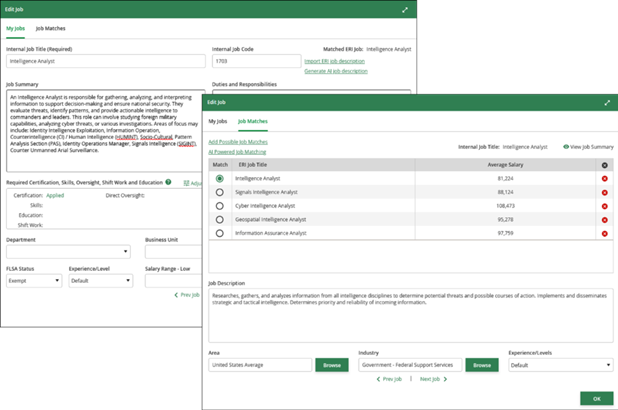
Collecting job content information from scratch and then writing job descriptions by hand can be incredibly time consuming and prone to inconsistencies. Job descriptions often rely on individual judgment to interpret the roles and responsibilities of each job. This subjectivity can lead to inaccurate or incomplete job descriptions, a problem that can trickle down to impact job matching, benchmarking, pay equity, and more. ERI’s AI-powered job description writing tool solves this problem by objectively analyzing the language and context of each job, ensuring consistent, data-backed descriptions of each unique role.
ERI’s AI-Generated Job Descriptions leverage the efficiency of modern artificial intelligence with an extensive job content database. By analyzing the detailed descriptions in ERI’s robust salary survey database, spanning over 35 years of occupational data research and best practices, our platform captures the true meaning and context behind each position. Backed by our research expertise, each job description includes comprehensive detail, with the specific duties, responsibilities, requirements, and scope of work tailored to each job title, even for niche roles. What’s more, ERI’s AI-Generated Job Descriptions can be edited easily and customized to the specific needs of each organization.
As organizations grow to include employees across diverse landscapes, ERI’s AI Job Description tool ensures consistency at scale. Rather than aggregating job descriptions analyzed and written by HR and compensation professionals in disparate locations, potentially resulting in inconsistencies and inaccuracies, our AI-powered platform standardizes terminology and descriptions across teams with varying functions and geographic contexts. This results in faster, more accurate job descriptions, helping compensation professionals make decisions with confidence and focus more on strategic planning.
The Future of AI at ERI
As AI technology evolves, ERI remains focused on responsible implementation, with solutions anchored in research, data integrity, and practical applicability. Every model we build is designed to enhance clarity, consistency, and confidence for compensation professionals.
At its core, ERI’s AI strategy is about augmenting expertise with intelligence by combining decades of compensation knowledge with modern AI innovation to solve real-world problems with accuracy and insight.
To learn more about the AI job description generator in ERI’s Assessor Platform, please try a free demo or sign up for a guided tour of ERI’s AI-powered features today!