With a dynamic labor market and increasingly uncertain economic conditions, many HR professionals are turning to compensation forecasts to plan and manage compensation in 2025. To meet those needs, ERI examines the rates at which compensation has increased each quarter and provides guidance on expected increases for the upcoming year in a quarterly National Compensation Forecast. These rates are calculated using ERI’s Salary Assessor and ERI’s Salary Increase Survey & Forecast. This blog post will highlight some findings from ERI’s latest National Compensation Forecast released in April 2025.
To explore labor market and overall economic conditions, ERI’s National Compensation Forecast offers insights into these indicators:
- Open jobs rate
- Hires rate
- Quits rate
- Unemployment rate
- Inflation rate
Job Openings Rate vs. Hires Rate
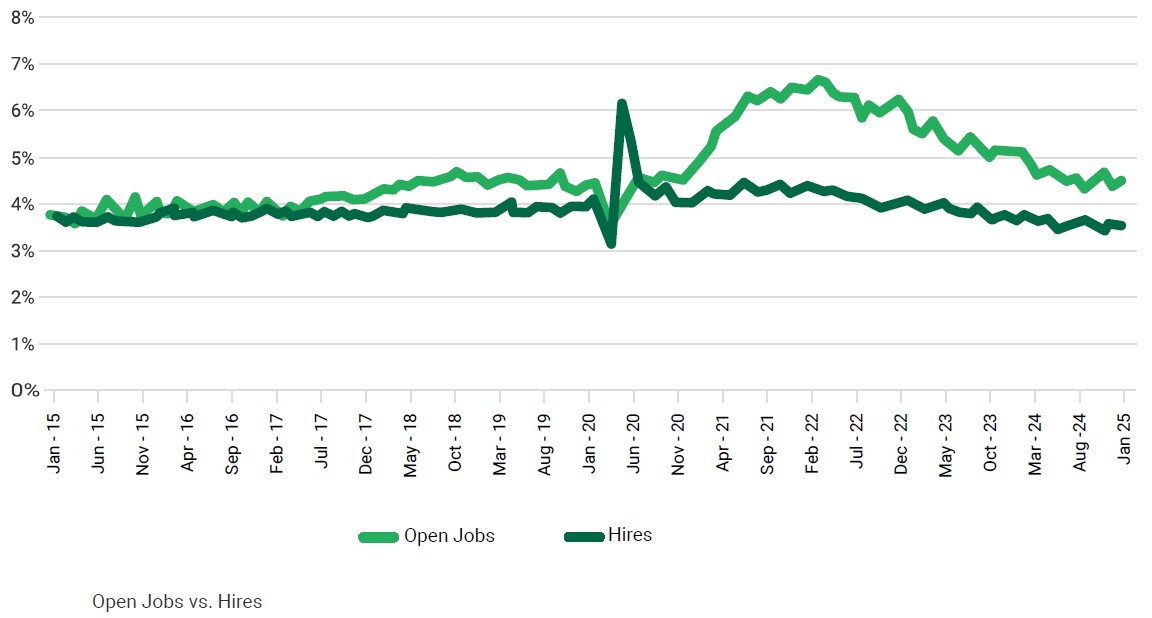
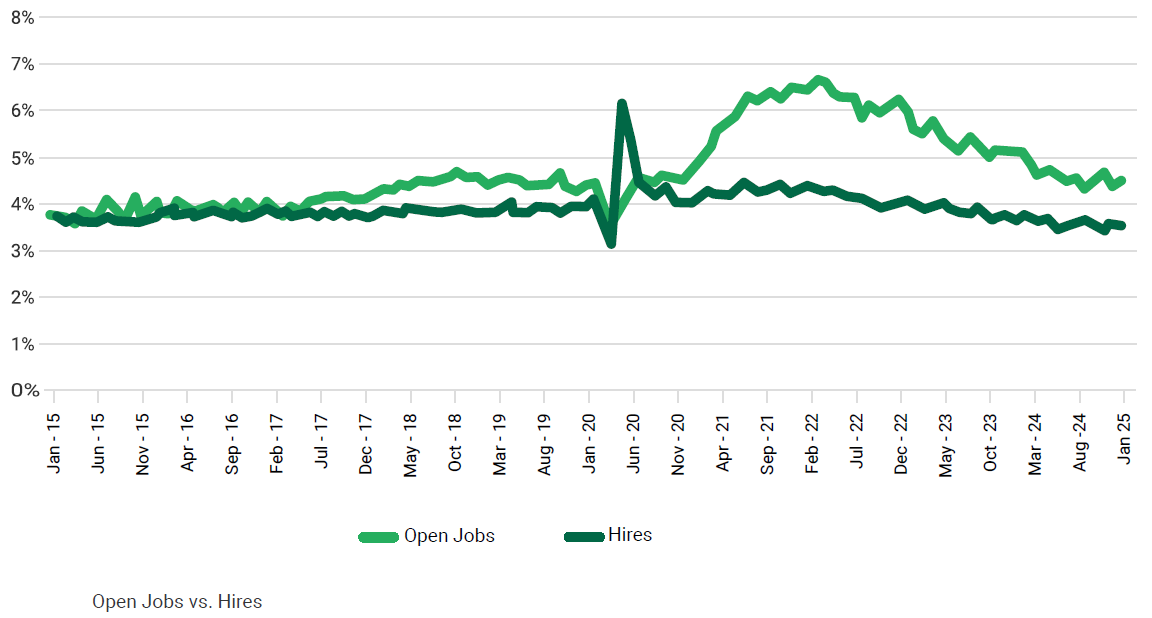
An examination of the current number of job openings indicates a high number of open jobs in the United States, with a job openings rate of 4.6%, which is lower than the 10-year average open job rate of 4.8%. It is also down significantly from the high of 7.3% in March 2022. The rate of hires is currently 3.4%, which has been slowly trending down since the high of 4.4% in March 2022. This gives us a current gap between open jobs and hires of 1.2%, which closed from its highest point of 2.9% in March 2022. The 15-year gap between hires and open jobs is 0.41%, so the gap between hires and open jobs remains above average. The chart below shows the historical difference between the rate of open jobs in the economy and the rate at which employees are hired. A gap between the number of open jobs and the number of employees who are hired indicates that organizations are not able to hire all the employees that they would like. This can lead to organizations needing to raise compensation rates to hire the employees that they need.
Quits Rate
Employees are currently quitting at a rate of 2.1%, which is down from the high of 2.9% in April 2022 and below the 10-year average of 2.29%. This rate is also unchanged since the January 2025 National Compensation Forecast. The gap between the job openings and hires rates, along with fewer people quitting, are now below long-term trends, which points towards slower rates of compensation growth.
Unemployment Rate
The unemployment rate is currently 4.1%, which is up from the low of 3.5% reported in July 2022 but still considered full employment. Full employment, which means that just about everyone who is willing and able to work is able to find work, is generally defined as an unemployment rate up to approximately 4%.
Inflation Rate
In March 2025, the inflation rate stood at 2.8%, which is up by 0.1% over last quarter and down by 6.5% since the high in June 2022. These rates continue the trend of slowing inflation, which may have a tempering effect on compensation increases. Inflation can influence the growth of compensation, and the extent of that influence also varies depending on the level of inflation, with high inflation related to higher levels of compensation growth.
In summary, the labor market remained largely unchanged over the first quarter of 2025 with minimal shifts in job openings, hires, quits, and unemployment rates. This consistency in the labor market, constraints on organization budgets, and low current inflation point towards an environment with less pressure on compensation growth than we have seen in the past several years. However, if tariffs lead to higher inflation, then we may see increased compensation growth towards the end of 2025. ERI expects moderate compensation growth continuing through 2025, with the potential of higher growth towards the end of 2025, depending on economic conditions. ERI will continue monitoring and reporting on these trends as they unfold over the next several quarters.
For a deeper analysis into these labor market and economic indicators and their impacts on compensation growth, please see ERI’s April 2025 National Compensation Forecast.
Overall Salary Trends
April salary growth (0.63%) is up slightly from the January 1 data release (0.60%), which is lower than the predicted quarterly rate of 0.69%. Growth over the past year has been 2.66%, with an average quarterly growth of 0.66%. To put this into context, the average quarterly growth over the past 20 years has been 0.71%. Over the same 20-year period, the average April increase has been 0.64%. Over the past 20 years, April increases (first quarter) have been lower than increases throughout the rest of the year, and the current quarter is no exception. The annual growth rate appears to have decreased from 2.82% to 2.62%, with growth rates in previous quarters of 0.6% (January 2025), 0.6% (October 2024), and 0.84% (July 2024).

Overall Trends by Year
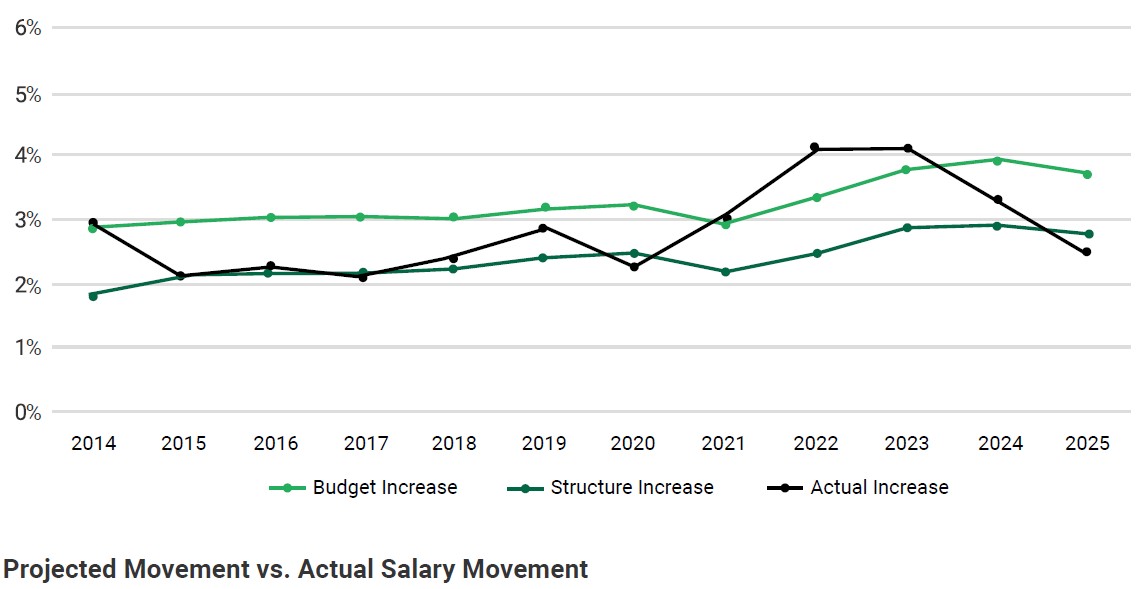
ERI’s April 2025 National Compensation Forecast also takes a closer look at overall trends by year by examining budget increases, structure increases, and expected increases over a ten-year period. This illustrates where the reality of salary movement has departed from the expected trend, giving us information regarding how salaries might move in the future. Compensation growth in 2025 appears to be slowing since the ten-year peak in 2022.
Salary Growth by Category
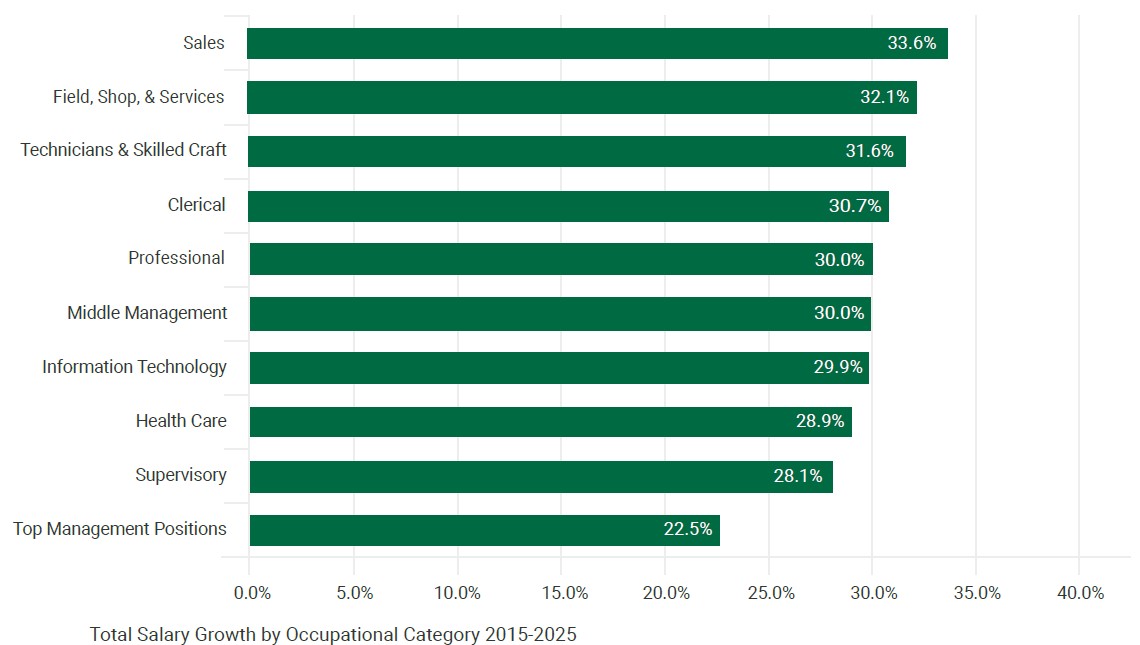
The April 2025 National Compensation Forecast also analyzes mean annual, three-year, and ten-year total salary growth trends by occupational category to understand how different types of occupations move relative to each other and across time. Not all occupations grow at the same rate, and not all occupations grow at the same rate across time. As of April 2025, Sales employees saw the highest level of growth, whereas Top Management occupations saw the slowest growth over the ten-year period spanning 2015 to 2025.
To learn more, please download the full April 2025 National Compensation Forecast and watch for upcoming quarterly reports on compensation growth trends at www.erieri.com.
ERI Economic Research Institute was founded over 30 years ago to provide accurate and up-to-date salary survey data and compensation management applications for private and public organizations. Our talented team of professionals is among the best in the industry. Most of the Fortune 500 and thousands of small and medium organizations rely on ERI data and analytics for key compensation decisions. We provide high quality, in-depth compensation data for over 39,000 positions in more than 1,000 industries and over 10,000 locations around the globe to support our subscribers in making reliable pay decisions. An added benefit is the wealth of resources available to ERI customers.
ERI’s Assessor Series® – Solutions for every compensation decision