During the COVID-19 pandemic, many organizations turned to remote work as a necessity to remain operational and productive while ensuring the safety of their workforces. Now, almost five years since the outbreak of the pandemic, myriad organizations are shifting towards a return to the workplace, encouraging or even requiring some employees to work in the office for part or all of the work week. Organizations often value the collaboration that face-to-face communication facilitates, along with the ability to train and oversee employees in person. On the other hand, many employees have grown accustomed to remote work and value not only the flexibility it provides but also the time and costs saved in avoiding the office commute. Considering these benefits, many employees are factoring the option of remote work into their decisions to take a new position or remain employed with an organization.
Given these remote work trends, organizations must make careful decisions about whether to offer remote work, provide a hybrid remote work option in which employees can work remotely part of the week and work in the office the remainder of the week, or mandate a full return to the office. In order to attract, retain, and motivate employees, organizations must stay abreast of current industry trends regarding remote work, knowing that new and current employees now place a significant value on the remote work option. Striking the right balance will be key to any organization’s success.
To that end, this blog post will highlight some findings related to remote work practices and trends from a recent survey conducted by ERI and summarized in the white paper, “Merit Increases, the Changing Economy, and Remote Work – Fall 2024.” Between October 7 and November 11, 2024, ERI conducted a survey of organizational responses concerning merit increases, compensation and workforce planning, and remote work. There were 327 organizations that submitted answers to the survey during that time. The goal of this survey was to identify the changes that organizations are making to their labor and compensation practices, particularly merit increases, as a direct result of the rise in remote workforces and economic gauges, such as inflation. ERI’s recent white paper, “Merit Increases, the Changing Economy, and Remote Work – Fall 2024,” offers insights into the present impact of these compensation drivers. To summarize the results of the study, this paper is split into the following sections: Merit Increase Policies and Planning, Compensation and Workforce Planning Changes, Remote Work Changes, and Organization Scope.
Looking specifically at the Remote Work Changes section of ERI’s latest white paper, several interesting trends were uncovered in this survey. First, ERI found that remote work is persisting, but there is a reduction in remote work hiring. ERI asked, “Are you currently hiring remote workers?” to determine if organizations were changing their approach to hiring remote workers. Many organizations, specifically 25% of respondents, are hiring remote workers without any specific restrictions. Additionally, 20% of organizations are not hiring remote workers at all but are hiring on-site employees. In a similar vein, 5% of organizations are reducing or eliminating the hiring of remote workers. Notably, 8% of respondents also indicated that they do not have an established policy on remote worker location, while the remaining 4% confirmed that they do not have remote workers and therefore do not have an established policy.
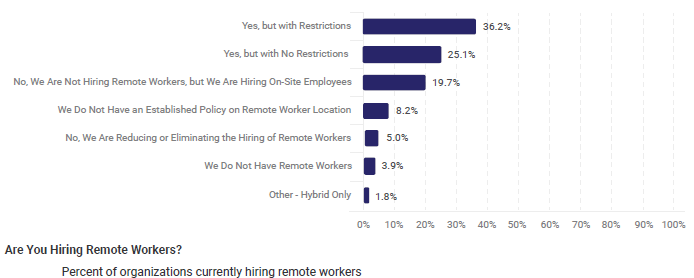
However, 36% of respondents reported that, while they are hiring remote workers, it is only under certain circumstances. Generally, these organizations noted the following restrictions: the position must be capable of being done remotely, the employee must be hybrid, or some restriction that is otherwise contingent on business needs.
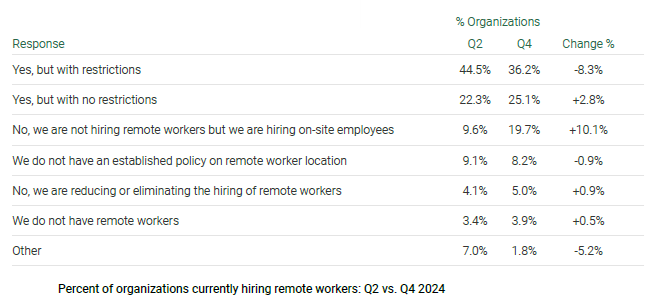
Comparing Q2 to Q4 2024, there has been a notable 10% increase in participant organizations reporting that they are not hiring remote workers but are hiring on-site employees. Similarly, there has been an 8% decrease in the number of participant organizations reporting that they are hiring with restrictions, while reports of restriction-free hiring have only increased by 3%. These remote work trends may be indicative of the increasingly commonplace return-to-work initiative that many organizations have been undertaking since the decline of the COVID-19 pandemic.
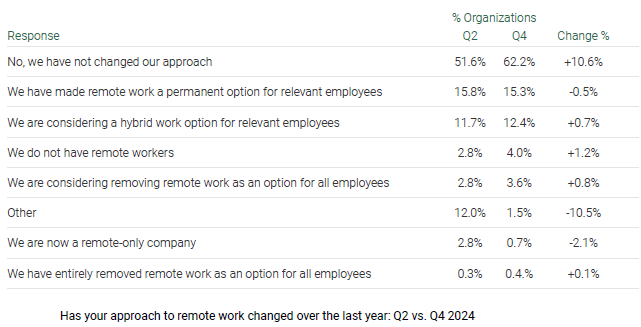
ERI asked survey respondents to note if they have changed their approach to remote work over the last year. The results concluded that many organizations have chosen to adopt some form of continued remote work, although the number of organizations reporting that they changed their policy have declined considerably since 2022. See ERI’s “Remote Work, AI, and Compensation Best Practices – Spring 2024” white paper for additional details.
As of Q4 2024, remote work has become a permanent option at 15% of organizations, and 12% indicated that they have adopted a hybrid work-from-home option for employees to work remotely on a part-time basis. The nature of some jobs disallows them from being able to work from home, and 4% of respondents confirmed that they have no remote workers for whom they can make remote work changes. Furthermore, 0.4% of organizations reported that they have removed their work-from-home option, and 4% are currently considering removing it. Moving from Q2 to Q4 2024, the most notable change is the 11% increase in participant organizations that reported that they have not changed their approach.
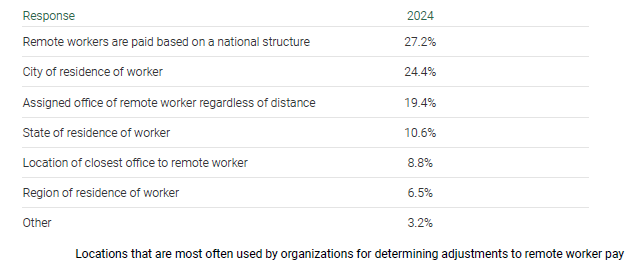
The survey yielded interesting results regarding the geographic basis for adjustments to remote worker pay. Currently, most organizations account for geography in some fashion when setting pay for remote workers. To clarify how organizations plan to adjust compensation, the survey asked, “Which location are you using to determine any adjustments to remote worker pay?” Of all participant organizations, 73% are using a specific location, while the remaining 27% are using a national structure rather than a specific location to decide adjustments for remote worker pay. Of those using a specific location, most are using the worker’s city of residence to decide adjustments for remote worker pay (24%), followed by the assigned office of the remote worker, regardless of distance (19%).
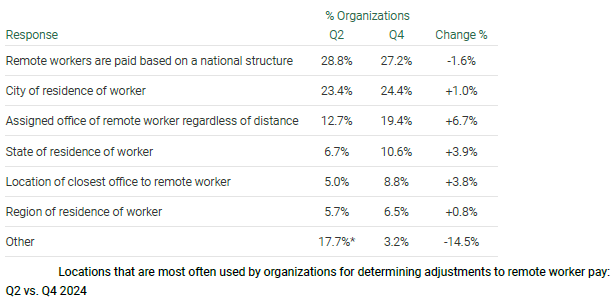
Moving from Q2 to Q4, there has been a 1% increase in organizations that are using the city of residence of the employee, a 4% increase in using the state of residence, and, most drastically, a 7% jump in using the assigned office of the remote worker, regardless of distance.
In summary, remote work persists as an option for most organizations, though the survey suggests a reduction in remote work hiring. There appears to be a trend towards streamlining and standardizing compensation policies for remote work compared to ERI’s previous survey, “Remote Work, AI, and Compensation Best Practices – Spring 2024.” Organizations are less concerned with remote-specific factors, such as employee-specific area adjustments. This coincides with the wider ongoing movement away from remote work in a post-COVID-19 world and towards a return to the office. In observing remote worker hiring practices, there has been a noteworthy 10% increase from Q2 to Q4 2024 in actively preferring on-site to remote workers. That said, remote work certainly remains an option in many organizations, and the compensation community is starting to coalesce around standard practices that integrate remote work.
This survey is part of a series of surveys aimed at examining and measuring changes to compensation and the labor force following the COVID-19 pandemic. It is the third of these surveys to be published post-pandemic that specifically addressed changes in the workforce in relation to remote work and economic drivers, such as inflation. The next survey will take a deep dive into remote work and performance management, examining which performance management practices organizations are using, particularly in relation to remote worker performance. For those interested in participating in the upcoming survey, “Workforce Insight Survey: Remote Work, Performance, and Compensation Best Practices in the Changing Economy,” please visit https://resources.erieri.com/free-workforce-insight-survey. The results of this survey will be free with participation.
For more information on how COVID-19 and post-pandemic economic factors have affected compensation, visit www.erieri.com. ERI compiles salary survey data on a semi-quarterly basis to help organizations understand and accurately benchmark compensation rates. Information published on our websites captures salary changes throughout the year and helps HR professionals plan and develop business strategies.