
Looking to Benchmark Pay?
Let’s take a look at other types of salary structures.
Automatic Step Rate
| Automatic Step Rate | A step range has standard progression rates for a job. Employees progress from step to step based on time or seniority. |
|---|
Step rates are normally time-dependent and may vary considerably in number of steps and the total range the steps cover. Clearly, the combination of these two will determine the size of each step. There are three variables present, and the determination of any two will decide the third.
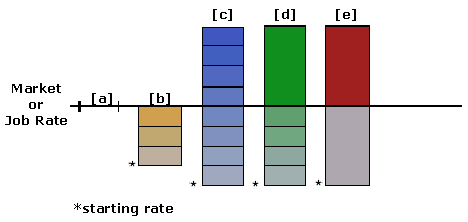
The first type of automatic step rate, option [b] above, consists of a starting rate below market (for typical new hires) and a job rate (assumed to be the market rate), as in the single-rate approach. New employees are brought in at the starting rate and then moved up to the job rate in a series of steps. If done properly, this movement corresponds with the job’s learning curve. The market rate is the maximum since it’s assumed that once the person has learned the job, performance differentials are minimal.
In this situation, there would be a number of steps (typically 5-7) between the starting rate and the job rate at a specified percent increase (typically 3-5%). This type of step system is most common for semi-skilled, blue-collar jobs.
The second type of automatic step system, option [c] above, places the market rate not at the top of the range, but in the center of it. Other places (such as the 1/3 point or the 2/3 point) could be possible, but the middle is the most common.
In a third type of automatic step system, option [d] employees are hired at the starting rate and will typically progress to the midpoint over time based on learning job proficiency or performance. Thus, a person at the midpoint of the range is assumed to be a satisfactory performer. Movement above the midpoint is based on performance or other methodology beyond the normal or average.
Variable step rate. A variable step rate program, also option [b,c,d] is very similar to an automatic step rate program. The difference is the variable step rate approach provides the capability to reward for performance or skill development and the ability to move more than one step at a time.
Pay range. Pay ranges, option [e] provide a minimum, midpoint (market or control point), and maximum. The hiring rate is commonly from minimum to midpoint of the salary range. Employees typically move through the range based on an annual performance merit review cycle. They may occasionally be called a salary range or an open range.
Broadbands. Broadbands enjoyed great success in the 1980s. In comparison to pay ranges, option [e], a broad band may collapse three salary ranges into one band to provide greater flexibility in managing compensation. Although there is a lot of flexibility under a broadband program, the lack of structure and lack of control can be time-consuming and costly to manage.
Use of multiple approaches. More than one approach may be used in a company. Lower-level pay grades may have the type of range that ends at the midpoint, while higher grades may have open ranges with no defined limit. The rationale for such a system is that the discretion exercised in higher-level jobs allows for performance differences not permitted in lower-level jobs.
Climbing the ladder. Movement within grades will be discussed later, but one point should be made here: a person who is moved from one step to the next usually retains the new step even when the overall salary structure is changed. In this way, adjusting the salary structure to meet labor-market changes automatically becomes a general increase for employees in a step system.
Employees can move to the top of the step range over time.
Let's take a look at two different situations an organization can experience:
| Normal growth and turnover | Low turnover, no growth |
|---|---|
| In a period of normal growth and turnover, the average salary for the job classification will probably match the market rate as people start to climb the ladder while others leave. | In a time of low turnover and no growth, the organization may find itself paying above the market rate (even if it sets the midpoint of the range at the market rate), because all of the employees in the job are in the top steps. |
Memory Jogger
Which type of salary structure moves an employee through the pay range with periodic increases based on the learning curve for the job?