
Looking to Benchmark Pay?
MOVING EMPLOYEES THROUGH SALARY RANGES
Salary ranges or grades group together multiple jobs with similar value based on internal and external comparisons. The salary range is typically defined by a minimum, midpoint, and maximum, which reflect jobs having a similar internal or external market value.
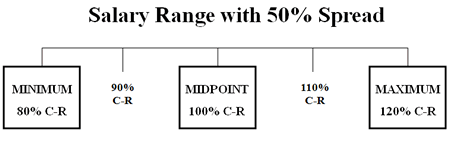
A salary range or pay grade may be segmented, or subdivided, in many ways, such as quintiles, quartiles or thirds. The number of segments within a salary range varies by company and may reflect the organization’s merit pay process and pay administration policy. These segments may or may not overlap. Basically, they serve as reference points for cost control and salary administration.
Compa-Ratios
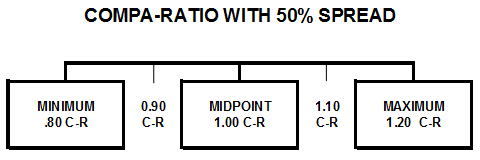
A compa-ratio compares a rate of pay to the midpoint of the range it is in.
To calculate an individual's compa-ratio, divide the actual base salary by the midpoint of the base salary range.
Compa-Ratio = Actual Salary/Midpoint of Range
Compa-ratios are used primarily to measure and monitor an individual's actual rate of pay compared to the midpoint of the assigned range. A compa-ratio can be calculated for an individual, a department, or even an entire organization.
Range Penetration
Unlike compa-ratios which are calculated using a grade's midpoint, range penetration is calculated using the minimum and maximum of a salary range.
| Range Penetration = |
|
| Range Penetration = |
|
= 80% |
Occasionally, range penetration will be used in lieu of compa-ratio because it provides a reference to how far into the range a particular individual's salary has penetrated, from 1%-100%.
So, if an employee has a range penetration of 100%, that employee would be at the maximum of the salary range.
If the range penetration was 50%, the employee would be paid at the midpoint of the salary range.