
Looking to Benchmark Pay?
Merit Progression
A merit increase program is used by the vast majority of businesses and recognizes pay for performance. It is so commonly used by businesses that well over 90% of companies have merit programs.
Pure merit progression employs an open salary range with only the minimum, maximum and midpoint defined. Refer to option [e] of the graph below. There are many variations of a merit pay program used to reward performance: a program may be managed to fixed increases, a discretionary increase range, position in range, or variable timing, etc. Regardless which variation is used, they all have a performance component.
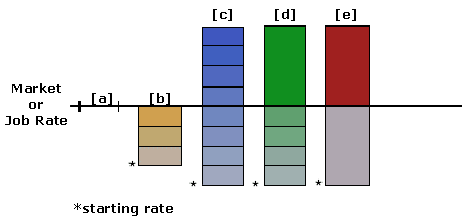
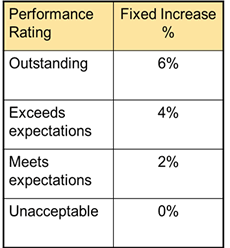
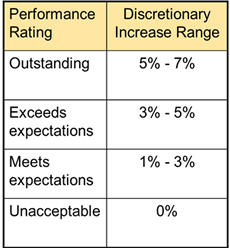
Under merit progression, movement within the range is based strictly on performance. This pay-for-performance system requires integration of an effective performance management system with pay determination. For those organizations who offer merit, or performance pay, a merit matrix is typically used as a guideline for management and administrative purposes. Merit matrices can be designed in a variety of formats, some offering more flexibility than others. Here are two examples for merit pay based on performance only:
You can also have merit matrices that vary the amount of increase based on performance and position in salary range. This can be based on a fixed increase amount according to position in salary range, a fixed increase amount with variable timing of increases according to position in salary range, or a discretionary increase range with variable timing of increases according to position in salary range. Here are two examples:
| Fixed Increase % According to Position in Range Before Increase | ||||
|---|---|---|---|---|
| Performance Rating | 1st Quartile | 2nd Quartile | 3rd Quartile | 4th Quartile |
| Outstanding |
7% | 6% | 6% | 5% |
| Exceeds expectations | 5% | 4% | 4% | 3% |
| Meets expectations | 2.5% | 2% | 1.5% | 0% |
| Unacceptable |
0% | 0% | 0% | 0% |
| Fixed Increase % With Variable Timing and Position in Range Before Increase | ||||
|---|---|---|---|---|
| Performance Rating | 1st Quartile | 2nd Quartile | 3rd Quartile | 4th Quartile |
| Outstanding |
6% (6-9 mo.) | 5% (8-10 mo.) | 4% (9-12 mo.) | 3% (10-12 mo.) |
| Exceeds expectations | 4% (8-10 mo.) | 3% (10-12 mo.) | 3% (12-15 mo.) | 2% (15-18 mo.) |
| Meets expectations | 2% (9-12 mo.) | 2% 12-15 mo.) | 1% (15-18 mo.) | 0% |
| Unacceptable |
0% | 0% | 0% | 0% |
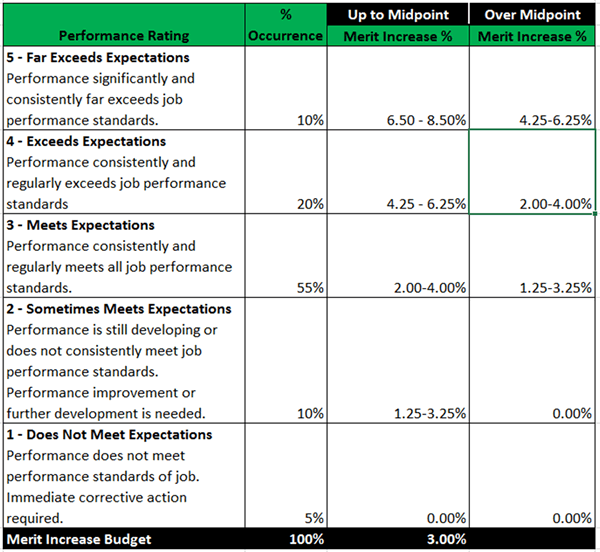
Where the top merit opportunity for top performers is commonly 150% of the budgeted rate, stretching the rate for top performers to 250% of the budgeted rate allows a company to truly distinguish pay for performance as displayed below:
Memory Jogger
Merit systems typically reward: