
Looking to Benchmark Pay?
INTRODUCTION
A sound compensation program should be:
- Internally equitable
- Externally competitive
- Cost effective
- Legally defensible
- Simple to understand
- Easy to administer
- Flexible and ongoing
A Compensation manager is responsible for the design, implementation, and integrity of an organization’s compensation plan.
Wisdom is knowing the right path to take...
Integrity is taking it.
Individual Salary Determination
To the employee, the paycheck is the end product of any compensation program. The paycheck includes base pay and cash payouts under short-term and long-term incentive plans.
This course addresses base pay design, implementation and administration. We suggest the following ERIDLC courses to supplement this program:
- Course 82: Creating a Market Competitive Salary Structure
- Course 78: Salary Increase Planning
- Course 77: Pay-for-Performance
- Course 75: Creating a Variable Pay Plan
BASE PAY AND SALARY STRUCTURES
Base pay is the core component of a compensation package. How well base pay programs are designed and administered will have a major impact on the organization's ability to attract and retain employees with the skills critical for the success of the business. If base pay is administered in a way that is viewed as equitable and competitive, it will support organizational effectiveness.
Base pay may be delivered through a salary, an hourly rate, or even a piece rate. Where a salaried employee tends to be paid on a weekly, biweekly, or even a monthly basis, an hourly employee is paid by the hour for the work performed.
A salary structure normally consists of a series of salary grades and salary ranges. Each range typically has a minimum, midpoint, and maximum rate of pay. There are many grades or levels within a salary structure. They represent relative job value. Normally, the salary structure is designed to capture competitive base pay reflecting the external marketplace. However, the structure can also be designed to ensure that total cash compensation is competitive with the external marketplace. The number of grades used by an organization typically depends on its size.
A salary structure is unique to an organization and may be used to manage:
- the hierarchy of jobs within the organization
- the competitive market rate and range for each job
- the hiring rate or range for each job
- budgeting and cost control
- ongoing salary administration
- career ladders and job families
- legal compliance
- the minimum, midpoint, and maximum value of a job
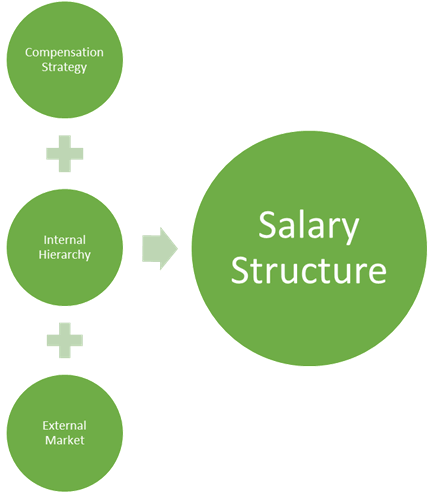
Compensation Strategy
An organization’s compensation strategy should complement the company’s mission, vision, and culture and support the overall business strategy of the company. Many C-suite executives have embraced their responsibilities for ensuring pay equity, and the compensation strategy is an appropriate document for managing this important requirement. The competitive market position is an organizational decision that determines the organization’s competitive posture relative to the external marketplace. For example, a company might target the 50th percentile for base salaries in the national marketplace for businesses of similar size in the Consumer Goods Industry. It might also include a lead-lag strategy with the market data aged to July 1 of each year. It might even be a performance-driven company with annual short-term and long-term incentive plans. The strategy might also include a focal review cycle for annual merit reviews on April 1 of each year.
Internal hierarchy of jobs within the organization
The second major compensation decision is to determine the methodology for establishing the internal hierarchy of jobs within the organization. This can be achieved by using some form of job evaluation such as a ranking or point factor plan. The majority of companies today, though, practice a market pricing approach where the external market value of jobs is used to establish the internal job hierarchy of the organization.
External Market
Applying external market data based on the compensation strategy and the internal hierarchy of jobs will enable an organization to create an effective salary structure.
Determining Pay differences
A salary structure most commonly includes one salary range per grade. Salary structures may occasionally include multiple ranges within grades. Multiple ranges within grades is a growing practice in a competitive marketplace. This is known as pure market pricing. Although one salary range per grade provides a range of pay that can be appropriate for all jobs within a grade, a further consideration is: should all jobs in a grade or individuals in one job receive the same pay range or different levels within a pay range? If different, on what basis and how? These are not trivial questions.
Most workers are paid through pay programs that provide variable amounts for their jobs. Such systems reflect the realization by management and employees that it's important to reward more than just minimal performance on the job.
Most employees are paid through pay programs that differentiate pay based on knowledge, skills, abilities, and performance. Such programs may reflect a company’s pay philosophy that it’s important to recognize the market value of jobs while maintaining an equitable hierarchy by recognizing key contributions and performance. A union may prefer to reward for learning, proficiency, and seniority.