
Looking to Benchmark Pay?
Methods of Progression
Methods of progression typically specify how an employee may move from the bottom of the range toward the top of the range. The major difference among them is the criteria for movement.
Methods of progression include:
- automatic progression
- a combination of merit and automatic progression
- merit progression
- merit progression and other increases
An organization could use different methods for different jobs, or even different methods for a single job at different parts of the salary range.
Automatic progression
Automatic progression (sometimes referred to as scheduled increases) consists of salary increases based automatically on length of service. This is a practice used more commonly within the government. It might also be used for hourly paid jobs such as in manufacturing, retail, or operations.
Let's take a look: In some situations (such as basic industries), there are a small number of increases often in rapid succession to the maximum rate for the job. These are jobs in which proficiency can be gained in a short amount of time.
The perception is that longevity on the job leads to higher proficiency, and the organization wishes to reward continuity of employment.
Nature of the maximum rate. The nature of the maximum rate provides a major source of variation in automatic plans (whether it's the market rate or an above-market rate):
| Market rate | Above-market rate |
|---|---|
| Organizations that move only to the market rate tend to have salary ranges with a small number of steps and a short time frame for progression. They are interested not so much in rewarding longevity as in encouraging learning the job. | Organizations that move beyond the market rate are specifically rewarding longevity on the job; they tend to spread out the progression to the top of the grade over a long period. |
A fully automatic-progression plan is actually a variation of the single-rate or flat-rate system. If all employees can expect to reach the maximum of the rate range after a given period on the job, the assumption is that the maximum is the real rate for the job.
Combinations of Automatic and Merit Progression
We've discussed that some introduction of merit is possible in automatic progression programs that focus on longevity.
Automatic progression to the midpoint
One approach is a program that combines automatic progression to the midpoint (the market rate) and progression beyond the midpoint based on performance. The rationale for this method of progression is that all employees can be expected to reach average proficiency within a certain time on the job; this period matches the automatic movement to the midpoint.
However, not all employees exceed average performance on the job, and movement beyond the midpoint should be based on performance that is above average. If the organization does a good job of matching time taken to reach the midpoint with time taken to reach proficiency in the job, then labor costs are equalized; if these are out of balance, then labor costs are higher or lower than is optimum.
In this case, the salary range can take either of the following approaches:
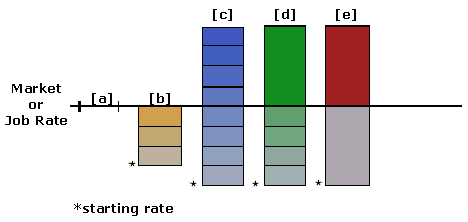
The first looks like option [c] in the graph below, with a series of steps from bottom to top and the market rate as the middle step. The distinguishing feature of this approach is how movement is determined after the midpoint has been reached.
In the second approach, there is a series of steps up to the midpoint, but an open range from that point on with movement of any degree possible and decided by merit. This approach is illustrated below in option [d].
Combining longevity and merit
Another method is to combine longevity and merit at all points in the range.
All employees receive an automatic adjustment, but those with above-average performance receive more (such as a two-step jump). It's also possible to hold back those employees that aren't performing well. Withholding salary increases is not a common practice but can be effective when dealing with disciplinary or sub-standard performance situations.
Automatic-progression methods are simple to administer since they're purely mechanical adjustments made by time in grade.
Introducing merit adds a complexity to the pay decision but allows an organization to recognize pay for performance.
Q: What's the advantage of combining automatic progression with merit progression?
A: A connection is made between performance and reward, and this may be worth the trouble.