
Looking to Benchmark Pay?
TYPES OF SALARY STRUCTURES
There are many different approaches to delivering base pay. Salary structures provide the framework for determining how pay will be delivered. Some examples of salary structures which determine pay delivery include:
- Single rate
- Automatic step rate
- Variable step rate
- Pay range (most prevalent in the marketplace)
- Broadband
Variable step rates, pay ranges, and broadbands typically will move employees throughout the structure based upon performance.
In the upcoming sections, we’ll discuss each of these methodologies, with an emphasis on pay ranges, the rationale for each, and pay delivery with a focus on merit pay.
Single-Rate Pay Systems
Before discussing various aspects of pay ranges, we should consider an approach in which there’s no range at all.
A single rate (flat rate) is paid for the job and each incumbent receives the same fixed rate. This single rate is typically the market rate for the job.
This is illustrated in the figure below as option [a].
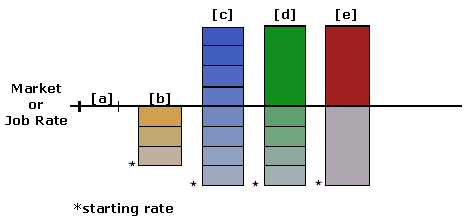
Market rate
The market or job rate for a single-rate approach can be determined through the analysis of competitive labor market data taken from salary surveys. (See DLC Course 73: Analyzing Salary Surveys.)
When to use a single-rate pay system
The single-rate pay system clearly is one of the simplest approaches to delivering pay to employees. In this case, a company will not have pay variations for experience, skill, seniority, or performance. Some manufacturing, service, temporary, or retail jobs that are routine and have a short learning time may be candidates for a single-rate pay system. In these types of jobs, recognizing performance through pay may not be desired. These jobs may also have limited discretion that a company does not wish to recognize through pay.
Simplicity
Employees in a single-rate pay system are paid for time on the job and completion of the job as directed.
Single-rate systems are simple to administer. Once the salary rate of a job is identified, no further decisions need to be made.
Unions often like single rate pay systems because they eliminate judgment-based differences in pay.
Memory Jogger
Note: Memory Jogger questions are not scored. They serve only to help you remember some of the course material covered thus far. You must select the correct answer in order to proceed to the next section.
In a single-rate pay system, the employee is typically paid the: