
Looking to Benchmark Pay?
SALARY ADMINISTRATION
Once a salary structure (and a salary increase matrix, if desired) is in place, the salary administration process starts with the monitoring and continual measurement of your organization's pay policy. In the final portion of this course, we will show you how to integrate each grade’s salary increases into a formula. Then we will discuss how to use percentages to compare:
- employees' pay levels within the organization
- pay for similar positions in different geographic areas
- budgeted vs. actual salary increases
Structure Formation
Most companies review adjustments to their salary structures annually, often using labor market data to determine increases in benchmark job salaries.
| Benchmark Job | A job that is commonly found and defined. Pay data for such a job is readily available in published surveys. It is useful in pay comparisons, either within the organization or to comparable jobs outside the organization. |
Once companies have this comparison data, they can create a structure formation formula for salary increase planning.
Example of structure formation
A salary structure has a pay policy line represented by: y = 11x + $4,000.
This salary structure is based on a point-factor job evaluation plan (see DLC Course 34: Using Job Evaluation in Your Organization). In the below salary structure graphic, the bottom of the point scale begins at 800 points, with salary increases of 3% annually. At the top of the structure at 7,000 points, salaries are indicated to increase 5% annually. What would be your new structure for the coming year if you were to match the 3% and 5% rates of increase?
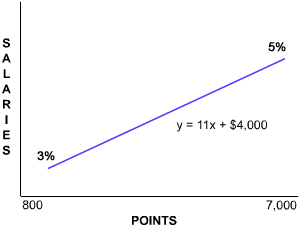
At the bottom of the salary structure:
y = 11x + $4,000
y = (11) (800 points) + $4,000
y = $12,800
Since the salaries at the bottom of the structure increase at a rate of 3%, you will need to find 3% of $12,800.
$12,800 x 0.03 = $384
$12,800 + $384 = $13,184
After calculating the bottom salary with a 3% increase, we need to repeat the process for the top of the structure.
y = 11x + $4,000
y = (11) (7,000 points) + $4,000
y = $81,000$81,000 x 0.05 = $4,050
$81,000 + $4,050 = $85,050
We can solve these two equations simultaneously to find the new structure by calculating the slope using this equation: y = mx + b
The first step is to solve for “m” using the information known about the line shown below.
$85,050 = (m) (7,000 points) + b
- $13,184 = (m) (800 points) + b
$71,866 = (m) (6,200 points)$71,866/6,200 = m
m = 11.591
Now substitute m into one of the original equations to find b:
$85,050 = (m) (7,000 points) + b
$85,050 = (11.591) (7,000 points) + b
$85,050 = 81,139 + b
$85,050 – 81,139 = b
$3,911 = b
Therefore, the pay policy line for the new structure in the coming year is:
y = 11.591x + $3,911
Memory Jogger
Your organization has the following salary structure: y = 8.34x + $2,400.
Your salary structure is based on a point evaluation system with 100 being the bottom and 900 being the top of the structure. Salaries at the bottom of the structure are increasing at a 6% rate. Salaries at the top of the structure are increasing at a 12% rate. What is your pay policy line for your salary structure in the coming year (assuming the same increases)?