
Looking to Benchmark Pay?
The Job Analyst Team
A best practices approach is the creation of a company-wide job analysis team that has been well-trained to perform this role and represent the job analyst’s department. The job analyst can provide guidance to their department in the review, audit, and approval of job descriptions. They can also write job descriptions when needed.
The role of a job analyst can be performed by:
- Members of the HR team
- Line management
- Professionals
- Senior administrative staff
The commitment to serve as a job analyst can be a developmental, one-year assignment or it can be an ongoing role. If a company trains a team of job analysts each year, knowledge of job analysis throughout the organization will become very strong over time. The quality of the job descriptions will reflect this expertise throughout the company.
Jobs analysts are typically key stakeholders and will represent members of the human resources team as well as line management. But the role of a job analyst can also be a developmental opportunity for supervisors, professionals, high performers or even high potentials.
Recruiting the Job Analyst Team
Achieving quality job descriptions is directly linked to the effort instilled in the job analysis process. When recruiting job analysts, ideally, they will possess and contribute these important human relations skills to the program’s success:
| Relate | Influence | Organization Knowledge | Empathy |
| Recognize Pertinent Information | Internal Equity | Good Judgement | Verbal Communication Skills |
| Written Communication Skills | Sincere and Neutral | Trust and Confidentiality | Fortitude, Calm, and Neutral |
- A job analyst should be able to relate to the person performing the job.
- An analyst should be able to influence both employees and management to ensure fair, consistent, and equitable job documentation throughout the company.
- A job analyst should also be knowledgeable of the organization and functional relationships within the business.
- The analyst needs empathy for the manager but also the employee who may be looking up from the bottom of the organizational pyramid.
- The analyst should be able to recognize which information is pertinent and which is not. Many times, too much information is provided, some of which may be irrelevant.
- A job analyst should ensure internal equity is maintained both within the department and within the company by providing clear, concise, and accurate job descriptions.
- The analyst should use proper judgement when communicating the facts of the job and lead the reader of the job description to an adequate understanding of the job. The final product should also communicate performance expectations.
- An analyst should have excellent verbal and written communication skills.
- A job analyst needs to display sincerity and neutrality on the project. The analyst is not evaluating an incumbent but providing documentation on the job.
- An analyst needs to earn the trust of both the employee as well as the manager. It’s also critical to treat information with confidentiality.
- A job analyst needs to maintain fortitude in the event an employee is not satisfied with the outcome of the completed job description. It is important that an Analyst be calm and neutral while reinforcing the credibility of the job description. Remember, a job analyst is representing the department and organization.
Training the Job Analyst Team
Job analysis training may be as short as 4 hours to as long as 2 days. The more time invested in the training, the higher the quality of the results and knowledge within the organization.
Day 1: Sample job analyst training:
- The role of the job analyst
- How to write an effective job description
- Available resources
- How to influence performance when writing job descriptions
Day 2: Practice interview, writing and feedback:
- Each attendee pairs up with a partner and interviews their partner in preparation for writing their job descriptions
- They will then write the job description for their partner and provide feedback to each other.
- As a group, the job descriptions can be shared and additional feedback provided.
Job Analysis Reference Sources
Job content information can be collected from both Primary and Secondary data sources.
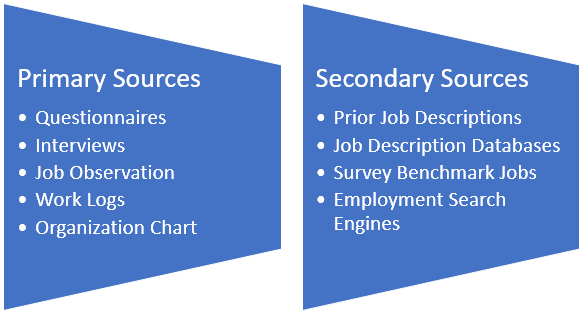
Primary sources are typically the most accurate and include input from supervisors, incumbents, or subject matter experts. This information is collected using:
- Questionnaires
- Interviews
- Job observation
- Work logs
- Organization charts
Secondary sources can be an excellent way to support job documentation, so it is not always necessary to use primary sources. They include:
- Prior job descriptions
- AI-powered job matching and job description generators such as ERI’s AI Job Matching and Description tool
- Job description databases such as ERI’s Enhanced Dictionary of Occupational Titles (eDOT), the O*NET and SHRM’s library
- AI search
- Employment search engines such as LinkedIn, Indeed, Monster, and even company websites are excellent reference sources for job descriptions.
- Salary surveys can be an excellent source for benchmark job descriptions
Memory Jogger
Primary data sources are typically the most accurate and include input from supervisors, incumbents, or subject matter experts. Sample job content primary data sources include: