
Looking to Benchmark Pay?
Essential Functions
Essential Functions include six to eight statements on the duties that enable the achievement of the job’s important end results. They are the key factors that determine performance success in the job.
Essential Function statements should always start with an action verb, and include the How, What, and Why of each major end result as follows:
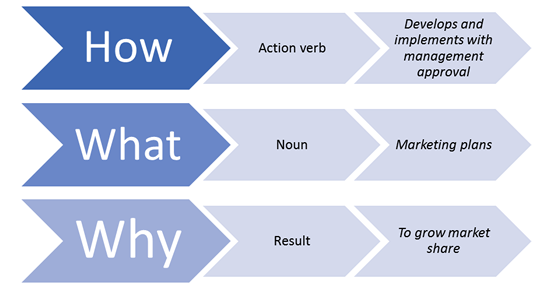
The Essential Functions should not be a laundry list of the daily activities of the job. For example, getting to work on time, filing, telephone calls, emails, and running reports are activities but are not Essential Functions.
The total effect of all employees’ end results impacting the corporation determines the organization’s success. The Essential Functions represent the “pieces” of the job’s end results which make up the Primary Purpose. Essential functions should always remain intact - with or without a reasonable accommodation under the American Disabilities Act.
Writing Essential Functions
Writing Essential Functions is the most difficult part of developing a job description. Write the essential function statements to drive organizational performance. Keep in mind, each Essential Function must be attainable.
There should be only 6 to 8 Essential Function statements. Each Essential Function should be weighted and ranked by percentage. The percentage weights are placed in high to low order (each not less than 5% nor more than 30% in weight) and add up to 100%. Weighting the essential functions is very useful for FLSA compliance and communicating performance expectations.
Some overlap between Essential Function statements may take place, but the statements should be as unique as possible. The emphasis should always be on the end result.
Example – Essential Functions for Chief Executive Officer
Job Title: Chief Executive Officer
Essential Functions:
- Establishes the mission, vision, and short- and long-term strategic objectives to ensure Natural Pharmaceuticals’ growth and profitability meet shareholder and Board of Directors’ expectations. (20%)
- Ensures the business aggressively pursues a pipeline of new and revised products capable of achieving its desired market share and supporting profitable business growth and development in the future. (20%)
- Meets or exceeds short- and long-term revenue and profit plans consistent with Natural Pharmaceuticals’ strategic objectives. (20%)
- Attracts, hires, retains, organizes, develops, motivates, manages, recognizes and rewards a workforce capable of achieving short- and long-term business objectives within company policies and procedures. (15%)
- Ensures appropriate systems, policies, budgets, controls, and procedures are in place to maintain sound legal practices that support the strategic direction of the business. (10%)
- Ensures appropriate systems, policies, budgets, controls, and procedures are in place to maintain sound legal practices that support the strategic direction of the business. (10%)
- Maintains an effective senior management team capable of leading the organization in the future. (5%)
- Oversees the manufacturing, quality assurance and distribution of the company’s products and ensures the availability of the necessary workforce, capital equipment, and resources necessary to produce the highest quality and cost-effective product that meets or exceeds customer expectations. (5%)
Time or Importance Used for Ranking Essential Functions
As the essential functions are weighted, you need to decide if percent of time performing a function, percentage importance of the function, or a combination of both, will be used.
The U.S. Department of Labor’s opinion letter below states the primary duty is the principal or “most important” duty that the employee performs and must be based on all the facts of a particular case. The emphasis is on the character of the employee’s job as a whole. Factors to consider when determining the primary duty include, but are not limited to, the relative importance of the exempt duties as compared with other types of duties, the “amount of time” spent performing exempt work, relative freedom from direct supervision and the relationship between the employee’s salary and wages paid to other employees for any nonexempt work performed.
United States Department of Labor Opinion Letter
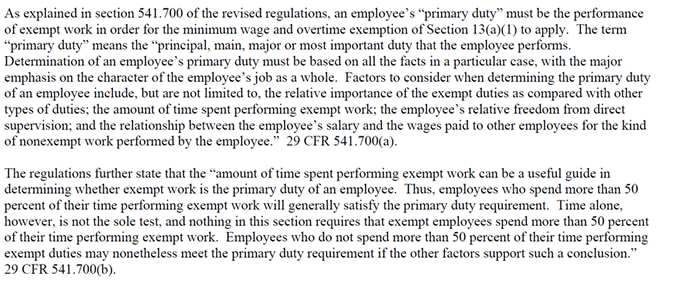
State law may be different. For example, California requires that the employee be primarily engaged in the duties which meet the test for the exemption. Primarily engaged means more than one-half of the employee’s work “time” which differs from the federal test.
California Division of Labor Standards Enforcement

So, you can see the importance of interpreting these laws as it relates to how guidance is provided within organizations to ensure the right information is captured to manage legal compliance. Obtaining legal guidance is always suggested as well.
Memory Jogger
Essential function statements should always start with an action verb and include the ___________________________________ for each major end result.