
Looking to Benchmark Pay?
Equal Pay Act
The Equal Pay Act requires that men and women be given equal pay for equal work in the same establishment. The jobs need not be identical, but they must be substantially equal. It is job content, not job titles, that determines whether jobs are substantially equal. Specifically, the Equal Pay Act provides that employers may not pay unequal wages to men and women who perform jobs that require substantially equal skill, effort and responsibility, and that are performed under similar working conditions within the same establishment. Each of these factors is summarized below.
Skill - Measured by factors such as the experience, ability, education, and training required to perform the job. The issue is what skills are required for the job, not what skills the individual employee may have. For example, two bookkeeping jobs could be considered equal under the Equal Pay Act even if one of the job holders has a master's degree in physics, since that degree would not be required for the job.
Effort - The amount of physical or mental exertion needed to perform the job. For example, suppose that men and women work side by side on a line assembling machine parts. The person at the end of the line must also lift the assembled product as he or she completes the work and places it on a board. That job requires more effort than the other assembly line jobs if the extra effort of lifting the assembled product off the line is substantial and is a regular part of the job. As a result, it would not be a violation to pay that person more, regardless of whether the job is held by a man or a woman.
Responsibility - The degree of accountability required in performing the job. For example, a salesperson who is delegated the duty of determining whether or not to accept customers' personal checks has more responsibility than other salespeople. On the other hand, a minor difference in responsibility, such as turning out the lights at the end of the day, would not justify a pay differential.
Working Conditions - This encompasses two factors: (1) physical surroundings like temperature, fumes, and ventilation, and (2) hazards.
Establishment - The prohibition against compensation discrimination under the Equal Pay Act applies only to jobs within an establishment. An establishment is a distinct physical place of business rather than an entire business or enterprise consisting of several places of business. In some circumstances, physically separate places of business may be treated as one establishment. For example, if a central administrative unit hires employees, sets their compensation, and assigns them to separate work locations, the separate work sites can be considered part of one establishment.
Pay differentials are permitted when they are based on seniority, merit, quantity or quality of production, or a factor other than sex. These are known as "affirmative defenses" and it is the employer's burden to prove that they apply.
In correcting a pay differential, no employee's pay may be reduced. Instead, the pay of the lower paid employee(s) must be increased.
Title VII, ADEA, and ADA
Title VII of the Civil Rights Act of 1964, the Age Discrimination in Employment Act of 1967, and the Americans with Disabilities Act of 1990 prohibit compensation discrimination on the basis of race, color, religion, sex, national origin, age, or disability. Unlike the Equal Pay Act, there is no requirement that the claimant's job be substantially equal to that of a higher paid person outside the claimant's protected class, nor do these statutes require the claimant to work in the same establishment as a comparator.
Compensation discrimination under Title VII, the ADEA, or the ADA can occur in a variety of forms. For example:
- An employer pays an employee with a disability less than similarly situated employees without disabilities and the employer's explanation (if any) does not satisfactorily account for the differential.
- An employer sets the compensation for jobs predominately held by, for example, women or African Americans below that suggested by the employer's job evaluation study, while the pay for jobs predominately held by men or whites is consistent with the level suggested by the job evaluation study.
- An employer maintains a neutral compensation policy or practice that has an adverse impact on employees in a protected class and cannot be justified as job-related and consistent with business necessity. For example, if an employer provides extra compensation to employees who are the "head of household," i.e., married with dependents and the primary financial contributor to the household, the practice may have an unlawful disparate impact on women.
It is also unlawful to retaliate against an individual for opposing employment practices that discriminate based on compensation or for filing a discrimination charge, testifying, or participating in any way in an investigation, proceeding, or litigation under Title VII, ADEA, ADA or the Equal Pay Act.
Pay Equity Today
Prevention is key to ensure legal compliance with pay equity laws at the local, state, federal, and international levels.
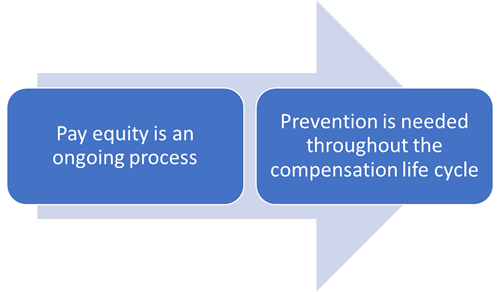
Job analysis and job descriptions are essential for maintaining pay equity requirements since they are the foundation of all compensation programs. Good job descriptions are key to preventing pay equity issues.
- Every organization should comply with local, state, national and international laws.
- Job descriptions should be written to be compliant with all protected classes under the law.
- Job architecture and job mapping should be reviewed to ensure jobs are appropriately evaluated based on skill, effort, responsibility, and work environment.
It is good practice to incorporate a pay equity analysis into the annual compensation plan.
Memory Jogger
The Equal Pay Act requires employers to: