
Looking to Benchmark Pay?
JOB DESCRIPTION USAGE
A successful job analysis and job description program will be broadly used throughout an organization. The key is to ensure they are transparent and utilized for many purposes. Consider broader applications for job descriptions such as the following:
- Job architecture
- Job evaluation
- Job matching for salary survey analysis
- Compensation plan design
- Talent acquisition
- Onboarding
- Training, development and succession planning
- Employee/manager communications and coaching
- Career ladders/career pathing
- Performance expectations and coaching
- Workforce planning
- Legal compliance
Let's take a deeper look at job description uses.
Job Architecture: Job architecture includes the mapping of job titles, job codes, job families, job functions, and job groups to support job and career ladder management as part of a human capital management system. Job descriptions are a critical tool to support in job architecture.
Job Evaluation: This is a very common use for job analysis and job descriptions. Job analysis and job documentation are important steps in job evaluation. It's essential to have consistent and accurate job descriptions to properly classify jobs into a compensation structure.
The Importance of Job Descriptions to Job Evaluation
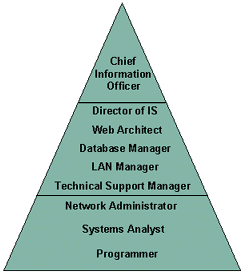
Complete and accurate job descriptions are a critical resource for evaluating jobs. When job evaluation is done well, the job hierarchy of an organization will be appropriately established from the CEO to the most entry-level job in the organization. Jobs will also be both internally equitable and externally competitive within the organization. With a competitive compensation strategy, employees will feel they are paid fairly and competitively within their labor markets for the jobs they perform.
A sample hierarchy of jobs may look similar to the example below:
Job Matching for Salary Survey Analysis: Job descriptions are essential for correct job matching when conducting salary survey analysis. AI Large Language Models (LLMs) such as the one used by ERI’s AI Job Matching and Job Description tool, can streamline time-consuming tasks, such as job matching and job description writing.
Compensation Plan Design: Good job documentation will provide important information to the compensation team that will ensure accurate job evaluations and job matching to the external labor market. This will result in appropriate base pay, total compensation, and total direct compensation levels. When performed well, job documentation can help an organization avoid pay equity issues.
Talent Acquisition: For staffing and selection, you must know the essential responsibilities and basic and preferred qualifications for the job. The ideal job description will be written to serve multiple purposes, including advertising for staffing.
Onboarding: The job description performs a critical role in communicating the requirements of a job. This supplements ongoing communications between a manager and a new employee.
Training, Development, and Succession Planning: A job description can be used to identify training and development needs for an incumbent to be successful on the job. Job descriptions also play a critical role in succession planning by defining professional growth expectations for key employees.
Employee/Manager Communications and Engagement: A well-written job description can help an applicant to select the right job for their career development. It can also help a manager to effectively communicate departmental needs and requirements. When done well, it will promote both employee and management engagement.
Career Ladders/Career Pathing: Job descriptions can perform an important role in supporting the development of career ladders and career pathing. Jobs can be designed with appropriate increases and decreases in essential responsibilities to ensure fair and equitable career steps within a job family.
Performance Expectations and Coaching: When the “how, what and why” of each essential function is clearly written to drive individual and organizational performance, they communicate performance expectations and can be used by a manager to coach employees.
Workforce Planning: Although job descriptions are typically prepared after the workforce planning process, existing job descriptions can be used to identify the workforce requirements of an organization.
Legal Compliance: Although job descriptions are not legally required, well-written job descriptions can be used in court cases trying employment related claims. Accurate essential function statements can also be valuable for determining accommodations under the ADA and FMLA. Well-written job descriptions are also valuable for SOX and immigration compliance.
Memory Jogger
Job descriptions may be used for: