From Manual Spreadsheets to Automated Compensation Planning

HR and compensation experts face the challenge of keeping track of many moving parts as compensation management encapsulates various complicated tasks and responsibilities, such as salary benchmarking, pay structure design, and compliance monitoring, to name a few. All these tasks that compensation specialists are responsible for work to ensure the successful implementation of an organization’s greater compensation philosophy and strategy.  

As compensation teams grow, the scope of what they can achieve becomes realized through coordination made infinitely easier through smarter technology. Compensation management software, such as ERI’s Assessor Platform, was specifically developed to automate and integrate compensation tasks, allowing teams to shift from a reactive approach to a more strategic and streamlined process.  

Using compensation management software, compensation specialists can move beyond outdated work processes, optimizing the time spent on manual and repetitive tasks to focus on more proactive responsibilities that require deeper deliberation. ERI’s suite of Compensation Management features help automate tasks by integrating reliable market data with features that take the tedium out of manual tasks – such as job description drafting and job matching – and improve pay accuracy. Instead of relying on bloated and outdated spreadsheets and sources, teams can use ERI’s Salary Assessor to quickly analyze compensation trends, evaluate internal pay equity, and build structured frameworks.  

Why Does My Approach to Compensation Management Matter? 

Compensation management drives business performance by aligning employee pay with company goals. When done effectively, compensation planning aids in controlling labor costs, reducing legal risks, and ensuring internal equity.  

However, compensation planning has often been managed through manual and homegrown spreadsheets in Excel. Spreadsheets have long been a familiar tool for HR and compensation professionals as they are flexible, relatively easy to use, and widely accessible. But, as organizations grow in size and scale, spreadsheets that were once a reliable solution can begin to reveal significant limitations.  

Why Do Manual Spreadsheets Fall Short for Compensation Management? 

Here are a few issues and limitations that HR and compensation professionals could experience when relying solely on manual spreadsheets: 

  • Increased risk of errors: Besides being a tedious and laborious process, manual data entry and management could potentially introduce a high risk of human error. Misplaced numerical values and formulas could lead to inaccurate salary adjustments, budget miscalculations, or even compliance issues as these errors may go undetected. 
  • Limited scalability: With expansion comes the need to scale an organization’s compensation planning. Managing compensation for hundreds or thousands of employees across multiple locations, roles, and pay structures can be difficult to sustain in a spreadsheet-based system. Moreover, the complexity of compensation in a growing organization may become nearly unmanageable when relying on spreadsheets alone. 
  • Version control: In many cases, compensation management requires the involvement of multiple team members, including department managers, in a review process that requires managing different versions of spreadsheets, potentially causing problems. For example, there could be conflicting versions, inconsistencies, overwritten data, or unclear ownership, introducing confusion and slowing down the entire pay cycle.  
  • Security concerns: An organization’s compensation information is highly sensitive, and spreadsheets shared through email or stored on local drives can be vulnerable to unauthorized access.  

How Does Automation Transform Compensation Management?  

The shift from manual spreadsheets to automated compensation cycles is a tactical transformation. In short, automated compensation cycles refer to the use of specialized compensation management software platforms to manage an organization’s entire compensation process. These compensation management software platforms enable organizations to operate and manage compensation with greater efficiency and accuracy by centralizing data and streamlining workflows. 

With automation comes the ability to easily integrate reliable market data directly into the compensation process, as achieved using ERI’s Salary Assessor. ERI’s compensation database houses over three decades of historical data, and salary data are continuously updated every six weeks to ensure market accuracy. Additionally, accurate salary benchmarking information allows organizations to make data-informed decisions, compare internal salaries against market rates, and justify compensation decisions at all structural levels.  

What Are the Key Benefits of Automation in Compensation Management Software? 

Here are a few of the seemingly endless benefits of automated compensation platforms:  

  • Improved accuracy and data integrity: Data syncing and system-supported calculations reduce the need for manual data entry and the input of complex formulas. Most compensation management software incorporates pay validation tools to ensure that compensation decisions are based on accurate and consistent data and formulas, minimizing the risk of costly errors and miscalculations.  
  • Realtime insights and analytics: HR and compensation professionals can access the most accurate and timely data at any point during a compensation cycle. As mentioned, ERI’s robust database is updated every six weeks to ensure that users can access and utilize ERI data to validate pay structures, benchmark roles, and conduct pay equity audits, as needed. This real-time visibility allows organizations to gain valuable insights rooted in market data.  
  • Streamlined workflows: Automated compensation platforms also enable organizations to design structured workflows with defined roles and permissions. For instance, ERI’s Salary Assessor supports manager/team collaboration through the Manager Audit Tool. A user can easily delegate certain tasks, such as assisting with setting performance evaluations for individual employees, to others within their organization.  
  • Enhanced compliance and auditability: Pay transparency and equity are prime concerns for all organizations regardless of size. Automated work systems provide documentation, audit trails, and reporting capabilities to ensure compliance on multiple levels.  
  • Scalability and flexibility: Compensation management software provides the ability for compensation structures to easily scale with the organization as they grow. Whether managing compensation for a small team or a global workforce, a compensation management system can accommodate varying levels of complexity and allow for customization based on an organization’s policies, compensation structures, and geographic considerations.  
  • Stronger data security: Centralized platforms also offer security features, access controls, encryptions, and secure cloud storage, ensuring that sensitive compensation information is protected under layers of security and only accessible to authorized users.  

Most importantly, automated compensation cycles fundamentally change the scope of the role of HR and compensation professionals. As organizations move from manual spreadsheets to compensation management software, compensation teams can focus on higher-value tasks, such as compensation strategy development and data analysis.  

The Salary Assessor as Your Compensation Management Solution 

The foundation of ERI’s Salary Assessor has always been data, but this solution also provides essential tools that HR and compensation professionals can utilize for efficient and effective compensation cycles and work processes. With new AI capabilities, the Salary Assessor is a robust platform with innovative features created to support scalable compensation management and administration. Consider these valuable resources: 

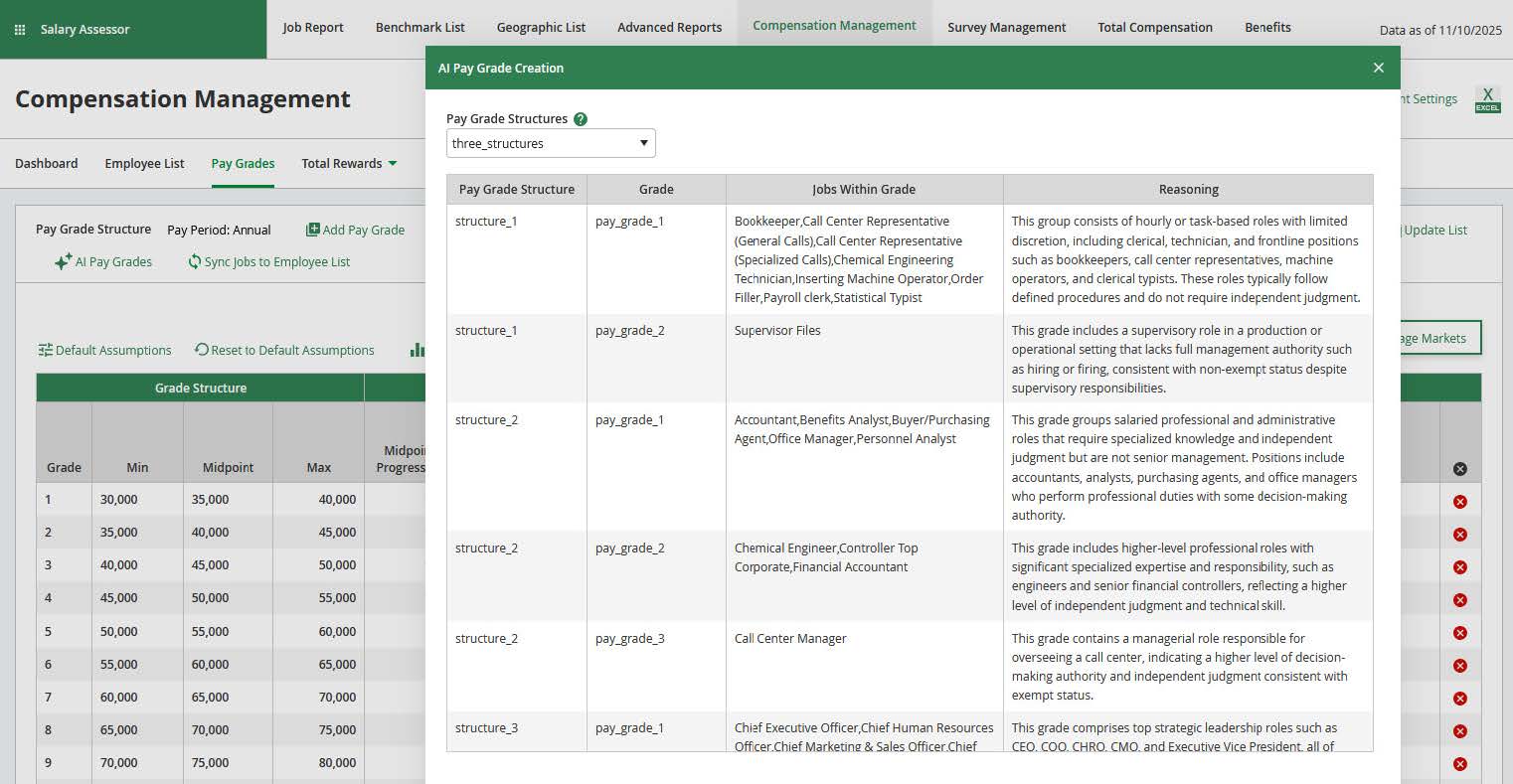
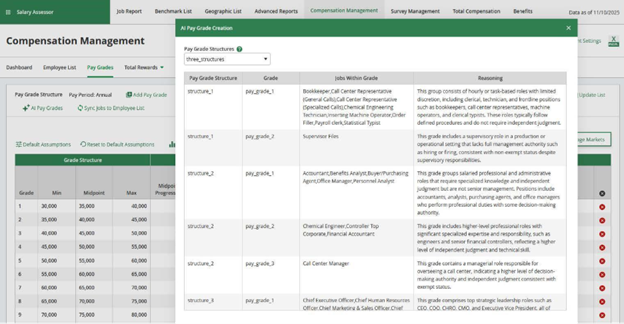
  • Pay structure development: The Pay Grade feature in Compensation Management simplifies pay structure development, allowing users to upload and maintain their organization’s salary structures. It also enables the customization of pay grades, easily adjusting salary structures to continuously reflect market or organizational changes. The Pay Grade feature includes several charts to help the user view various pay grades and overlaps in the structure and also includes the option to add geographic markets to the pay grade structures and choose localization options for each market. Additionally, ERI’s AI Pay Grade Creation tool accelerates this process even further, generating complete and editable pay grade structures with jobs already assigned to corresponding grades or levels. 
Figure 1. Use ERI’s Pay Grade tool to define and manage pay structures that exist within an organization.
  • Salary benchmarking: ERI’s salary benchmarking solution prioritizes data accuracy to ensure that every compensation decision is market-driven and defensible. Users can upload and compare multiple survey sources using the Survey Management feature to build competitive compensation packages based on data from all their survey vendors.  
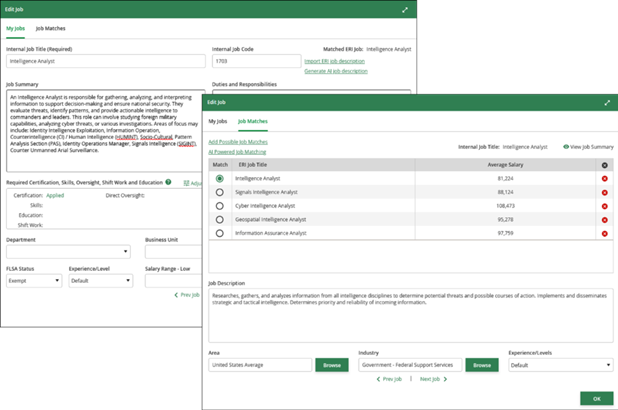
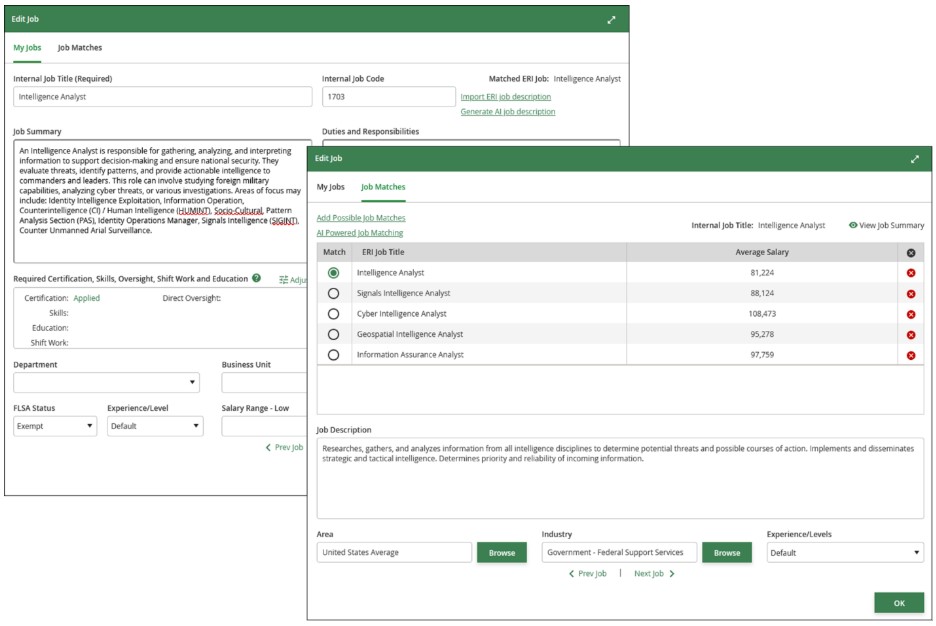
  • Job Matching: Time-consuming job matching becomes exponentially easier with ERI’s new AI Job Matching tool. Users can instantly align internal job titles with ERI’s top five most relevant roles, leading to expedited and accurate salary benchmarking. Additionally, subscribers can quickly generate detailed job descriptions with the AI Job Description Writing tool, including comprehensive duties and responsibilities tailored to job titles, to improve and inform job matching decisions.  
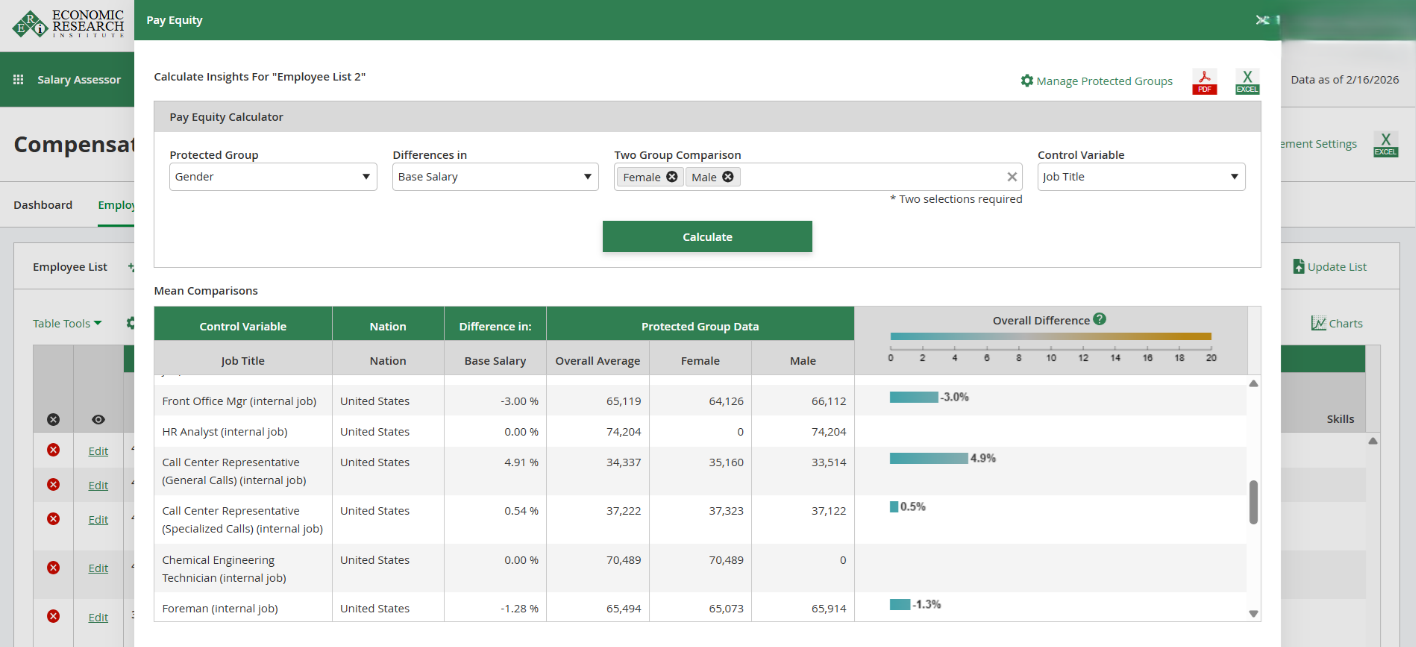
  • Workforce Insights: Use the Pay Equity tool in Compensation Management to identify potential pay gaps between employees in protected groups. Additionally, address subordinate-versus-supervisor pay compression risks using ERI’s Compression Check feature.
Figure 2. Use the Pay Equity tool to identify potential pay gaps based on user-defined protected groups.
  • Coordination and complianceThe Manager Audit tool allows a coordinator to delegate tasks to other department managers for processes such as merit and pay reviews. Additionally, the Notifications Report alerts users to check any potential FLSA and minimum wage compliance issues. 
  • HRIS integration: Our secure HRIS integration process syncs ERI’s software with a user’s HCM/HRIS platform, pulling employee data and records to efficiently upload and update whole employee lists. This expedites importing employee information and ensures that you are always accurately pulling the necessary data straight from your original employee data repository.  
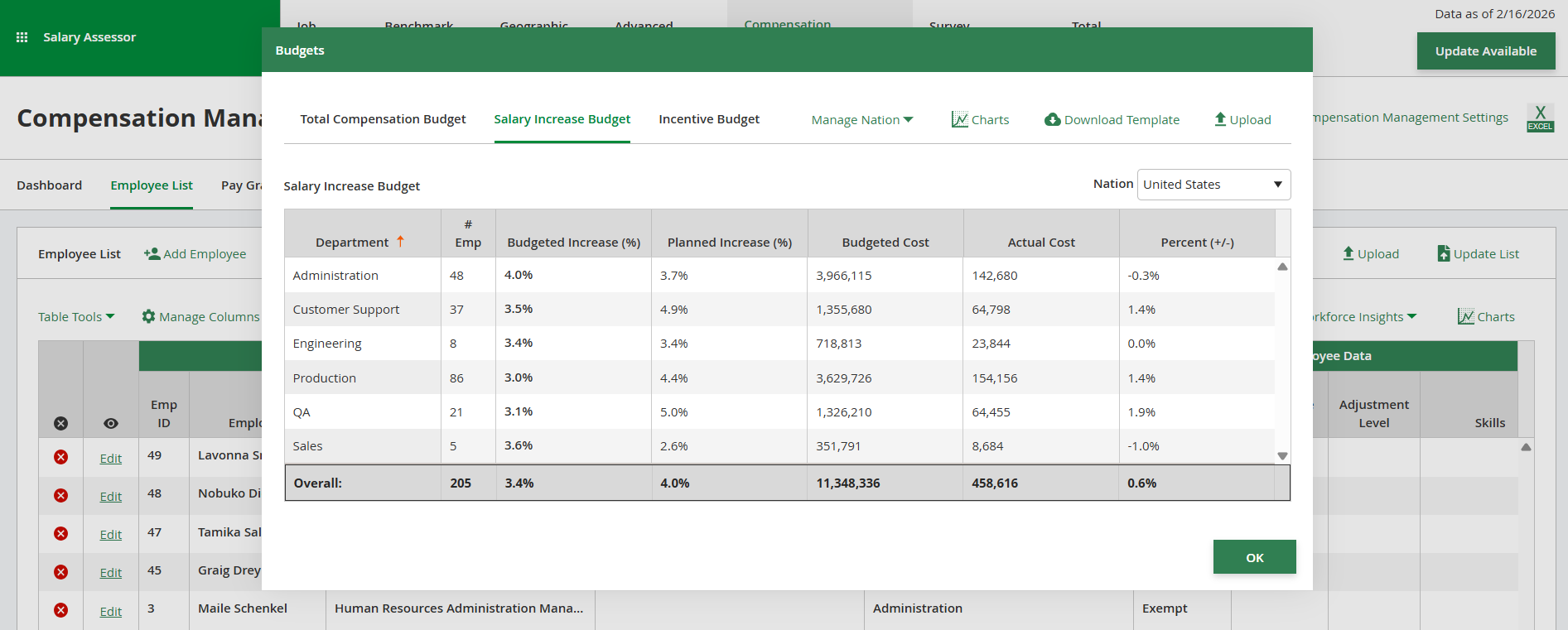
  • Compensation budgeting and scenario modeling: The Budget feature in Compensation Management allows users to set department-level budgets for pay elements, such as salary increases or incentives, and then track actual compensation costs against those targets as information changes.  
Figure 3. Use the Budget tool in Compensation Management to model, plan, and implement salary increases or incentives by departments.
  • Salary increases forecastingAdditionally, ERI’s homegrown AI Job Growth Model, CompAtlas, uses our proprietary transformer to forecast compensation changes over time, delivering granular insights on occupation-based salary increases to inform future pay decisions.  

Are you interested in seeing how ERI can transform the way you approach compensation? Click here for a free demo to get started today!  

Top 10 Highest-Paid Nonprofit CEOs in California in 2026

Although executive pay, in general, has been often closely examined, nonprofit CEO compensation has been especially scrutinized as the function of nonprofit organizations is typically to fulfill a specific mission statement, frequently to the benefit of community-based values or ideals. Because of the ethical and legal optics that are tied to how tax-exempt organizations operate, nonprofit CEO pay is shaped by regulatory oversight, mission alignment, and funding structures. 

What Determines Nonprofit CEO Pay? 

Many may not associate higher executive pay with nonprofit organizations, but fair and reasonable compensation, especially at the executive level, ensures that a nonprofit can operate smoothly while maintaining its mission. Similar to for-profit organizations, nonprofit CEO pay is determined by various elements: 

  • Organization Size and Budget: The scale and scope of a nonprofit is a large determinant of how much an executive is paid at the tax-exempt organizations. Critical metrics, such as the total operating budget, number of employees, program scope, and more, are used to set appropriate executive pay. Because larger organizations usually require larger budgets, CEOs at these organizations can earn higher pay due to the complexity of managing sizeable budgets and operations. 
  • Funding: The complexity and composition of a nonprofit’s funding programs can ultimately affect executive pay at these organizations. For instance, organizations that are supported by diversified funding sources may offer more competitive executive compensation packages. Diversified funding can be sourced from grants, government funding, and major donors. 
  • Board of Directors: One of the most important influences on nonprofit executive pay, the board of directors is typically responsible for ensuring that compensation is fair and transparent while aligning with an organization’s mission and resources. Directors involved in pay decisions should be independent and free of conflicts of interest. They often rely on market data, organizational budget and funding, and any applicable legal and regulatory standards to ensure that executive compensation is defensible and compliant.  

To learn more, see ERI’s “Guide To Setting Nonprofit Executive Compensation.” 

Top 10 Highest-Paid Nonprofit CEOs in California  

As tax-exempt organizations take center stage, nonprofit executive compensation continues to stay relevant. Based on 2025 data, the chart below highlights the top 10 highest-paid nonprofit CEOs in the state of California from highest to lowest Total Cash (Base + Incentives). Based on 2025 compensation data from filings and reports, the chart below highlights the top 10 highest-paid nonprofit CEOs in California, ranked from highest to lowest by total cash compensation, which includes base pay and incentive compensation.

Company Name Title Total Cash
Kaiser Foundation Health Plan Inc Gregory Adams Chairman & CEO $12,567,386
Sutter Health Warner Thomas President & CEO $8,705,274
Delta Dental of California Castro Michael J Chief Executive Officer $6,909,365
Credit Unions in the State of California Gary Rodrigues President & CEO $6,705,661
Motion Picture Association Inc Charles Rivkin Chairman & CEO $4,284,073
Educational Employees Credit Union Elizabeth Dooley CEO $3,304,415
Adventist Health System-West Heinrich Kerry Director/CEO $3,302,428
Scan Health Plan Jain Md Sachin H President & CEO $3,268,166
San Diego County Credit Union Teresa Campbell CEO & President $3,100,634
Emanate Health Rajesh Sharma President $2,411,826

Nonprofit CEO pay should reflect a balance between an organization’s mission, financial stewardship, and the necessity to attract and retain capable and innovative leadership. Using ERI’s Nonprofit Comparables Assessor, HR and compensation professionals can accurately set competitive and fair pay for nonprofit executives.  

For a more detailed breakdown of executive compensation in the nonprofit sector, turn to ERI’s Nonprofit Comparables Assessor today and take advantage of these features:   

  • Calculate average competitive nonprofit compensation levels, along with user-defined ranges and percentiles. 
  • Review compensation data collected from nonprofit organizations’ IRS Forms 990, 990-EZ, and 990-PF in easy-to-interpret interactive graphs and tables.  
  • Generate benchmark reports based on salary data from comparable peers in tax-exempt and/or for-profit organizations.   
  • Group peer organizations, including for-profit data, with the detailed compensation comparables needed for a “rebuttable presumption of reasonableness” that protects an organization from the imposition of intermediate sanctions taxes, penalties, and interest by the IRS (IRC 4958).  

ERI’s Assessor Platform helps HR and compensation analysts confidently grasp how executive salaries compare in their specific industry and make the most accurate data-driven decisions.Turn to ERI to conduct a more strategic nonprofit executive compensation analysis that will ensure that executive pay remains fair, defensible, and competitive.  

Click here for a free demo today!  

Top 20 Highest-Paid Tech CEOs in 2026

The technology sector continues to shape the trajectory of automation and invention. As technology companies expand and shape global markets, the demand for experienced and innovative leadership has intensified, driving complex and sophisticated executive compensation packages. 

Executive compensation, specifically CEO pay, in the technology sector is unique, sitting at the intersection of innovation, competition, and performance. Because the technology sector is an ever-evolving industry, HR and compensation professionals must leverage reliable resources, like ERI’s Executive Compensation Assessor, to approach pay strategically using the most accurate data available. As HR leaders and compensation analysts design these compensation packages, understanding the factors that build competitive and attractive executive compensation for technology leaders is crucial. 

What Factors Shape Executive Compensation in Tech? 

CEO compensation in the technology sector is often structured around a combination of market dynamics and strategic leadership. While the size, scope, and stage of an organization can impact tech CEO compensation, there are additional factors that often influence executive compensation, such as performance. Similar to other industries, a tech CEO’s total rewards package typically consists of additional components besides base pay that are tied to performance:  

  • Annual Incentive: Usually a lump-sum payment (cash or stock) made in addition to an employee’s normal pay for a fiscal or calendar year, based on performance (individual, business unit, and/or company). This may also be called an annual bonus. 
  • Long Term: Payouts from multi-year cash plans plus the grant date value of equity awards for those executives earning some form of long-term incentive. 
  • Stock: A certificate of ownership, a contract between the issuing corporation and the owner that gives the latter an interest in the management of the corporation, the right to participate in profits and, if the corporation is dissolved, a claim upon assets remaining from all debts that have been paid. 

With CEO pay in tech often tied to performance metrics, it is critical to create packages based on current market data. ERI’s Executive Compensation Assessor provides a detailed breakdown of executive compensation in tech and other sectors. The Executive Compensation Assessor ensures that compensation analysts and HR coordinators can confidently design complex and data-backed executive compensation packages that accurately reflect the tech industry and market. 

The Highest-Paid Technology CEOs

The past year saw historic advancements in technology, including AI innovation, with influential impacts on global markets. It comes at no immediate surprise that CEOs in the technology sector continue to dominate executive compensation. The top tech CEOs saw multi-million earnings, supplemented by stock awards and bonuses. The chart below reflects the highest-paid CEOs in the technology sector from highest to lowest Total Compensation based on 2025 data.

Company  Name  Title  Salary  Total Compensation 
Broadcom Inc  Hock Tan  Director, President, and Chief Executive Officer  $1,200,000  $161,826,161 
Palo Alto Networks Inc  Nikesh Arora  Chief Executive Officer and Chairman of the Board  $750,000  $151,425,203 
Workday Inc  Carl Eschenbach  Director and Co-Chief Executive Officer  $119,231  $102,685,309 
II-VI Inc  James Anderson  Director and Chief Executive Officer  $81,538  $101,497,009 
DocuSign Inc  Allan Thygesen  Director, President, and Chief Executive Officer  $269,231  $85,035,381 
AppLovin Corp  Adam Foroughi  Chairperson of the Board and Chief Executive Officer  $400,000  $83,361,678 
Microsoft Corp  Satya Nadella  Chairman of the Board and Chief Executive Officer  $2,500,000  $79,106,183 
Lyft Inc  John Risher  Director and Chief Executive Officer  $514,969  $78,238,027 
Zoom Video Communications Inc  Eric Yuan  Chairman of the Board, President, and Chief Executive Officer  $402,962  $75,959,683 
Apple Inc  Timothy Cook  Director and Chief Executive Officer  $3,000,000  $74,609,802 
Fair Isaac Corp  William Lansing  Director and Chief Executive Officer  $750,000  $66,349,962 
Zscaler Inc  Jagtar Chaudhry  Chairman of the Board and Chief Executive Officer  $23,660  $57,775,483 
UiPath Inc  Robert Enslin  Co-Chief Executive Officer  $531,250  $54,055,629 
Adobe Inc  Shantanu Narayen  Chairman of the Board and Chief Executive Officer  $1,500,000  $52,390,182 
Splunk Inc  Gary Steele  Director, President, and Chief Executive Officer  $729,863  $51,212,720 
Nutanix Inc  Rajiv Ramaswami  Director, President, and Chief Executive Officer  $800,008  $51,143,711 
Net Element Inc  David Michery  Chairman of the Board, President, and Chief Executive Officer  $750,000  $49,629,463 
CrowdStrike Holdings Inc  George Kurtz  Co-President, Chief Executive Officer, and Director  $950,000  $46,983,855 
Informatica Inc  Amit Walia  Chief Executive Officer and Director  $700,000  $41,443,075 
Roper Technologies Inc  L. Neil Hunn  Director, President, and Chief Executive Officer  $1,000,000  $41,295,585 

This table presents the top 20 highest-paid CEOs in Tech based on total reported compensation.

As markets fluctuate, it is crucial to ensure that your organization’s compensation strategy stays accurate and backed by data. Numbers are dynamic, making ERI’s software an essential resource for HR and compensation professionals to utilize. ERI’s Executive Compensation Assessor gives HR teams the ability to easily benchmark executive compensation for planning and reporting. 

In the Executive Compensation Assessor, HR and compensation professionals will be able to perform the following task with confidence:  

  • Review current and historical data for executive salaries, bonuses, long-term incentives, stock awards, and more. 
  • Sort through ERI’s database of up-to-date proxy data for in-depth proxy analyses. 
  • Calculate base salary, incentive, total cash, long-term incentive, total direct, and total compensation data for all executives in ERI’s database. 
  • Combine data from executive compensation surveys and proxy statements to analyze salary, bonus, non-equity awards, stock awards, option awards, pensions, and other compensation components for top executives’ compensation packages. 
  • Analyze statistics on equity and other non-cash compensation components. 

With ERI’s Executive Compensation Assessor, strategy becomes part of practice. Interested in how ERI’s Assessor Series can supplement your compensation planning? Click here for a free demo! 

Creating Pay Grades with AI-Powered Tools

For over 35 years, ERI has utilized the latest technology and statistical methods to automate compensation tasks to save subscribers time and money. At ERI, our approach to artificial intelligence is rooted in practical solutions that solve real world challenges. We have initiatives in three areas: reducing time spent on repetitive tasks, improving data accuracy, and enhancing decision-making in complex compensation work.  

Our philosophy is simple: AI should make professionals more effective and strategic. It should amplify expertise, ensure consistency, and uncover insights that would otherwise remain hidden in data. To this end, ERI has developed a suite of AI-powered tools, including an innovative AI Pay Grade Creation tool, to help HR professionals efficiently and accurately manage compensation. 

What Are Pay Grades? 

Pay grades, also known as salary grades, are used within a salary structure and support defining the job hierarchy within an organization, typically based on several factors, including market competitivenessinternal equity, job content, experience, and education. 

How Are Pay Grades Determined? 

An organization’s salary structure(s) will typically include the lowest-paid job up to the highest-paid job within a structure (e.g., exempt, nonexempt, executive, sales, etc.). The salary structure can even include the entire organization. The structure is then divided into pay grades to support managing the organization’s hierarchy of jobs and to ensure market competitiveness. The number and range of pay grades within a structure can vary considerably, from 1 up to 25 pay grades or even more. For example, a small organization or an executive team might have just 5 pay grades, whereas a large organization with 8,000 employees might have 25 pay grades. Generally, pay structures with more than 10 pay grades are considered a narrow-graded pay structure, while those with fewer than 10 are considered a broad-graded pay structure. 

market pricing or formal job evaluation process will typically determine the midpoint and pay grade for the job. Government agencies, as well as many for-profit and nonprofit organizations, often use a salary structure that includes pay grades to determine how each job should be paid. Market pricing of jobs is the most effective way to establish a salary structure with fair and competitive midpoints for each pay grade. Salary ranges within a pay grade are commonly 40-50% in width, but they can be as narrow as 30% or as broad as 80% or even more. Executive positions commonly have wider ranges, while operative or production jobs tend to have narrower ranges. Some industries will even use broad pay bands without pay grades. The percent difference between salary range midpoints, representing the market value of jobs, commonly increases between nonexempt and exempt salary structures. 

Who Should Use Pay Grades? 

Salary structures with pay grades can be used in any job, job family, job type, or organization. They are typically found in the public sector, private sector (including for-profit and nonprofit organizations), and unionized work. 

Why Do Organizations Use Pay Grades? 

Pay grades will support an organization in establishing the hierarchy of jobs, fairly and competitively deliver employee pay, and motivate employees with the perception of growth and opportunities for development. Not all jobs can lead to promotions or transfers, so pay grades may increase an employee’s salary even while performing the same job. 

Pay grades play a crucial role in determining short- and long-term incentive compensation eligibility. For instance, employees in grade 6 may be eligible for an annual incentive plan with a target of 10% of base pay. This information is vital for managing new hire compensation, performance pay increases, promotions, transfers, and even demotions, providing a comprehensive view of the compensation landscape. 

How Can ERI’s AI Pay Grade Creation Tool Support Enhanced Decision Making? 

Creating and administering pay grades and structures within an organization is an advanced and challenging task for compensation professionals. Instead of relying on weeks of manual data review, ERI’s smart tool analyzes job titles, pay levels, and job hierarchies to generate complete, review-ready pay grade frameworks.  

ERI’s AI Pay Grade Creation tool simplifies and accelerates the creation of compensation frameworks by transforming raw employee data into fully formed pay grade structures. Built on decades of research into how leading organizations define and manage job hierarchies, the tool analyzes titles, compensation levels, and experience requirements to determine the appropriate number of pay grades and how jobs should be grouped within them. Using established compensation principles, this tool identifies logical progressions between roles based on scope and pay patterns, which ensures that the resulting structure reflects widely adopted best practices.  

Additionally, users can evaluate multiple compensation philosophies simultaneously, apply consistent logic across hundreds of roles, and receive a set of complete, review-ready pay grade frameworks. The tool also provides clear explanations for each grouping, making it easier to align stakeholders and communicate decisions with confidence. Rather than manually reviewing job titles to identify compensation patterns, teams receive a data-backed structure that is ready for adjustment and implementation. 

The Future of AI at ERI  

As AI technology evolves, ERI remains focused on responsible implementation, with solutions anchored in research, data integrity, and practical applicability. Every model we build is designed to enhance clarity, consistency, and confidence for compensation professionals.  

At its core, ERI’s AI strategy is about augmenting expertise with intelligence by combining decades of compensation knowledge with modern AI innovation to solve real-world problems with accuracy and insight. 

To learn more about ERI’s AI Pay Grade Creation tool, please try a free demo of the Assessor Platform or sign up for a guided tour of ERI’s AI-powered features today! 

The Best Salary Benchmarking Tools for 2026

Equitable compensation is the foundation of any organization’s compensation strategy and philosophy. With labor markets rapidly evolving and compensation expectations shifting across industries and regions, accurate salary benchmarking has never been more essential. To meet those complex demands, compensation and HR leaders need reliable salary data to make competitive and equitable pay decisions.  

Reliable salary data are at the core of effective salary benchmarking, ensuring pay decisions remain competitive and defensible with vetted data. This makes salary benchmarking tools a necessary investment as they are specifically designed to deliver accurate salary data to compensation and HR leaders. Moreover, the functionality of salary benchmarking tools helps HR teams utilize data strategically and effectively. Rather than depending on scattered sources, the right salary benchmarking tools arm an organization with precise and comparable compensation insights to gain that competitive advantage over competitors. With effective salary benchmarking tools and resources in hand, compensation and HR teams are in a better position to create compensation packages that appeal to current and prospective employees.  

The first step to utilizing salary benchmarking tools and resources efficiently is to understand what they are and how they can be utilized effectively for a specific organization’s needs.  

Why Salary Benchmarking Matters 

In short, salary benchmarking, or compensation benchmarking, is a process that prioritizes data as a strategy to inform compensation decisions. It enables organizations to gauge where exactly they stand in the market regarding employee compensation while maintaining pay equity and adhering to applicable laws and regulations. A data-driven process, salary benchmarking involves comparing an organization’s compensation practices against industry standards and peer data to ensure fairness and competitiveness. Factors that influence compensation benchmarking include industry, organization size, geographic location, job responsibilities, and more.  

Salary benchmarking is an indispensable best practice for effective and strategic compensation management that HR teams leverage for success. When done properly, this process provides data-driven pay comparisons to identify gaps and inconsistencies in an organization’s current compensation practices. The insights from this will allow HR teams to make informed decisions with their compensation plan and achieve the following goals:  

  • Maintain market-competitive pay to attract and retain talent 
  • Support fair pay practices and reduce inequities  
  • Provide data-backed justification for compensation decisions 
  • Improve offer acceptance rates and reduce turnover 
  • Satisfy regulatory requirements related to pay transparency 

That said, not all salary data sources are created equal. Benchmarking accuracy, relevance, update frequency, and tool usability vary immensely, which is why choosing the right solution matters to an organization’s success. 

How Salary Data Can Be Accessed: Three Main Approaches 

Salary benchmarking solutions generally rely on one of three data types. Each has strengths and limitations, but choosing the right solution for a specific organization’s needs and priorities will ultimately determine how effective the process will be in informing future compensation decisions.  

1. Traditional Salary Surveys and Third-Party Data Providers

Considered to be the traditional route, salary surveys and third-party data providers are standard sources of data. Typically, established consultancies and survey firms gather employer-submitted payroll and salary information from participating organizations and publish aggregated results. Based on an organization’s interpretation of the data, data would then enable HR teams to make defensible, competitive, and evidence-based compensation decisions.  

Pros: 

  • Broad historical datasets 
  • Recognized credibility with leadership or compliance teams 
  • Highly structured and detailed market data 

Cons: 

  • Data can be months old by the time of publication 
  • Manual submission increases risk of error 
  • Often delivered in static datasets with limited analytics 

2. Real-Time Compensation Platforms

The next type of salary benchmarking solution advocates the speed and accuracy of collected data, lauding its platform as a “real-time” data source. These tools will generally pull live salary and total compensation data through integrations with HRIS, ATS, or payroll systems. Because these types of data are sourced directly from participating employers, benchmarks remain current and context-rich, including data on compensation elements such as base pay, bonuses, benefits, and equity. 

Pros: 

  • Continuously updated data 
  • Highly accurate and directly comparable 
  • Filters for industry, location, organization size, years of experience, etc. 
  • Often part of broader compensation management workflows 

Cons: 

  • Requires subscription and implementation 
  • Coverage varies by region and contributor base

3. Public and Self-Reported Salary Sources

These salary sources are usually collected from individual employees, targeting job seekers. Platforms like Glassdoor and other job boards offer free salary ranges or crowdsourced pay data (typically contingent on a user opening a free account). While free and accessible, the data often lack verification and context, and may not accurately reflect detailed salary information, such as job descriptions, salary ranges, or industry practices that would be valuable to benchmarking.  

Pros: 

  • Free or low cost 
  • Good starting point for informal benchmarking 

Cons: 

  • Unverified and inconsistent entries 
  • No ability to filter by comparable company profiles 
  • Insufficient for formal compensation planning 

The Top 6 Salary Benchmarking Tools for 2026 

Below are six salary benchmarking tools that are widely used by compensation professionals and HR teams, each with strengths and considerations that address the unique needs of different organizations.  

1. ERI Economic Research Institute 

ERI Economic Research Institute delivers highly localized data across thousands of jobs and geographic markets worldwide, with a depth of analysis that supports both strategic planning and operational decision making. Benchmarks are easy to use in various tasks, such as compensation reviews, budget planning, and pay structure design. ERI’s compensation management platform also includes a survey management solution with the capability to store and manage salary surveys, in addition to a suite of smart features designed for HR teams to plan, structure, and administer compensation plans.  

Key Features: 

  • Get updated salary trend rates with flexible growth modeling, including ERI’s cutting-edge AI Growth Model 
  • Benchmarks across base salary, incentives (annual and long term), benefits, and other rewards 
  • Job-level adjustments for education, shift work, supervisory oversight, skills, and certifications, including security clearances 
  • Role-specific data with robust filtration by industry, organization size, and function 

Best for: Small start-ups to Fortune 500 companies, particularly mid- to large-sized organizations needing detailed international benchmarks 

2. Willis Towers Watson 

Willis Towers Watson is a traditional survey provider and source, often preferred for multinational standardization. Organizations prioritizing geographic scope make use of Willis Towers Watson’s salary data to account for global pay governance frameworks and total rewards design.  

Key Features: 

  • Global comparability and consistent survey methodology across countries 
  • Strong executive and incentive data 
  • Supports board-level governance and regulatory defensibility 
  • Integrated rewards benchmarking 
  • Data security and anti-trust compliance 

Best for: Multinational organizations managing pay philosophy across regions 

Considerations: Requires heavy implementation effort for analysis and slower, annual survey cadence 

3. Pave 

Pave supports strong integration of compensation planning and forecasting, positioning itself as a beneficial resource for high-growth companies expanding their U.S. operations. With data pulled directly from HRIS and ATS systems, Pave emphasizes real-time compensation intelligence and equity compensation benchmarking.  

Key Features: 

  • Real-time salary, equity, and variable pay data 
  • Built-in compensation planning workflows and offer guidance tools 
  • AI-assisted job leveling and salary structure modeling 

Best for: U.S. technology companies and startups 

Considerations: Limited equity and bonus data outside core U.S. and Canadian markets and not ideal as the sole source for formal pay structures 

4. Culpepper and Associates  

Culpepper and Associates is another traditional salary survey resource, prioritizing specialized roles (e.g., engineering, health care, tech, etc.) with functional datasets that focus on operational accuracy, data freshness, and internal equity.  

Key Features: 

  • Functional market pricing with strong role-specific granularity 
  • Datasets collected and released monthly 
  • Internal pay equity feedback built into participation 
  • Guided job matching for participants 

Best for: Mid-market and high-growth firms that need credible benchmarking 

Considerations: Smaller participant pool in survey data  

5. Compa 

Compa is an offers-based market intelligence solution, making it a preferred supplemental tool (in addition to traditional salary surveys) for organizations focused on current offer market rates. Compa provides organizations with real-time benchmarks through ATS integrations, projecting unique data and insights into specialized roles.  

Key Features: 

  • Benchmarks derived from actual offers via ATS integrations 
  • Bi-weekly updates reflect real hiring activity 
  • Skills and offer trend analysis 
  • Real-world offer data, giving insight into current pay practices 

Best for: Organizations focused on current offer market rates  

Considerations: Limited full compensation management workflows 

6. Oyster HR

Oyster HR is designed for distributed workforce development and management, not sole compensation governance. Although providing limited benchmarking information, Oyster HR’s technology and data offer insight into specific compensation data with a global focus, helping organizations align roles with market values.  

Key Features: 

  • Country-specific pay guidance  
  • Market-based salary benchmarks by country or region 
  • Cost modeling and forecasting before offers 
  • Strategic workforce planning advantages based on talent availability, cost efficiency, and employment overhead 

Best for: Remote-first organizations expanding internationally 

Considerations: Less detailed benchmarking for roles 

ERI: The Industry Staple and Source for Salary Benchmarking 

ERI has been a leading salary benchmarking source for over 35 years, providing compensation professionals and HR teams with reliable and vetted salary survey data. Unlike tools that rely solely on employee-reported data, ERI uses multiple authoritative data sources to deliver the following:  

  • Highly granular job-level compensation benchmarks 
  • Geographic pay differentials across domestic and global markets 
  • Cost-of-labor and cost-of-living adjustments tied to real economic conditions 
  • Consistent methodologies suitable for audits, litigation support, and regulatory scrutiny 

Depending on an organization’s specific needs, ERI’s Assessor Platform offers subscriptions at various levels and can be used to accomplish a range of compensation tasks, from salary benchmarking to comprehensive compensation management. In addition, ERI supports an array of compensation management workflows, including these important processes: 

  • Salary structure design: Build pay ranges aligned to market percentiles 
  • Internal equity analysis: Compare roles consistently across locations and levels 
  • Executive and professional pricing: Price complex executive jobs or specialized roles not well covered by generic datasets 

ERI serves as a source for dependable and defensible salary benchmarking, ensuring that decisions are grounded in accurate data and a trusted methodology.  

How to Choose the Right Salary Benchmarking Tool 

Salary benchmarking is a core component of strategic compensation management. Whether you are building pay structures, evaluating market competitiveness, or designing equity programs, choosing the right benchmarking tool supports confident and impactful decisions. Now, which salary benchmarking tool should you choose? This all depends on your organization’s scale, geographic footprint, and compensation strategy. For many HR teams, platforms with rich data depth and frequent updates provide the strongest foundation.  

Selecting a salary benchmarking platform involves aligning features with organizational priorities. Consider these key criteria when looking at possible vendors: 

  • Data Freshness and Source Quality: Prioritize tools with live or frequent data updates and transparent methodologies. 
  • Geographic and Industry Coverage: Ensure that the dataset reflects your organization’s markets and peer groups. 
  • Total Compensation vs. Base Salary: Comprehensive tools should include bonuses, equity, and benefits where relevant. 
  • Integration Capabilities: Seamless HRIS, ATS, or payroll integration improves accuracy and efficiency. 
  • Usability and Reporting: Look for intuitive interfaces and robust reporting tools that stakeholders can easily adopt. 
  • Compliance and Security: Data handling standards (e.g., SOC2, GDPR) matter when sensitive salary information is involved. 

From ERI’s global depth to niche solutions tailored to unique jobs and specific use cases, ERI’s data and software are a dependable resource to support an organization’s compensation strategy and philosophy. ERI’s salary benchmarking platform is completely customizable, taking into consideration your organization’s needs. It allows HR teams to build compensation strategies grounded in accurate, actionable data and helps ensure that your compensation choices remain competitive and defensible. Ready to see how ERI’s data and analytical tools can transform the way you manage compensation? Click here for a free demo!  

Strategic Workforce Planning with ERI’s AI Job Growth Model

Since 1989, ERI has utilized the latest technology and statistical methods to automate compensation tasks to save subscribers time and money. At ERI, our approach to artificial intelligence is rooted in practical solutions and strategic workforce planning that solve real world challenges. We have initiatives in three areas: reducing time spent on repetitive tasks, improving data accuracy, and enhancing decision-making in complex compensation work.  

Our philosophy is simple: AI should make professionals more effective and strategic. It should amplify expertise, ensure consistency, and uncover insights that would otherwise remain hidden in data. To this end, ERI has developed a suite of AI-powered tools, including ERI’s innovative AI Job Growth Model, to help HR professionals efficiently and accurately manage compensation. 

Improved Data Accuracy with AI Data Analysis and Compensation Forecasting 

The foundation of every compensation decision is accurate data, yet small inconsistencies can lead to issues like turnover or over-expenditure on labor. AI enhances data accuracy by detecting patterns, anomalies, and trends that traditional methods often overlook, ensuring that insights are both current and reliable. With cleaner, smarter data, organizations can make compensation decisions that are more defensible, equitable, and aligned with real market conditions. 

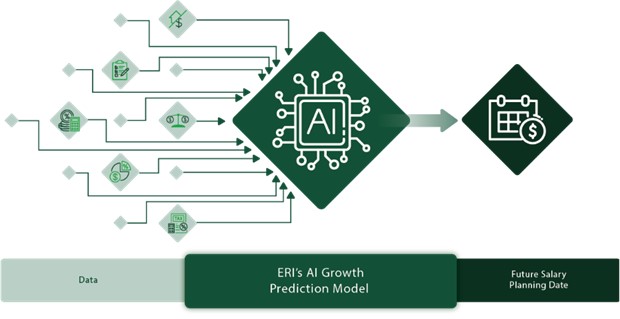
ERI’s AI growth analysis uses cutting-edge transformer architecture built in house to predict compensation changes over time. Traditional methods often rely on simple trendlines or aging factors, which assume that past rates of change will remain consistent into the future. In contrast to traditional methods, transformers excel at capturing complex relationships across diverse data. By training the model on ERI’s licensed salary survey library, including over 35 years of employer-verified compensation data, and pairing those observations with leading economic indicators, ERI can provide compensation results with much greater accuracy than traditional methods.  

ERI’s time-series transformer architecture uses the six-digit Standard Occupational Classification (SOC) level as the level of aggregation for the growth model, meaning it provides specific growth rates across 800 job families, as opposed to traditional structure or budget growth models based on only 3 levels (i.e., general employee, professional, and executive). This ensures that every unique job has an accurate growth prediction. 

ERI’s approach produces growth projections that are both data-grounded and economically informed. This allows our AI-enabled compensation analysis model to use massive amounts of real-time data to provide a remarkably strong projection of compensation trends in a rapidly changing world. ERI’s next-generation AI Job Growth Model, named “CompAtlas,” is legitimately the most accurate predictor of compensation growth in market rates currently available. In fact, ERI has found that the result is an 83.9% reduction in error, as compared to traditional growth models, when predicting compensation one year into the future.


The Future of AI at ERI  

As AI technology evolves, ERI remains focused on responsible implementation, with solutions anchored in research, data integrity, and practical applicability. Every model we build is designed to enhance clarity, consistency, and confidence for compensation professionals.  

At its core, ERI’s AI strategy is about augmenting expertise with workforce intelligence by combining decades of compensation knowledge with modern AI innovation to solve real-world problems with accuracy and insight. 

To learn more about ERI’s ground-breaking AI Job Growth Model, please try a free demo of the Assessor Platform or sign up for a guided tour of ERI’s AI-powered features today! 

How AI Job Matching Improves Compensation Management

Since 1989, ERI has utilized the latest technology and statistical methods to automate compensation tasks to save subscribers time and money. At ERI, our approach to artificial intelligence is rooted in practical solutions that solve real world challenges. We have initiatives in three areas: reducing time spent on repetitive tasks, improving data accuracy, and enhancing decision-making in complex compensation work.  

Our philosophy is simple: AI should make professionals more effective and strategic. It should amplify expertise, ensure consistency, and uncover insights that would otherwise remain hidden in data. To this end, ERI has developed a suite of AI-powered tools, including AI job matching, to help HR professionals efficiently and accurately manage compensation. 

What Is Job Matching? 

Job matching is the process of reading and analyzing internal job descriptions and comparing them to job descriptions found in salary surveys. Once an internal description is matched to a survey description, then HR and compensation professionals can use the survey’s market rate to establish, verify, and modify the salary for an internal job.  

Why Is Job Matching Important? 

It is crucial to get pay rates right, and salary accuracy depends on getting the correct job matches between an organization’s internal jobs and benchmark jobs in salary surveys. Accurate market pay rates allow organizations to be competitive in recruiting and retaining talent. To determine these pay rates, organizations must first assess market rates through survey job matching.  

Organizations should know how their internal pay ranges and compensation philosophies compare to that of their peer organizations. Understanding the market for a job starts with identifying that job in a salary survey. A poor match to the marketplace can lead to significant overpayment or underpayment for a job, which is why job matching is an integral part of the compensation process. What’s more, in addition to external equity, the quality of a job match can impact internal equity, including pay compression. 

The Benefits of AI-Powered Job Matching  

Manually matching your organization’s jobs to an external job taxonomy can be time consuming and inconsistent. Furthermore, job matching heavily relies on individual judgment to interpret titles and descriptions that may vary widely between organizations. This subjectivity can lead to mismatched benchmarks, inaccurate market comparisons, and issues with pay compression. AI-driven job matching solves this by analyzing the language and context of each role, ensuring consistent, data-backed alignment between internal positions and external market data.  

ERI’s AI-Powered Job Matching leverages artificial intelligence to seamlessly connect your organization’s roles with the most relevant benchmarks in our extensive job database. By analyzing both job titles and detailed descriptions, our system goes beyond simple keyword searches to capture the true meaning and context behind each position. This ensures that, even when job titles differ across organizations, the underlying responsibilities, requirements, and scope of work are recognized and matched appropriately.  

Through advanced language modeling and similarity analysis, ERI’s AI job matching functionality identifies the top five most compatible benchmark jobs for each submission. This intelligent process reduces the time involved in manual job matching, delivering consistent, data-driven results that align with ERI’s trusted methodology. The result is a faster, more accurate matching experience, helping compensation professionals, analysts, and organization leadership make confident decisions backed by modern AI and over 35 years of ERI research expertise. 

Use ERI’s AI-Powered Job Matching tool to crosswalk labor categories (LCATs), saving time in government contract applications.

The Future of AI at ERI  

As AI technology evolves, ERI remains focused on responsible implementation, with solutions anchored in research, data integrity, and practical applicability. Every model we build is designed to enhance clarity, consistency, and confidence for compensation professionals.  

At its core, ERI’s AI strategy is about augmenting expertise with intelligence by combining decades of compensation knowledge with modern AI innovation to solve real-world problems with accuracy and insight. 

To learn more about the AI job matching tool in ERI’s Assessor Platform, please try a free demo or sign up for a guided tour of ERI’s AI-powered features today! 

What to Look for in a Compensation Management Software

Compensation is one of the largest expenses that organizations invest in, making accurate and effective compensation management a priority. This is why compensation professionals turn to reliable compensation management software like ERI’s Assessor Platform. A reliable compensation management solution positions an organization for success as it streamlines and optimizes outdated and manual work processes.  

When sticking to manual work processes, such as handling and tracking countless spreadsheets or manually calculating complex merit increases for multiple departments across an organization, managing compensation can get quite cumbersome and even overwhelming. Although these workflows have served compensation professionals well for decades, they are not without pitfalls given a manual process leaves room for potential error, miscalculation, and noncompliance. 

Investing in reliable compensation management software reduces the risk of those manual errors, ensuring that compensation professionals can meet demands and standards with strategic efficiency and accuracy.  

Now, what exactly are the particulars of compensation management software and where do compensation professionals begin when searching for the software that best fits their needs? 

What Is Compensation Management Software? 

Today’s compensation management has evolved well beyond manual spreadsheets and annual salary surveys. Compensation professionals are expected to design pay structures that are competitive, compliant, equitable, and defensible, all while responding to shifting labor markets, geographic pay differences, and growing transparency requirements. 

Instead of relying on outdated processes, compensation professionals have moved towards utilizing compensation management tools and software to design, analyze, and administer compensation decisions. In addition to optimizing the way that experts manage compensation, intelligent software, like ERI’s Assessors Platform, supports compensation management and planning with an array of advanced solutions: 

  • Identify potential pay gaps using ERI’s Pay Equity tool and address compression risks with ERI’s Compression Check feature. 
  • Delegate tasks with the Manager Audit Tool feature for internal reviews and reporting from different departments. 

The right Compensation Management platform replaces fragmented spreadsheets with centralized, auditable, and defensible compensation data. Through organized and streamlined processes, compensation professionals will, in turn, be able to create and administer effective compensation strategies that are measurable and impactful. 

Core Categories of Compensation Management Tools 

Most compensation management solutions fall into one of four categories. As compensation management software is an investment, understanding these distinctions is critical when evaluating potential vendors to ensure that an organization’s compensation goals are empowered by the software that they choose.  

1. Compensation Data and Market Intelligence Platforms 

This type of platform focuses on delivering authoritative and statistically validated compensation data across roles, industries, and geographic locations. Instead of relying solely on crowdsourced or employee-submitted data, platforms rooted in employer-submitted data – like ERI’s Assessor Platform – tend to apply structured frameworks, such as economic modeling and labor market adjustments, to provide market-based compensation data and trends.  

Best forOrganizations that need accurate, defensible pay benchmarks for complex tasks, such as creating salary structures, maintaining compliance with labor laws, and executive decision making 

Key Capabilities:

  • Market pricing by job, location, industry, and organization size, with customizable adjustments for skills, certifications (including security clearance), education, and shift work 
  • Cost-of-labor and cost-of-living adjustments 
  • Global compensation coverage 
  • Total cash and total compensation analysis 

2. Compensation Planning and Workflow Tools 

These platforms emphasize planning and administration, such as annual merit cycles, promotion increases, and budget controls. They often integrate with HRIS platforms and guide managers through compensation decisions, ensuring work processes stay organized and trackable.  

Best for: Organizations focused on streamlining compensation cycles and approvals 

Key Capabilities:

  • Merit and bonus planning workflows 
  • Budget modeling and approval hierarchies 
  • HRIS and payroll integrations 

Limitations: Some planning tools rely on third-party or limited compensation data and may not provide deep market pricing accuracy.  

3. Offer-Based and Real-Time Market Tools 

These solutions often use active job offers and hiring data that are sourced from applicant tracking systems (ATS). 

Best for: Fast-growing companies competing aggressively for talent in hot labor markets 

Key Capabilities:

  • Offer-level market insights 
  • Hiring trend analysis 
  • Skill-based pay signals 

Limitations: Offer-based data may skew toward specific industries or job families and is often less suitable for enterprise-wide compensation structures. 

 4. Survey-Driven and Consulting Tools 

Traditional compensation surveys and consulting solutions aggregate employer-submitted data and publish periodic reports. 

Best for: Organizations seeking historical trend data or executive-level validation 

Limitations:

  • Data may lag current market conditions 
  • Often delivered in static formats with limited analytics 

Top 6 Compensation Management Software for 2026 

Below are six widely adopted compensation management platforms, each with strengths that address different organizational needs. 

  1. ERI Economic Research Institute

ERI’s compensation management software delivers accurate market data grounded in labor economics and statistically validated methodologies. It is well suited for compensation teams that require reliable market insights, defensible benchmarks, and geographic pay differential analysis, while also seeking practical compensation planning tools.  

Best for: Teams needing rigorous job-level benchmarks and geographic pay differentials 

Key Strengths:

  • Statistically validated data 
  • Cost-of-living and cost-of-labor indices 
  • Detailed job pricing across professional and technical roles 

Considerations: ERI is most effective as a source of market intelligence and workflow-oriented tools for full compensation cycle management. 

  1. OpenComp

OpenComp provides accessible compensation management with a focus on establishing pay strategy and ranges and implementing scalable governance without heavy technical overhead. It is especially attractive to teams without a dedicated compensation function. 

Best for: Mid-sized companies needing streamlined compensation infrastructure 

Key Strengths:

  • Simplified salary band creation 
  • Alignment of internal structures and market data 
  • Lightweight workflows for planning and approvals 
  • Good balance of guidance and user-friendly interface 

Considerations: Compared to enterprise suites, OpenComp lacks deep analytics that some teams may need. However, the software is ideal for companies transitioning from manual methods. 

  1. SalaryCube

SalaryCube delivers segmented salary benchmarking based on industry, location, and company size, with continuous updates from multiple reliable sources, including salary surveys and market research.  

Best for: Organizations seeking comprehensive benchmarking focused on accurate market data 

Key Strengths:

  • Multi-dimensional benchmarking by industry and revenue size 
  • Regularly updated compensation data 
  • Accessible for small- to mid-sized HR teams 
  • Provides contextual insights to support range and structure decisions 

Considerations: Additional tools may be needed to operate full compensation cycles as they are primarily a benchmarking and data analytics source. 

  1. HRsoft

HRsoft provides a suite of tools for merit and bonus planning, salary range management, calibration cycles, and pay equity analysis. It emphasizes configurable workflows and robust reporting designed to support transparent compensation decisions and scale with organizational complexity. 

Best for: Mid-sized to large enterprises seeking centralized compensation planning and governance 

Key Strengths:

  • End-to-end planning and budgeting workflows 
  • Pay equity dashboards and AI-assisted recommendations 
  • Calibration and approval cycle support 
  • Integration with HRIS and analytics systems 

Considerations: HRsoft’s strength is in planning and governance, while market benchmarking data are typically sourced through integrations with third-party compensation intelligence providers. 

  1. Pave

Pave combines compensation planning workflows with real-time compensation benchmarking data and market insights into salaries, bonuses, and equity. Its emphasis on usability for modern compensation cycles is an attractive feature for startups. 

Best for: Fast-growing companies and startups, especially in U.S. technology sectors 

Key Strengths:

  • Interactive planning and offer tools 
  • Equity and bonus modeling 
  • User-friendly interface designed for hiring workflows 

Considerations: Although market coverage is strongest for U.S. roles and technology sectors, broader international data may be more limited. 

  1. Comptryx (by Mercer) 

Comptryx provides a comprehensive compensation dataset and tools for job evaluation, benchmarking, and pay structure design. Its integration with Mercer’s broader talent frameworks is valuable for enterprise HR functions. 

Best for: Large organizations needing deep competency-based job mapping and pay benchmarking 

Key Strengths:

  • Detailed job benchmarking data 
  • Competency and job architecture support 
  • Integration with broader talent and HR strategies 

Considerations: Comptryx is positioned toward larger tech enterprises with established HR analytics and processes. 

ERI’s Assessor Platform: Compensation Management Grounded in Data 

ERI provides a foundation that supports both strategic and operational compensation decisions, making it an effective and favored compensation management solution for compensation professionals. Unlike tools that rely solely on employee-reported data, ERI uses multiple authoritative data sources to deliver the following: 

  • Highly granular job-level compensation benchmarks 
  • Geographic pay differentials across domestic and global markets 
  • Cost-of-labor and cost-of-living adjustments tied to current economic conditions 
  • Consistent methodologies suitable for audits, litigation support, and regulatory scrutiny 

This makes ERI’s compensation data and, by extension, ERI’s compensation management software particularly valuable for organizations that require defensible, repeatable, and transparent compensation decisions.  

Core Compensation Management Use Cases 

Depending on an organization’s specific needs, ERI’s Assessor Platform offers subscriptions at various levels and can be used to accomplish numerous compensation tasks, from benchmarking to comprehensive compensation management. In addition, ERI supports a wide range of compensation management workflows, including these processes, among others: 

  • Salary structure design: Build pay ranges aligned to market percentiles. 
  • Geographic pay strategy: Adjust compensation for remote, hybrid, or multi-location workforces. 
  • Internal equity analysis: Compare roles consistently across locations and levels. 
  • Executive and professional pricing: Price complex or specialized roles that are not often covered by generic datasets. 

ERI serves as a source for market-aligned, intelligent compensation management tools that ensure planning decisions are grounded in accurate data and strategically effective. 

Choosing the Best Compensation Management Software for Your Organization 

Compensation management software is no longer optional for organizations navigating competitive labor markets and increasing pay transparency expectations. It has become critical to an organization’s success. While workflow-driven tools streamline administration, they are only as effective as the data behind them. 

ERI provides the economic and market intelligence foundation that enables reliable, consistent, and defensible compensation decisions. Additionally, our comprehensive Compensation Management software supports everything from salary structures and geographic pay strategies to compliance and executive compensation analysis. 

In addition, ERI’s compensation platform consolidates compensation data, reducing errors, and saving time so that teams can focus on strategy instead of manual calculations. Our platform has these capabilities: 

  • Adapt to any organization’s needs and integrates with existing HR tech for seamless compensation management.
  • Easily analyze market trends, conduct pay equity analyses, and align compensation strategies with business goals. 
  • Create competitive and equitable pay structures with innovative tools, such as our Pay Grades feature, now including AI support.
  • Securely manage sensitive compensation data within a protected and structured environment audited for security.

ERI provides hands-on support with expert guidance to ensure that HR teams can make use of every potential feature available in our platform. Ready to see how our solution can change the way you manage compensation? Try a free demo today! 

Reading the Labor Market Through Job Posting Trends

Information regarding sought-after jobs can be useful for labor economists, talent managers, workforce planners, and HR analysts. This type of knowledge can help understand the changing nature of work to anticipate and plan for future needs. Postings on job boards are one source of such information.  

In addition to wage, cost-of-living, and job demand data, ERI gathers job posting information. While this database is rich with job titles, descriptions, wage, and location information, it is also organization specific and can be labor intensive to clean. A crucial step in the process is matching titles from job postings to a benchmark list, in this case, ERI jobs. To accomplish this, we utilize various large language model (LLM) and artificial intelligence (AI) tools, as well as human analysts.  

For this report, 460,000 job posts from a 12-month period ranging from August 2024 to July 2025 were analyzed. In order to efficiently summarize the information, jobs were aggregated into SOC job categories at both the 2- and 3-digit level. For this analysis, 2-digit aggregations are referred to as job families, while 3-digit aggregations are referred to as job groups 

The analysis revealed a strong concentration of postings in five job families: Management, Administrative, Health Care, Education, and Production. As shown below, Management jobs dominated the postings, and the top five accounted for nearly 50% of all postings.  

Looking at the top five job families by geography, we see some regional differences in the United States. In particular, the Southeast seems to deviate the most from other regions, with a higher concentration of Management postings and a lower proportion of Health Care and Production postings 

Looking at the 12-month job posting trend for the top five job families, they appear to remain relatively stable over time, with some having expected peaks and valleys (e.g., Education postings rising during the spring months).  

Although generally stable over time, jobs in Education, Health Care, and Management had the second, third, and fourth largest fluctuations, respectively, on average throughout the 12-month time span studied (bookended by Computer & Math and Architecture & Engineering jobs).

Job Family  % Change 
Computer & Mathematical  3.9% 
Education  3.7% 
Health Care  3.6% 
Management  2.8% 
Architecture & Engineering  2.5% 

Turning to the job group (3-digit) analysis, seven of the top ten postings were, not surprisingly, members of the top five job families with the greatest increase in job postings. The remaining three were from different, distinct job families.  

Job Group  % Change 
Service Managers  6.9% 
Health Care Diagnosing or Treating Practitioners  5.6% 
Operations Specialties Managers  4.9% 
Business Operations Specialists  4.2% 
Health Technologists and Technicians  3.7% 
Information and Record Clerks  3.3% 
Preschool, Elementary, Middle, Secondary, and Special Education Teachers  3.3% 
Computer Occupations  3.1% 
Counselors, Social Workers, and Community and Social Service Specialists  2.8% 
Personal Care and Recreation Workers  2.6% 

At the job group level, postings displayed lower fluctuations over time than the job family level. Computer Operations saw the largest change at 3.8%, while Health Care Diagnosing jobs were a modest 2.0%.

In addition to the summaries presented, we also looked at postings with remote work optionsRemote work has become more common as technology has advanced and saw a large increase in 2020 due to the pandemic. Despite a return-to-work trend, there continues to be a modest demand for jobs with remote options. When looking at job postings, the most likely to include remote work were occupations in these fieldsLegal, Computer & Mathematical, and Business & Finance. Interestingly, postings for jobs in the Southeast were much more likely to include remote work options compared to the rest of the country.  

Taken together, these job postings suggest that the current labor market may be led by needs for leadership, essential services, and operational capacities. It is unclear at this time whether this job market trend will continue as we have experienced a slight uptick in unemployment and recent slowing in some job markets according to government job reports. Nevertheless, the overall diversity in types of jobs posted should be encouraging.

A Guide to Compensation Management: Strategy, Benefits, and Solutions

Compensation management has evolved far beyond setting pay ranges and administering annual merit increases. Today’s labor market is defined by talent shortages, pay transparency legislation, geographic pay complexity, and heightened employee expectations, making compensation a strategic business function. As a result, organizations that manage pay thoughtfully and systematically are in a better position to attract talent, retain high performers, maintain internal equity, and control labor costs. 

This makes understanding the fundamentals of compensation management essential in any organization. Now, what exactly is compensation management and how can organizations, specifically compensation and HR professionals, use this effectively to benefit their organizations?  

What Is Compensation Management? 

Compensation management refers to the structured process of designing, implementing, and maintaining an organization’s total pay strategy. This includes the following: 

  • Base pay (salary or hourly wages) 
  • Variable pay (bonuses, incentives, commissions) 
  • Equity or long-term incentives (where applicable) 
  • Pay differentials (such as geographic, shift, skill, or supervisory oversight) 
  • Governance, policies, and pay administration processes 

At its most basic level, compensation management ensures that employees are paid accurately and on time. At its most strategic level, it aligns pay with organizational goals, labor market realities, internal equity principles, and regulatory requirements. 

For HR and compensation professionals, effective compensation management requires balancing three competing forces: 

  1. External competitiveness: Paying in line with the labor market 
  2. Internal equity: Ensuring fair and consistent pay relationships 
  3. Affordability and sustainability: Managing compensation spending responsibly 

Without a disciplined approach, organizations risk overpaying for some roles, underpaying for others, or introducing inequities that undermine trust and engagement. To prevent these issues from taking place, many HR teams tap into intelligent compensation management software like ERI’s Assessor Platform to streamline work processes, reduce human errors, and leverage benchmarking tools to stay competitive and compliant.  

Why Strategic Compensation Management Matters 

Compensation Is a Primary Talent Lever 

Compensation remains one of the most influential factors in employee attraction and retention. While culture, flexibility, and career development matter, pay is often the deciding factor in whether employees join or even leave an organization. 

Take for instance this scenario. A health care organization struggling with nurse turnover discovered that, while its average pay looked competitive, certain critical roles lagged behind market rates when analyzed by geography and specialty. Using compensation data to refine job-specific and location-specific pay ranges, the organization can reduce turnover in those roles, lowering reliance on costly contract labor. 

Pay Practices Signal Organizational Values 

Employees interpret compensation decisions as signals of what the organization values. Pay that is inconsistent or disconnected from performance can erode trust. This is why tapping into strategic compensation management software like ERI’s Salary Assessor is so crucial. For instance, here are but a few uses of the Compensation Management solution: 

This becomes especially important as pay transparency laws expand, and employees have greater access to salary information. 

Compensation Drives Business Outcomes 

When compensation is aligned with organizational priorities, it can reinforce desired outcomes such as productivity, innovation, customer satisfaction, or safety. In the Compensation Management solution of ERI’s Salary Assessor, users can manage various pay elements, including incentive pay, skill-based pay, and pay progression frameworks, that can directly support business objectives by creating clear pathways that prioritize employees and their expectations, thus affecting an organization’s overall goals. 

Effective Compensation Management Benefits 

Organizations with data-backed and systematized compensation management practices experience measurable advantages: 

1. Improved Attraction and Retention 

Market-aligned pay reduces hiring friction and limits costly turnover. Replacing an employee is expensive, depending on role and industry, making competitive compensation a preventative investment. 

2. Greater Pay Equity and Compliance 

Structured pay ranges and consistent benchmarking support equitable pay practices. This is increasingly critical as organizations face audits, employee inquiries, and regulatory scrutiny. 

3. Better Budget Control and Forecasting 

Compensation management tools allow organizations to model merit increases, employee- and job-level adjustments, and incentives before decisions are finalized, helping leaders understand cost implications. 

Common Challenges in Compensation Management 

Despite its importance, compensation management remains one of the most challenging areas of HR as there are so many moving parts to keep track of over time. Here are a few common challenges that HR and compensation professionals could face: 

1. Fragmented and Inconsistent Data 

Many organizations rely on a mix of spreadsheets, HRIS systems and exports, salary surveys, and manager input. This fragmentation increases the risk of errors and makes it difficult to answer basic questions, such as these: 

  • Are we paying competitively for this role in this location? 
  • How consistent are our pay decisions across departments? 
  • What will this compensation cycle cost us? 

2. Manual and Time-Consuming Processes 

Salary increase and bonus cycles depend on multiple resources and time, involving multiple approval layers. This not only slows decision making but also increases the likelihood of inconsistent outcomes. 

For instance, imagine that a national professional services firm requires HR to manually consolidate compensation recommendations from dozens of managers across regions. Each cycle took months and produced frequent discrepancies. However, with ERI’s Manager Audit Tool feature, HR and managers can collaborate and edit centralized data, significantly reducing errors and improving consistency and cycle workflow. 

3. Keeping Pace with Market and Regulatory Changes 

Labor markets shift rapidly, and compensation data could become outdated quickly, especially in high-demand roles. At the same time, new regulations around pay transparency and equity require organizations to document and justify compensation decisions more thoroughly than ever. 

Resources That Support Strategic Compensation Planning 

To manage compensation effectively and accurately, HR and compensation leaders must rely on a combination of data, expertise, and technology. 

Market Pay Data 

Accurate and current job and pay data are foundational to compensation management. The best tools for making compensation decisions based on data include, but are not limited to the following resources: This includes, but is not limited to, these resources: 

  • Salary surveys and benchmarking tools 
  • Geographic and cost-of-labor differentials 
  • Industry-specific and job-level data 

ERI provides robust compensation data covering a wide range of roles, industries, and locations, helping organizations understand what competitive pay looks like. 

Analytical Frameworks 

Beyond raw data, compensation professionals use structured frameworks to ensure that compensation decisions are consistent and defensible, including the following: 

  • Job architecture and leveling systems 
  • Pay range design methodologies 
  • Market positioning strategies (e.g., target percentiles, such as the 25th/median/75th percentile, to lead, match, or lag the market) 

Professional Guidance and Best Practices 

HR associations, peer networks, and thought leadership resources help professionals stay informed about emerging trends, regulatory changes, and evolving employee expectations. 

Compensation Management Solutions: From Data to Execution 

As compensation grows more complex, technology such as ERI’s smart Compensation Management software plays an increasingly vital role in helping organizations manage pay decisions effectively. 

What Comprehensive Compensation Solutions Offer 

ERI’s Salary Assessor provides a comprehensive and cutting-edge Compensation Management platform with innovative AI-powered features and HRIS integration built to support compensation planning and administration: 

  • Market Benchmarking: Access to reliable compensation data by role, location, and industry 
  • Pay Structure Development: Essential tools, such as the Pay Grade feature in Compensation Management, to design and maintain structured salary grades and ranges 
  • Planning and Modeling: Current versus adjusted compensation, market index, compa ratio, salary increases, and incentives 
  • Workflow Management: Streamlined approvals and collaboration 
  • Reporting and Analytics: Insights into equity, competitiveness, and total spending 

With these workflows in place and supported by ERI’s compensation platform, HR teams will be able to focus on the strategic side of compensation, while also ensuring a solid foundation for their compensation planning. 

How ERI Supports Strategic Compensation Management 

ERI’s Compensation Management tools are designed to help organizations move from static to strategic pay decisions. By combining extensive compensation data with practical planning tools, ERI’s Compensation Management platform enables HR teams to seamlessly accomplish essential tasks, such as these: 

These capabilities and features of a compensation management solution are especially valuable for organizations managing distributed workforces, specialized roles, or highly competitive labor markets. 

Compensation Management in Practice: A Strategic Advantage 

Compensation management is no longer just about keeping up with the market. It’s about using pay to support workforce and business goals with clarity and reliability. Organizations that invest in the right data, processes, and tools gain confidence in their decisions and reduce the roadblocks that slow down compensation cycles. 

With ERI’s Compensation Management software, HR and compensation leaders can implement a structured framework, ground decisions in reliable market data, and align pay practices with organizational values and objectives.  

Ready to see what this looks like in your workflow? Try a free demo today!