Since 1989, ERI has utilized the latest technology and statistical methods to automate compensation tasks to save subscribers time and money. At ERI, our approach to artificial intelligence is rooted in practical solutions and strategic workforce planning that solve real world challenges. We have initiatives in three areas: reducing time spent on repetitive tasks, improving data accuracy, and enhancing decision-making in complex compensation work.
Our philosophy is simple: AI should make professionals more effective and strategic. It should amplify expertise, ensure consistency, and uncover insights that would otherwise remain hidden in data. To this end, ERI has developed a suite of AI-powered tools, including ERI’s innovative AI Job Growth Model, to help HR professionals efficiently and accurately manage compensation.
Improved Data Accuracy with AI Data Analysis and Compensation Forecasting
The foundation of every compensation decision is accurate data, yet small inconsistencies can lead to issues like turnover or over-expenditure on labor. AI enhances data accuracy by detecting patterns, anomalies, and trends that traditional methods often overlook, ensuring that insights are both current and reliable. With cleaner, smarter data, organizations can make compensation decisions that are more defensible, equitable, and aligned with real market conditions.
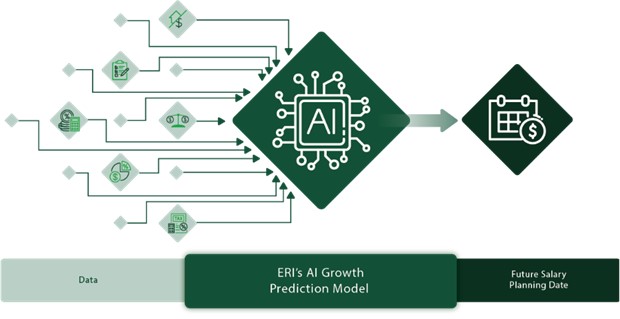
ERI’s AI growth analysis uses cutting-edge transformer architecture built in house to predict compensation changes over time. Traditional methods often rely on simple trendlines or aging factors, which assume that past rates of change will remain consistent into the future. In contrast to traditional methods, transformers excel at capturing complex relationships across diverse data. By training the model on ERI’s licensed salary survey library, including over 35 years of employer-verified compensation data, and pairing those observations with leading economic indicators, ERI can provide compensation results with much greater accuracy than traditional methods.
ERI’s time-series transformer architecture uses the six-digit Standard Occupational Classification (SOC) level as the level of aggregation for the growth model, meaning it provides specific growth rates across 800 job families, as opposed to traditional structure or budget growth models based on only 3 levels (i.e., general employee, professional, and executive). This ensures that every unique job has an accurate growth prediction.
ERI’s approach produces growth projections that are both data-grounded and economically informed. This allows our AI-enabled compensation analysis model to use massive amounts of real-time data to provide a remarkably strong projection of compensation trends in a rapidly changing world. ERI’s next-generation AI Job Growth Model, named “CompAtlas,” is legitimately the most accurate predictor of compensation growth in market rates currently available. In fact, ERI has found that the result is an 83.9% reduction in error, as compared to traditional growth models, when predicting compensation one year into the future.
The Future of AI at ERI
As AI technology evolves, ERI remains focused on responsible implementation, with solutions anchored in research, data integrity, and practical applicability. Every model we build is designed to enhance clarity, consistency, and confidence for compensation professionals.
At its core, ERI’s AI strategy is about augmenting expertise with workforce intelligence by combining decades of compensation knowledge with modern AI innovation to solve real-world problems with accuracy and insight.
To learn more about ERI’s ground-breaking AI Job Growth Model, please try a free demo of the Assessor Platform or sign up for a guided tour of ERI’s AI-powered features today!