For over 35 years, ERI has utilized the latest technology and statistical methods to automate compensation tasks to save subscribers time and money. At ERI, our approach to artificial intelligence is rooted in practical solutions that solve real world challenges. We have initiatives in three areas: reducing time spent on repetitive tasks, improving data accuracy, and enhancing decision-making in complex compensation work.
Our philosophy is simple: AI should make professionals more effective and strategic. It should amplify expertise, ensure consistency, and uncover insights that would otherwise remain hidden in data. To this end, ERI has developed a suite of AI-powered tools, including an innovative AI Pay Grade Creation tool, to help HR professionals efficiently and accurately manage compensation.
What Are Pay Grades?
Pay grades, also known as salary grades, are used within a salary structure and support defining the job hierarchy within an organization, typically based on several factors, including market competitiveness, internal equity, job content, experience, and education.
How Are Pay Grades Determined?
An organization’s salary structure(s) will typically include the lowest-paid job up to the highest-paid job within a structure (e.g., exempt, nonexempt, executive, sales, etc.). The salary structure can even include the entire organization. The structure is then divided into pay grades to support managing the organization’s hierarchy of jobs and to ensure market competitiveness. The number and range of pay grades within a structure can vary considerably, from 1 up to 25 pay grades or even more. For example, a small organization or an executive team might have just 5 pay grades, whereas a large organization with 8,000 employees might have 25 pay grades. Generally, pay structures with more than 10 pay grades are considered a narrow-graded pay structure, while those with fewer than 10 are considered a broad-graded pay structure.
A market pricing or formal job evaluation process will typically determine the midpoint and pay grade for the job. Government agencies, as well as many for-profit and nonprofit organizations, often use a salary structure that includes pay grades to determine how each job should be paid. Market pricing of jobs is the most effective way to establish a salary structure with fair and competitive midpoints for each pay grade. Salary ranges within a pay grade are commonly 40-50% in width, but they can be as narrow as 30% or as broad as 80% or even more. Executive positions commonly have wider ranges, while operative or production jobs tend to have narrower ranges. Some industries will even use broad pay bands without pay grades. The percent difference between salary range midpoints, representing the market value of jobs, commonly increases between nonexempt and exempt salary structures.
Who Should Use Pay Grades?
Salary structures with pay grades can be used in any job, job family, job type, or organization. They are typically found in the public sector, private sector (including for-profit and nonprofit organizations), and unionized work.
Why Do Organizations Use Pay Grades?
Pay grades will support an organization in establishing the hierarchy of jobs, fairly and competitively deliver employee pay, and motivate employees with the perception of growth and opportunities for development. Not all jobs can lead to promotions or transfers, so pay grades may increase an employee’s salary even while performing the same job.
Pay grades play a crucial role in determining short- and long-term incentive compensation eligibility. For instance, employees in grade 6 may be eligible for an annual incentive plan with a target of 10% of base pay. This information is vital for managing new hire compensation, performance pay increases, promotions, transfers, and even demotions, providing a comprehensive view of the compensation landscape.
How Can ERI’s AI Pay Grade Creation Tool Support Enhanced Decision Making?
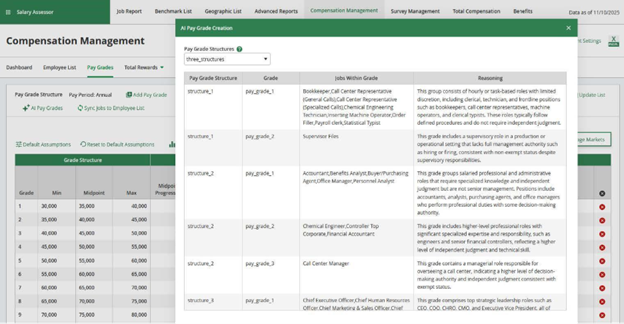
Creating and administering pay grades and structures within an organization is an advanced and challenging task for compensation professionals. Instead of relying on weeks of manual data review, ERI’s smart tool analyzes job titles, pay levels, and job hierarchies to generate complete, review-ready pay grade frameworks.
ERI’s AI Pay Grade Creation tool simplifies and accelerates the creation of compensation frameworks by transforming raw employee data into fully formed pay grade structures. Built on decades of research into how leading organizations define and manage job hierarchies, the tool analyzes titles, compensation levels, and experience requirements to determine the appropriate number of pay grades and how jobs should be grouped within them. Using established compensation principles, this tool identifies logical progressions between roles based on scope and pay patterns, which ensures that the resulting structure reflects widely adopted best practices.
Additionally, users can evaluate multiple compensation philosophies simultaneously, apply consistent logic across hundreds of roles, and receive a set of complete, review-ready pay grade frameworks. The tool also provides clear explanations for each grouping, making it easier to align stakeholders and communicate decisions with confidence. Rather than manually reviewing job titles to identify compensation patterns, teams receive a data-backed structure that is ready for adjustment and implementation.
The Future of AI at ERI
As AI technology evolves, ERI remains focused on responsible implementation, with solutions anchored in research, data integrity, and practical applicability. Every model we build is designed to enhance clarity, consistency, and confidence for compensation professionals.
At its core, ERI’s AI strategy is about augmenting expertise with intelligence by combining decades of compensation knowledge with modern AI innovation to solve real-world problems with accuracy and insight.
To learn more about ERI’s AI Pay Grade Creation tool, please try a free demo of the Assessor Platform or sign up for a guided tour of ERI’s AI-powered features today!