Equality between men and women as it pertains to equal pay has been a fundamental principle of the European Union (EU) since the Treaty of Rome of 1957, which established the European Economic Community (EEC). Since 1957, a number of EU laws have sought to clarify and expand the principle of gender equality to include working conditions, social security, access to goods and services, work-life balance, maternity protection, parental leave, and equal treatment in work in a self-employed capacity.1 However, according to a recent report by the European Commission, “A Union of Equality: Gender Equality Strategy 2020-2025,” the EU still has a 15.7% gender pay gap.2
In an effort to close the gender pay gap, the European Union recently adopted a new law, Directive 2023/970, to specifically address pay equity and transparency. According to the Official Journal of the European Union, the purpose of Directive 2023/970 is “to strengthen the application of the principle of equal pay for equal work or work of equal value between men and women through pay transparency and enforcement mechanisms.”3 Directive 2023/970 was adopted in 2023 with a three-year implementation period ending on June 7, 2026, with companies obligated to report for the entire period of 2026. This means that employers in EU member states need to have the required systems and processes in place by January 2026 to comply with the reporting requirements.4 This article will outline the main points of the EU Pay Equity and Pay Transparency Directive so that HR and compensation professionals can prepare and take the necessary steps toward compliance.
What Is the Objective?
The goal of Directive 2023/970 is to end gender-based pay inequity by mandating greater transparency in salary structures and improving employee access to pay information.
What Is the Scope?
The Directive applies to both public and private sector employers and covers all individuals in an employment relationship under national law in the EU, including part-time, fixed-term contract, temporary employment agency, and digital platform workers, often known as workers in the “gig economy.” In addition, the Directive seeks to improve the rights of job applicants during the recruitment process.5
Key Transparency Measures
The Directive seeks to increase transparency in pay structures and improve employee rights to access compensation information, including candidates applying for jobs. While the specific legal requirements of the Directive should be reviewed carefully for compliance, here are the key transparency measures to consider:
Pay Transparency before Employment
Employers must disclose the initial pay or pay range for a position to candidates prior to the interview or job offer stage to encourage transparent negotiation. Also, employers cannot request current or prior salary amounts from candidates. Job titles and job advertisements must also be gender neutral.5
Transparency in Compensation Structures
Employers must provide employees with the criteria used to establish pay levels and pay progressions. This does not entail disclosing individual pay information for specific employees; rather, companies are obliged to provide accessible statistical data on compensation structures based on gender-neutral and objective criteria for progression, such as skills, seniority, results, and impact.4
Employee Rights to Information
Employees can request details on their individual pay levels and average pay levels for their category of work (i.e., those performing the same or equivalent work) broken down by gender. Employers have up to two months to supply this information after the request has been submitted.5
In addition, employers can no longer impose confidentiality clauses regarding employee compensation. Employees cannot be discouraged from sharing their pay information, but disclosure must be specifically for the purpose of enforcing equal pay rights. Keep in mind that these requirements must also comply with EU data protection legislation.4
Reporting Obligations
Companies with 100 or more employees are required to publish data on gender pay gaps, including (but not limited to) data on overall and median pay gaps, variable pay, the proportion of women and men in each pay quartile, and the gender pay gap within each category of work. If unjustified gender-based pay disparities exceed 5% within any worker category, then they must be rectified within six months. Otherwise, employers are obligated to conduct a joint pay assessment with employee representatives to pinpoint the causes and implement corrective action plans.
The reporting requirement timelines vary by organization size:
- Employers with 100 to 149 employees: reporting every three years from 2031
- Employers with 150 to 249 employees: reporting every three years from 2027
- Employers with 250 or more employees: annual reporting from 2027 5
How Can ERI Help You Achieve Equal Pay?
Organizations of all sizes can turn to ERI’s Assessor Platform to develop transparent, data-driven pay structures. Our robust salary survey database provides the current market data that you need to benchmark jobs accurately, set consistent pay ranges, define pay grades and easily export customized reports that clearly communicate the criteria for your pay decisions, such as years of experience, level, organization size (revenue, assets, number of employees, or fiscal year budget), skills, certifications, shift differentials, and much more.
In addition to providing the data and analytical tools needed for transparent benchmarking, ERI’s Compensation Management solution includes tools specifically designed to address internal pay equity, including gender-based pay gaps. Subscribers can use the Pay Equity tool to comb through a selected Employee List and compare pay for members of a protected group, such as gender, to identify differences in base salary, incentive, or total cash compensation based on job title or another control variable, such as department, location, seniority, grade, education, performance, or hire date. Users can easily export Pay Equity reports to share findings and follow up with action plans to resolve any unjustified pay disparities. After implementing any corrective actions, the platform makes it easy to update Employee Lists with new compensation information so that subscribers can rerun Pay Equity audits and check that all gender-based pay gaps have been resolved.
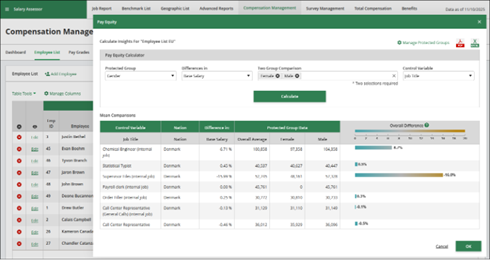
Use ERI’s Pay Equity tool to identify gender-based pay disparities.
References:
- “Equality between Women and Men.” EUR-Lex, Publications Office of the European Union, 3 Oct. 2021, eur-lex.europa.eu/EN/legal-content/glossary/equality-between-women-and-men.html.
- European Commission, Directorate-General for Justice and Consumers. “Communication from the Commission to the European Parliament, the Council, the European Economic and Social Committee and the Committee of the Regions. A Union of Equality: Gender Equality Strategy 2020-2025.” Document 52020DC0152, EUR-Lex, Publications Office of the European Union, 3 May 2020, eur-lex.europa.eu/legal-content/EN/TXT/?uri=CELEX:52020DC0152.
- European Parliament, Council of the European Union. “Directive (EU) 2023/970 of the European Parliament and of the Council of 10 May 2023 to Strengthen the Application of the Principle of Equal Pay for Equal Work or Work of Equal Value between Men and Women through Pay Transparency and Enforcement Mechanisms.” Document 32023L0970, EUR-Lex, Publications Office of the European Union, 10 May 2023, eur-lex.europa.eu/eli/dir/2023/970/oj/eng.
- Pop, Ancuța and Cătălina Șuhan. “Pay Transparency in Practice: What It Means for Companies and Their Executive.” Business Review, 10 Nov. 2025, business-review.eu/business/legal/pay-transparency-in-practice-what-it-means-for-companies-and-their-executives-290716.
- Thenmayr, Florina. “The EU Pay Transparency Directive: How Companies Can Prepare for New Rules on Equal Pay.” Legal 500, 14 Nov. 2025, www.legal500.com/developments/thought-leadership/the-eu-pay-transparency-directive-how-companies-can-prepare-for-new-rules-on-equal-pay/.