Between September 2 and September 29, 2025, ERI conducted a survey of organizational responses concerning artificial intelligence (AI). There were 240 organizations that submitted answers to the survey during that time. The goal of this survey was to identify the changes that organizations are making to their labor and compensation practices, particularly regarding artificial intelligence, remote work, and organizational culture. This paper is one of several that will offer insight into the present impact of these compensation and policy drivers, beginning with AI tools and their implementation. To summarize the results of this portion of the study, ERI’s white paper, Artificial Intelligence and Compensation Strategies – Fall 2025, is organized around three topics: AI expectations, AI implementation, and AI impacts.
This blog post will highlight some of the most salient findings in the white paper, though readers are encouraged to download the complete white paper, which drills down into the survey results in greater detail. ERI’s Artificial Intelligence and Compensation Strategies – Fall 2025 reveals that most organizations continue to be highly optimistic about AI and the benefits that they expect to reap. However, while AI tools are currently being implemented, there is some hesitation around their use for compensation and workforce management. The key findings are summarized below:
AI Optimism in Compensation
Across industries and organizational scope, many are anticipating that AI will benefit their industry, organization, and workforce. This is an upward trend that continues from 2024 and is reflected in the large volume of organizations that intend to implement AI in some way. Among those that do not currently have plans, much of the apprehension surrounding implementation had to do with uncertainty that was either implied or outright stated as expected to be cleared with time. Essentially, for those who might be considered a part of the “AI-hesitant” camp, the general attitude can be summarized as, “AI isn’t in the right place for us yet.” The exception to this is those organizations with significant data privacy and confidentiality concerns or companies that have or necessitate a human-over-AI preference for their work.
High Volume of AI Integration within Compensation Planning
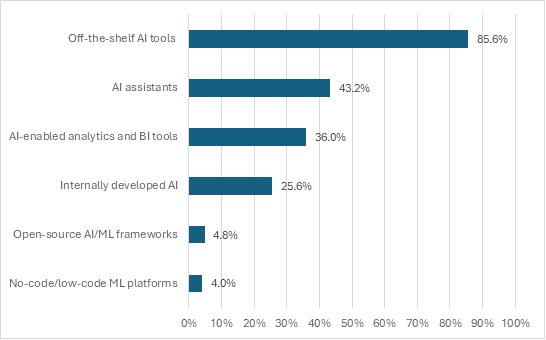
Consistent with their optimism, many organizations – about 77% – are actively using AI in their existing work processes. Most use AI for streamlining rote mundane tasks or otherwise use AI as a supplementary tool for decision making and document analysis. The most common types of tools that are being used are off-the-shelf products, such as ChatGPT, Copilot, or Gemini. These are tools that can be leveraged to accomplish a variety of tasks, however, not every organization has the internal skillset or knowledge base to maximize their utility. Regardless, on average, organizations reported that there have been some improvements in productivity and workload due to AI. However, whether this necessarily aligns with the high expectations for AI’s impact on the organization will need to be investigated further in future studies.
Limited Impact on Compensation Decisions and Job Displacement
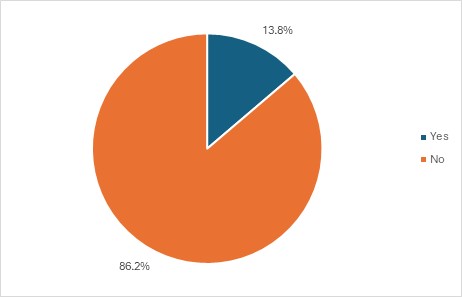
An often-echoed fear among workers is that AI will replace them or, at a minimum, significantly impact their compensation. Currently, though, most organizations are not allowing AI to influence compensation, and very few have removed jobs because of it. However, there does appear to be a small increase from 2024 in those organizations that are doing so. This trend may change as organizations continue to integrate with AI and develop established policies and philosophies for their usage, especially decisions that directly impact their employees. It is worth highlighting that, while AI–driven compensation is generally not being used, some organizations are using AI in other related practices, such as job matching, market research, benchmarking, and even performance evaluations. The extent to which AI is being used as the decision maker versus a supplemental assistant in these processes will be considered for later study.
Minimal Cultural Impact
Beyond the more forward-facing metrics of organizational success, such as productivity and workload, the current study also sought to evaluate how AI’s introduction has shaped companies’ cultural landscapes, specifically, communication and trust. In general, it appears that AI has somewhat improved communication in three different areas: between employees, between leaders and their employees, and between the organization and their customers. At this time, employees’ trust in leadership and the organization is largely unwavering in the face of AI, although this may change with time. It may be important, as well, to consider employees’ and customers’ perceptions of AI, especially for person-to-person interactions. As Kirk and Givi (2025) highlighted in the case of generative AI in marketing communications, people tend to view AI-driven content quite negatively.
Tentative Organizational Trust in AI
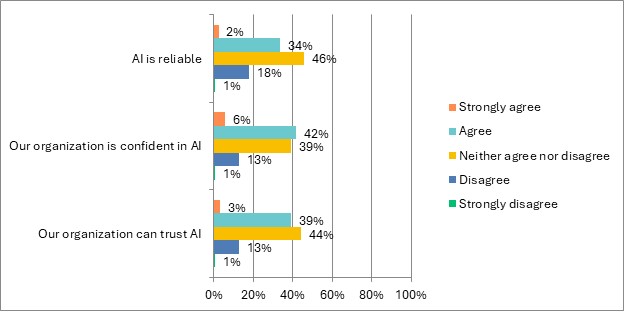
While organizations do have highly positive expectations of AI and continue to integrate it, organizations do appear to have a somewhat low confidence that AI is trustworthy and reliable. This may be a consequence of its limited application, such that organizations do not have a broad enough range of experience with AI to evaluate it affirmatively. Although this does echo the sentiment of hesitation that AI is “not there yet” for some organizations, such as those that cited concerns with privacy, reliability, and consistency. The specific reasons behind this level of trust will need to be examined more closely.
Summary
In summary, many organizations are optimistic and excited about the potential for AI to improve their businesses. AI tools continue to be implemented at high volume while companies see improvements to their productivity. However, this is partly colored by a subtle hesitation, one that often accompanies new technology, that is expressed by limited tool implementation for sensitive processes like compensation and workforce management. As organizations strive to keep abreast of this emerging technology, there appears to be a delicate balance between full throttle integration and healthy skepticism that is pushing many toward a future with AI as a commonplace tool.
To learn more about how ERI approaches artificial intelligence in compensation management to save time, improve data accuracy, and enhance decision making, please download ERI’s recent white paper: ERI’s Focus on AI in Compensation.
References:
Kirk, C.P., & Givi, J. (2025). The AI-authorship effect: Understanding authenticity, moral disgust, and consumer responses to AI-generated marketing communications. Journal of Business Research, 186. https://doi.org/10.1016/j.jbusres.2024.114984