Ways to Prevent Pay Compression

According to Benjamin Franklin, “An ounce of prevention is worth a pound of cure.” It is the prevailing sentiment when it comes to dealing with pay compression – the best way to deal with it is to prevent it from occurring in the first place. Pay compression also referred to as salary compression or wage compression, occurs when there is very little differentiation between the salaries of jobs despite variations in employees’ respective knowledge, skills, and experience. Pay compression can lead to a disengaged workforce and ultimately affect the bottom line negatively. A sense of inequity erodes trust. Pay compression is one of the most pervasive pay issues that can lead to recruitment and retention challenges for an organization. If not prevented or managed as it emerges, pay compression can be difficult to address.

Pay compression occurs when there is only a relatively small difference in pay between employees regardless of skill sets, experience, direct reporting relationships, tenure, and other contributing factors. It may be the result of the market rate for a given job outpacing the increases that incumbents receive, resulting in new hire salaries that are equal to or higher than the salaries of senior professionals. There could be legitimate reasons, such as a hot skill set or technical and niche expertise, but inconsistent pay practices could also be the culprit, enabling pay compression.

If new hire salaries are not vetted by the HR or Compensation team, then salaries may reflect the whims of the hiring manager whose focus is on getting a warm body in the position as quickly as possible, rather than ensuring fairness across the entire organization. When a job is deemed difficult to fill or a position has been open for a long time, recruiters and hiring managers may be focused on filling the role and overlook fit. Perhaps the candidate is overqualified, or the current incumbents are underpaid. Sometimes managers have a candidate in mind and are willing to make exceptions to bring that person on board, regardless of the impact to the existing workforce.

In a union environment, pay compression often occurs. A pre-determined schedule of regular wage increases over the life of a contract, often multi-year, are negotiated and guaranteed. Non-union jobs are often subject to fluctuations in budget and the overall job market. If the minimum wage increases, then those earning at the lower end of the range may receive a higher rate than those further along in the range, who may remain at the same rate, creating more compression issues.

Jobs with a shrinking labor pool but high demand, or jobs that earn overtime and wage differentials, can outpace the salary growth rates of those managing or supervising them. The exempt manager usually has a broader scope of responsibilities without additional compensation for long hours and weekends. This can be demotivating and challenging when the manager is being paid less than those supervised. However, compression may be acceptable in some cases, such as a new manager with very limited experience supervising employees with considerable experience and years of service within the organization.

Pay compression can lead to employee disengagement, regrettable turnover, or even accusations of unfair pay practices. Some employees may even figure out that the only way to get a raise is to quit and reapply. Valued employees may start searching for opportunities that offer more competitive salaries, in which case the company is faced with losing top talent or digging deep to offer the higher salary that was appropriate in the first place.


How to Prevent Salary Compression Issues


There are many ways in which organizations can find themselves in the middle of compression issues; however, the best way to manage and ultimately avoid it is through vigilance, internal controls, and communication. Compensation must be managed consistently and intentionally. The organization’s compensation philosophy and pay practices should be formalized and reviewed for fairness and equity. It should be well communicated to leaders, recruiters, hiring managers, and the entire organization.

An evaluation of all jobs in relation to market survey data, as well as internal equity, should be performed periodically (at least annually) to assist in budgeting for necessary pay range adjustments and salary adjustments, while also anticipating salary needs for key positions. Issues can be identified proactively and brought to Finance for budget considerations. It can also facilitate review of the current salary structures to determine if the market has shifted up or down significantly and if the ranges are in alignment. Do positions need better descriptions to differentiate the work performed? Do the pay rates established in the union contract outpace the salaries of supervisors and, if so, how should this be addressed? Recruiters and hiring managers are great sources of anecdotal data regarding demand for hot jobs or skill sets, as well as hard-to-fill jobs requiring competition for talent. When jobs are benchmarked to other similar roles in the relevant market, an organization can develop new hire pay strategies and regular salary increase processes (merit, equity, or market adjustments) for existing employees. Job offers should be centralized or at least vetted by a compensation professional who can review the offer for overall internal equity impact and compression. Reviewing the impact to peers, direct reports, and similar positions will allow for greater consistency and fairness.

The compensation data should be reviewed in detail. Compare the employees’ position in range or compa-ratio to experience and performance. If a new hire is deeper within the range than a long-term employee, find out the reasons why. Typically, you would expect to see employees with more experience and greater performance to be positioned higher in the range than those just starting out. Look beyond the numbers. Consult with managers and business partners to tell the story that may not be obvious on paper. Once you have determined what the issues are, develop a plan (including projected costs), in conjunction with Finance and approval from senior leadership, to adjust employee pay appropriately. It can be an expensive endeavor, but the cost of not addressing the issues can be even more.

Finally, equip front-line managers with talking points to communicate the plan that addresses pay compression. Morale and engagement are often positively affected by open, honest communication and follow-up. Knowing that the issues are being addressed can encourage the retention of high performers and the longest-tenured employees who may not have received pay increases, giving the organization the opportunity to do the right thing. Employees are aware of who is paid more and who is paid less for the same job. The effort to get pay compression right and prevent further issues is worth the time and effort spent by an organization. Visit SalaryExpert.com for more tips and salary benchmarking tools that you can use to prevent salary compression.

How to Calculate Employee Bonuses

Simply defined, a bonus is additional pay given on top of an employee’s regular pay or base salary.  Companies use bonuses as a means to reward employees who work hard to help reach their strategic goals, as a thank you for a job well done, as recognition of teams for achievement of goals or projects, as a way of motivating employees and boosting morale, to attract candidates, or to maintain competitiveness within the industry. 

The terms bonus and incentive are often used interchangeably; however, the major difference between the two is that most bonuses are discretionary, an addition to salary, and usually paid after the completion of a certain event.  Leaders and managers decide who and how much. Incentives, on the other hand, are non-discretionary and based on the achievement of specific objectives set at the outset of the plan year and communicated to eligible employee participants.  Bonuses look back; incentives look forward.  It is important to make the distinction between the two and use the terms consistently.  A written plan document outlining the plans is helpful in eliminating confusion and avoiding a culture of entitlement.

Different Types of Employee Bonuses

Generally speaking, bonuses are performance-based.  A company distributes them based on how employees contribute to team or company goals.  Bonuses may be distributed at a focal point – quarterly, annually, or on the spot – depending on the type of bonus and the participant eligibility. However, there are several other types of bonuses:

  • Spot Bonus – As the name suggests, a spot bonus is awarded on the spot, when the performance is noted.  It is usually tied to a special project, service beyond the call of duty, or an unexpected contribution to the company’s success. It is an occasional occurrence and could be a small cash award (in the form of a gift certificate), tickets to an amusement park or sporting event, or recognition in the company newsletter. 
  • Referral Bonus – Current employees are often great sources of recruitment, especially for hard-to-fill positions.  A referral bonus encourages current employees to refer great candidates for jobs. It is typically not given until the candidate is hired and has completed the probationary period.  This bonus is most commonly paid as a flat rate.
  • Signing Bonus – This type of bonus provides an incentive for candidates to accept a new role. It is used when an employee is walking away from something (such as in the middle of a plan year that disqualifies the employee for a company bonus or incentive plan), as a form of a relocation package, or to make up for salary demands that cannot be met.
  • Retention Bonus – A retention bonus is offered to entice valuable talent to stay with the company. It can be offered in response to a competing offer and is typically an increase to base salary.  During a merger or acquisition, retention bonuses may be provided to encourage employees to see the company through a period of transition and paid on the backend, after the agreed upon period of time.
  • Commissions – These are considered non-guaranteed compensation and depend upon the employee’s individual performance.  Typically, sales jobs (as well as recruiting and many other jobs) are paid based on a commission structure using a set percentage or formula.  Payment is distributed periodically, as defined by the plan, and when the commission is considered earned. The commission calculation is generally tied to a quota or goal.
  • Annual Bonus – An annual bonus is usually performance-based, involving earnings, revenue, or some other measure that aligns with the strategic goals of the business. The bonus is tied to the organization’s strategic goals and is an incentive to drive performance.  The company’s level of success determines the size of the bonus.  This can also be considered “profit sharing.” Companies wait a full year before payout, and most plans require employees to be actively employed at the time of payout to receive the bonus.  

Depending on the complexity, most performance-based annual bonuses can be calculated with an Excel workbook. A sample plan on how to calculate bonus pay is described below.

QRS Company had a banner year, achieving all of its strategic goals.  The board of directors has determined that a bonus is appropriate for the company employees:

  • Front-line employees will receive a flat dollar amount of $1,500. 
  • Senior leaders will receive 20% of their annual salary, while managers and supervisors will receive 15% and 10%, respectively. 
  • Participation is prorated based on date of hire.  The plan year is based on the annual calendar of January to December 2020.
  • The bonus payout date is January 30, 2021, following the end of the plan year.

For the senior leader (executive) earning an annual salary of $160,000 and hired on 12/15/2019, the calculation is as follows:

ANNUAL SALARY * BONUS PERCENT

or $160,000 * 0.20 = $32,000

There is no need to pro-rate the amount since the executive was hired before the plan year.

The manager and supervisor bonuses are calculated using the same formula and prorated since both were hired within the plan year.  The manager receives 25% (with 3 months of service), and the supervisor receives 67% (with 8 months in the role).

While the front-line employee receives the full flat dollar amount (based on length of service), the bonus may be subject to inclusion in computing the regular rate of pay if the employee is non-exempt.  The DOL Code of Federal Regulations, section 29CFR778, provides details for consideration.

If the company did not perform well, a smaller bonus percentage may be used.  For example, if the company reached 50% of its goals, then the bonuses would be prorated by 50%. 

In summary, spot bonuses are often small cash awards or gift certificates, recognition, or amusement park or sporting event tickets.  Referral and signing bonuses are usually flat dollar amounts.  Retention bonuses can be a flat dollar amount or an increase to base salary.  Commission calculations are tied to the company’s commission structure based on a percentage or formula and can be complicated.  The annual bonus structure and calculation example provided above is straightforward, easy to calculate, and simple to understand; however, the structure can be as complex as the company decides to make it.  Paying employee bonuses is a good way to energize and motivate employees but can have unintended negative consequences. Companies need to develop, and periodically review, a plan document that outlines the details of the bonus – that it is discretionary, what it is based upon, and if and when it will be calculated and paid out.

The Impact of Permanent Remote Work on Salary Data

Employers may have had misgivings about telework before the spread of Coronavirus, misgivings around the ability to effectively manage a remote team, productivity, accountability, or perhaps just a preference for the traditional work setting of a physical office. The COVID-19 pandemic and resulting quarantine thrust us into a unique situation, where work had to somehow continue while the workforce sheltered in place. Flexibility and innovative solutions were necessary responses.

Remote work suddenly became the norm for many organizations and not just technology companies already experienced in successful telework.  As the quarantine continued beyond a few weeks or months and now a year, many employees responded by moving away.  Many decided to move closer to family, perhaps to take care of sick or aging parents.  Some left large metropolitan areas hit hardest by the virus, relocating to the perceived safety of locations with fewer outbreaks.  Still others no longer tied to the physical location of an office left to take advantage of moves to lower cost-of-living locales with friendlier state tax rates, while maintaining their current salaries. Selling a home in a high cost of living area and moving to a lower cost area increased purchasing power (e.g., a larger, less expensive home) while allowing the employee to enjoy lower living expenses.

Now, as we carefully watch the news of the world to determine if we truly are out of the woods, the employees are settling into a new way of working, rather successfully, and companies are responding to this shift by examining their pay policies.  If employees move to a cheaper area, should their salaries be adjusted? Should employees’ pay reflect the geographic location of their residence?  Jobs market-priced in San Francisco or New York typically command higher salaries.  But what happens when those salaries are not reflective of the actual remote locations of employees?  It would demand consideration of not only the geographic location of the workforce (or the base of the company headquarters), but also where the employees reside.

According to a yahoo finance article detailing how a remote work boom will affect salaries, jobs, and where people live, some large organizations like Facebook are taking a close look at localizing salaries based on where an employee lives.  Bloomberg reports how Redfin actually cut salaries for some employees leaving high cost areas to reflect their current residence locations. 

In the traditional sense, location is a big determining factor when it comes to salary ranges because the cost of labor varies so much from place to place. But, with remote jobs, people are often working far away from a company’s office location or, in the case of a fully remote company, there is no office location.  Then there are those employees who work in locations with high cost of living but reside in more reasonably priced locations and endure a longer-than-average commute. Alternatively, some may rent a small apartment near work, while the actual family residence is in a less expensive location.  Traditionally, companies set salaries based on how much similarly qualified and experienced professionals are being paid in the company’s local area, as reported in salary surveys. One argument is that, regardless of whether an employee works from home or in an office, that should not affect the pay range.

Compensation is based on the job. A salary structure is created for each particular job at a particular level, based on the company’s compensation philosophy. Geographic location, as well as company size and industry, are factors considered in setting the ranges. The job commonly has one salary range, no matter where the employee lives. A geographic differential may be applied, based on the location of the branch office in which the job is being performed. Pay is traditionally based on the location of the business unit, not the residence of the employee.

How Does Remote Work Affect Geographic Salary Data?

So how could permanent remote work impact salary data? The simple answer is “it depends.”  It is really too early to tell just how a permanent or at least long-term remote workforce will impact salary data. If companies change salaries to reflect the geographic location of the employee rather than the job, salary data could reflect lower wages in geographic areas once considered high labor cost areas and higher salaries in the areas typically thought of as cheaper to live.  Will salary decisions be impacted by access to a larger labor pool (national) for jobs typically sourced locally?  Will companies adjust pay policies and compensation strategies temporarily or are there long-term implications? We are just coming out of the pandemic restrictions, so will have to wait and see if remote work is truly a permanent solution and what the impact is on the delivery of service, productivity, and costs to the bottom line. 

In the meantime, companies should monitor the impact of the moves, such as changes in state taxes and compliance-related issues.  Are there impacts to local union contracts if workers are in another state?  Are there added benefits costs due to accessing health providers out of network for those outside of the negotiated network of health care professionals? Companies could see an impact to benefits plan design and employer premium costs.  It may be more expensive to provide benefits in smaller, more rural areas.  Is recruitment and retention impacted if salary is adjusted downward based on home address?  Is the company losing candidates?  Has turnover increased as employees look for jobs elsewhere, where their residence is not a factor in establishing pay?  If an employee moves multiple times to different geographic zones, what are the pay implications and when will they occur?  How often or at what percentage will salary be adjusted with the employee’s relocations?

Salary survey providers will need to ask specifically if companies are adjusting salaries (which may impact average salaries reported) based on employees’ home addresses.  Salary surveys consist of data as of a point in time.  Aging factors and predictors for overall salary increases can be mathematically applied to develop a salary range that reflects the current period.  Companies are still in the midst of making policy adjustments for remote work and may not yet know the full impact of such changes to the bottom line. A comparison of year-over-year changes, once available, can be used to provide insight on any unusual or significant trends.

Changes in the cost of labor will occur as compensation changes take effect throughout the nation.  If telework is prevalent, labor costs will gradually increase or decrease by location.  If remote work is only temporary in nature or only implemented by a small number of companies, it will have less of an impact on the cost of labor in the external marketplace.  Over time, the impact on the cost of labor will be reflected in ERI’s Salary Assessor and other external market sources.

Drive Your Salary Planning Strategy Using Salary Survey Data

Whether formalized or not, all companies have a compensation philosophy.  Decisions about how employees are paid, how work is valued, and how much of the company’s financial resources are allocated create a framework for transparency, consistency, and fairness.  Factors such as market, company size, revenue, sales, location, industry, and competition for qualified workers impact the budget for one of the biggest costs of doing business – the labor force.  A salary planning strategy that supports the “why” behind employee pay is key to determining short- and long-term needs. Salary surveys provide a plethora of data that can be used to drive the salary planning strategy. 

Often, formal salary planning is nonexistent or reactionary in nature.  An urgent business need requires creation of a new job, recruitment for a position proves hard to fill, internal compression and equity issues surface, or rapid market movement creates a high demand for a certain skill set or certification.  Survey data are used to address the immediate need without necessarily looking at the downstream impact.  One formal planning strategy is to perform an annual salary review of all jobs using external salary survey data.  Some companies may have the internal resources to perform a comprehensive review of all jobs, while smaller organizations may not.  Whether outsourced or completed in house, a review of all jobs on a regular basis (at least annually) allows for planning and preparation to make timely financial decisions to keep the labor force competitive.

Periodic review begins by comparing internal jobs to external benchmark salary survey data. Salary survey data show how your company fares at a point in time in comparison to other organizations and industries. It is important to pay attention to market changes and stay current because failing to keep up with the competition can lead to the loss of valuable employees. It is a starting point for determining the next steps in deciding how much expense is palatable for sound business sense and economic solvency and to support the compensation philosophy.

ERI’s Salary Assessor provides tools for creating a comprehensive benchmark list of the jobs within a company.  It has the capability for creating hybrid jobs and benchmarking against those, as well.  Additionally, market data are accessible at multiple percentiles, allowing input of actual salaries to calculate the market index or compa-ratio.  Comparisons of base salary, incentives, or total cash compensation based on various pay periods (annual, monthly, weekly, etc.) and relevant years of experience or organization size are available. Reports are downloadable in Excel or PDF format, allowing further detailed analysis and clear documentation. Lists can be saved and used again, with further adjustments as needed.

ERI’s salary planning tools provide the ability to manage employees, analyze data by function, department, or an overall big picture view – whichever is most relevant for your company.  Aging factors to project future needs, data cuts by industry, size, revenue, and location, plus job descriptions including overview and typical functions are all included.  The goal is to accurately determine how competitive your jobs are and what the external market is demanding.  

The Salary Assessor also includes a dashboard and scheduling assistant to walk you through the process of setting up its robust compensation management tool.  Once completed, periodic review is at the ready.  Communicate often with key stakeholders, such as hiring managers, talent acquisition specialists, HR business partners, and senior leadership.  Include them in the review and analysis as a source for future workforce business needs, recruitment issues (such as a limited labor pool or an aging profession), retention issues, turnover (especially turnover of key positions and high potential employees), and fair pay considerations.  Identify areas of rapid growth or stagnation in the market. Solicit specific requests to review based on anecdotal information. While the analytics may tell one story, the company may place a different value on specific jobs that is not necessarily reflected in the survey data. Communication is vital in these analyses, so ERI’s compensation management application includes tools for management review of increases and communication of compensation changes to employees. 

Once the compensation management tool is to set up to reflect the particulars of your organization, hypothetical analyses can be made to determine costs based on different scenarios, such as leading the market, an acceptable lag, or keeping up with the market.  These costs can then be incorporated into the overall payroll budget, and critical decisions can be evaluated for addressing salary needs to support the organizational goals, mission, vision, and compensation philosophy. 

To develop a solid understanding of the current labor force, it is important to have access to reliable salary survey data and also take the time to know and review your jobs, the organization’s needs, and strategic goals. When you have a clear understanding, you can plan better for annual wage increases and improve the overall efficiency of your budget and salary planning process.   Leadership wants to be prepared for gaps in managing the company’s most valuable assets – people.  

Top 10 Highest-Paid Real Estate CEOs in the United States 2021

The real estate industry is defined as companies that focus on selling and buying property either in residential, commercial, or industrial areas. Salaries for CEOs can vary wildly depending on the segment of real estate in which they operate. While compensation for CEOs in this sector can potentially be high, the bottom four CEOs on this list make the lowest total compensation compared to any other top 10 CEOs in other industries.

Below is a list of the top 10 highest-paid CEOs in the real estate industry for the most recent complete fiscal year: 2019. The list is ordered by the highest total pay and not the highest salary. “Other” compensation is defined as total compensation minus salary and includes annual variable cash, long-term incentive awards, pension, and any other compensation awarded in 2019.

CompanyNameTitleSalaryIncentiveLong-TermAll OtherTotal
Prologis IncHamid MoghadamChairman of the Board and Chief Executive Officer$1$1,800,000$28,499,922$83,515$30,383,438
SL Green Realty CorpMarc HollidayChairman of the Board and Chief Executive Officer$1,250,000$3,293,070$16,397,131$49,815$20,990,016
CoStar Group IncAndrew FloranceDirector, President and Chief Executive Officer$792,308$1,666,627$16,837,955$27,650$19,324,540
Equinix IncCharles MeyersDirector, Chief Executive Officer and President$1,000,000$59$15,477,843$97,694$16,575,596
AGNC Investment CorpGary KainDirector; Chief Executive Officer and Chief Investment Officer of the Company and MTGE Investment Corp.$975,000$7,047,000$8,100,000$8,400$16,130,400
Colony NorthStar IncThomas BarrackExecutive Chairman of the Board and Chief Executive Officer$1,000,000$5,448,925$4,641,107$4,866,923$15,956,955
The Howard Hughes CorpDavid WeinrebDirector and Chief Executive Officer$1,000,000$0$1,466,615$11,122,725$13,589,340
CBRE Group IncRobert SulenticDirector, President and Chief Executive Officer$1,000,000$2,415,000$9,999,919$4,500$13,419,419
Welltower IncThomas DerosaChairman of the Board and Chief Executive Officer$1,100,000$3,270,667$8,700,048$71,409$13,142,124
Digital Realty Trust IncA. SteinDirector and Chief Executive Officer$1,000,000$2,428,571$8,607,025$302,104$12,337,700

Looking for more information?

ERI’s Executive Compensation Assessor can show you more detailed executive compensation data.

ERI Economic Research Institute compiles the most robust salary, cost-of-living, and executive compensation survey data available, with current market data for more than 1,000 industry sectors.

ERI’s Assessor Series® – Solutions for every compensation decision.

Top 10 Highest-Paid Utility CEOs in the United States 2020

The utility sector is defined by companies that provide basic necessities such as sewage, water, electricity, and natural gas. Companies in this sector can make a profit but are also heavily regulated due to the necessary nature of the services they provide. CEOs in this sector are well compensated, even if they are not as highly compensated as CEOs in the technology industry.

Below is a list of the top 10 highest-paid CEOs in the utility industry for the most recent complete fiscal year: 2019. The list is ordered by the highest total pay and not the highest salary. “Other” compensation is defined as total compensation minus salary and includes annual variable cash, long-term incentive awards, pension, and any other compensation awarded in 2019.

CompanyNameTitleSalaryIncentiveLong-TermAll OtherTotal
Southern CoThomas FanningChairman of the Board, President and Chief Executive Officer$1,389,616$3,496,675$10,836,513$12,142,381$27,865,185
NextEra Energy IncJames RoboPresident and Chief Executive Officer$1,450,000$4,570,400$14,569,534$1,287,663$21,877,597
Sempra EnergyJeffrey MartinChief Executive Officer and Chairman of the Board$1,200,000$3,027,100$7,727,202$7,852,044$19,806,346
Eversource EnergyJames JudgePresident and Chief Executive Officer and a Trustee of Eversource Energy$1,319,232$3,000,000$6,676,043$8,810,813$19,806,088
Dominion Energy IncThomas FarrellPresident and Chief Executive Officer of Company and Dominion Midstream GP, LLC$1,554,992$7,336,680$5,741,884$2,623,479$17,257,035
Duke Energy CorpLynn GoodChairman of the Board, Chief Executive Officer and President$1,383,750$2,793,389$10,122,579$729,668$15,029,386
FirstEnergy CorpCharles JonesDirector, Chief Executive Officer and President$1,136,113$1,615,111$6,247,802$5,685,633$14,684,659
American Electric Power Co IncNicholas AkinsPresident and Chief Executive Officer of the Company and Subsidiaries$1,475,654$3,600,000$8,775,003$641,779$14,492,436
Entergy CorpLeo DenaultChairman of the Board and Chief Executive Officer$1,260,000$2,416,680$6,674,247$3,913,322$14,264,249
PPL CorpWilliam SpenceChairman of the Board and Chief Executive Officer$1,184,580$2,867,395$5,663,150$4,427,442$14,142,567

Looking for more information?

Detailed executive compensation data can be found in ERI’s Executive Compensation Assessor.

ERI Economic Research Institute compiles the most robust salary, cost-of-living, and executive compensation survey data available, with current market data for more than 1,000 industry sectors.

ERI’s Assessor Series® – Solutions for every compensation decision.

Top 10 Highest-Paid CEOs in the United States

As the highest-ranking person in a company, Chief Executive Officers tend to be the highest-paid executives at any organization. Over the years, total compensation for CEOs has continued to trend up, especially in lucrative industries. Out of the top 10 highest-paid CEOs in the United States, five of them work in the technology sector.

Below is a list of the top 10 highest-paid CEOs for the most recent complete fiscal year: 2019. The list is ordered by the highest total pay and not the highest salary. “Other” compensation is defined as total compensation minus salary and includes annual variable cash, long-term incentive awards, pension, and any other compensation awarded in 2019.

CompanyNameTitleSalaryIncentiveLong-TermAll Other
ViacomCBS IncJoseph IannielloChairman and Chief Executive Officer of the CBS business$2,846,154 $0$37,420,506 $85,167,013
Henry Schein IncStanley BergmanChairman of the Board and Chief Executive Officer$1,458,423 $2,998,027 $96,480,004 $3,184,945
Intel CorpRobert SwanChief Executive Officer and Director$1,227,300 $3,682,100 $61,722,600 $303,100
Advanced Micro Devices IncLisa SuDirector, President and Chief Executive Officer$1,026,442 $1,228,476 $56,264,106 $15,264
Blackstone Group IncStephen SchwarzmanChairman of the Board and Chief Executive Officer$350,000 $0$0$56,723,953
Madison Square Garden Sports CorpJames DolanExecutive Chairman of the Board and Chief Executive Officer$1,000,000 $2,550,800 $49,862,525 $703,166
Palo Alto Networks IncAmit SinghPresident$562,500 $187,500 $46,424,036 $1,718
Pinterest IncBenjamin SilbermannDirector, Chairman, Co-Founder, President and Chief Executive Officer$197,100 $0$45,745,013 $280,000
Discovery IncDavid ZaslavDirector, President and Chief Executive Officer$3,000,000 $21,763,500 $20,405,998 $674,414
CrowdStrike Holdings IncGeorge KurtzDirector, President and Chief Executive Officer$394,039 $600,000 $43,924,017 $11,774

Looking for more information?

Detailed executive compensation data can be found in ERI’s Executive Compensation Assessor.

ERI Economic Research Institute compiles the most robust salary, cost-of-living, and executive compensation survey data available, with current market data for more than 1,000 industry sectors.

ERI’s Assessor Series® – Solutions for every compensation decision.

3 Methods to Determine Pay for Remote Workers

The COVID-19 pandemic has suddenly and significantly increased the number of remote workers across a wide spectrum of jobs and locations. Any job that can be done remotely has been done remotely for many months. While much of the country is in some stage of reopening, many remote workers have been keeping productivity up for several months.

Many companies are opting to keep a remote workforce instead of ushering their employees back into the office during the country’s reopening as workers have maintained or increased productivity. Most noteworthy is Facebook, which plans to move a significant amount of its employees to permanent remote work. They are also considering adjusting compensation as part of this process.  In announcing the move, Facebook stated that in January of 2021 they would adjust employee’s compensation based on “the cost of living in the locations where employees choose to live.”

Turns out there are many different approaches to setting pay. In this blog, we will go over a few methods.  For a more detailed discussion of compensation strategies for remote workers, take a look at our Remote Worker Compensation Strategies white paper.

Cost-of-Labor Approaches

In some ways, a remote worker could be considered a company branch office with the number of employees of that branch office simply being equal to one. Therefore, using compensation methods that apply to branch offices is one option to pay remote workers.

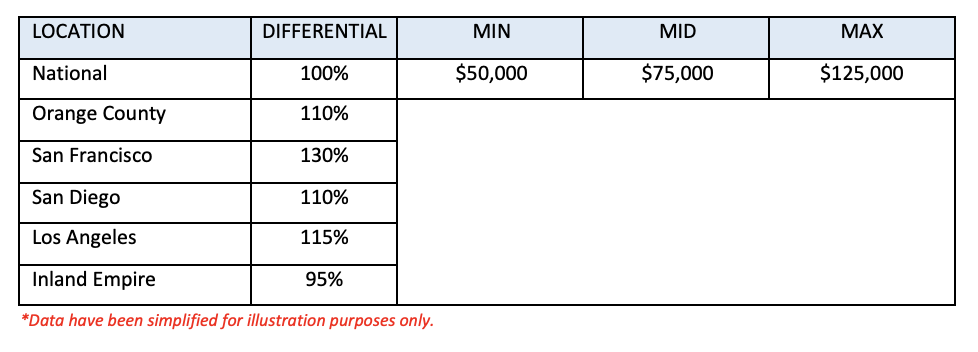
One of the most frequently used methods is to apply geographic pay differentials when adjusting salary structures for branch offices. This takes the completed salary structure for a base location and adjusts it up or down based on the differences of overall local labor market pay rates from the base location to the second location. This cost of labor approach has several advantages, include retaining the same overall pay structure between offices, while fitting those structures to the local pay patterns. 

Bands

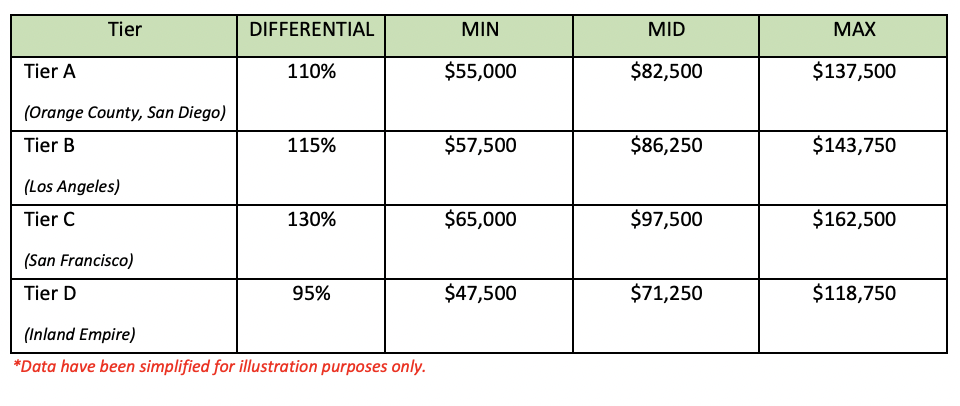
Another method that companies often use with branch office structures is to group locations into bands, or tiers. This way, a range of individual points will fall into a single band, simplifying administration while still matching relatively closely to local labor market conditions. Of companies using geographic pay differentials, almost 80% use some sort of banding, with 5% being the most common (over 25% reported using this width) followed by 10% (over 15% reporting) according to results from ERI’s Geographic Pay Differentials in Practice survey.

Cost-of-Living Approaches

The two branch office methods (geographic pay differential and market pricing using bands) seek to match compensation costs to the local labor market pay rates. Another option, such as that suggested by Facebook, could be to use methods based on cost of living. The cost of living is primarily used in compensation planning for building relocation packages for employees moving from low-cost to high-cost areas. Some differences exist in the application to salaries. But just as it is possible to view a remote worker as a branch office of size one, it is also possible to view the remote worker as a relocated employee.

When relocating employees, one goal is to “keep the employee whole,” at least until they have had an opportunity to adjust their spending pattern to the higher cost location and cost-of-living data are compiled to support this process. This involves a detailed analysis of the employee’s spending patterns – housing situation, family size, and other individual parameters – clearly something that does not need to be done for a salary adjustment.

Implications

Some practical questions arise out of these data. Should remote workers be compensated based on cost-of-labor (labor market differential or market pricing using bands) or cost-of-living differences? Stated differently, does the company want to adjust the salary of the employee to match those with a similar job already in that labor market (cost of labor)? Or does the company want to match (or help retain) the buying power of the employee in the new or remote location (cost of living)? It is important to keep in mind that not every location is equal in terms of affordability (i.e., affordability being buying power, but for a location). Some locations tend to have above-average salaries, but relatively lower cost of living – these are considered more affordable locations. Other locations have the opposite situation.

Remote Worker Survey Results

Another way to view questions related to remote worker compensation is to look at how companies treated remote workers prior to the COVID-19 pandemic. ERI asked a question related to this topic as part of a Compensation Best Practices Survey conducted before March 2020. These were companies that had already established remote worker compensation practices. They can provide some insight into general practices already in place. Results are summarized below:

A screenshot of a cell phone

Description automatically generated

The Geographic Pay Differentials in Practice survey includes more results.

This blog’s intention was to introduce multiple ways of setting pay for remote employees. For more information on the advantages and disadvantages of each method and other aspects to consider when choosing pay levels, download our Remote Worker Compensation Strategies white paper.

Top 10 Highest-Paid CEOs in the Technology Industry

The technology industry is one of the largest industries in the United States and the world — and it is constantly growing. CEOs tend to be the highest-paid executives at any organization; even so, CEO pay in the technology industry is relatively high. Out of the top 10 highest-paid CEOs in the United States, 5 of them work in tech.

Below is a list of the top 10 highest-paid CEOs in the technology industry for the most recent complete fiscal year: 2019. The list is ordered by the highest total pay and not the highest salary. “Other” compensation is defined as total compensation minus salary and includes annual variable cash, long-term incentive awards, pension, and any other compensation awarded in 2019.

CompanyNameTitleSalaryIncentiveLong-TermAll Other
Intel CorpRobert SwanChief Executive Officer and Director$1,227,300$3,682,100$61,722,600$303,100
Advanced Micro Devices IncLisa SuDirector, President and Chief Executive Officer$1,026,442$1,228,476$56,264,106$15,264
Palo Alto Networks IncAmit SinghPresident$562,500$187,500$46,424,036$1,718
Pinterest IncBenjamin SilbermannDirector, Chairman, Co-Founder, President and Chief Executive Officer$197,100$0$45,745,013$280,000
CrowdStrike Holdings IncGeorge KurtzDirector, President and Chief Executive Officer$394,039$600,000$43,924,017$11,774
Microsoft CorpSatya NadellaDirector and Chief Executive Officer$2,333,333$10,796,868$29,668,651$111,363
Uber Technologies IncDara KhosrowshahiChief Executive Officer and Director$1,000,000$2,000,000$37,434,334$1,993,899
Adobe IncShantanu NarayenChairman of the Board, President and Chief Executive Officer$1,000,000$950,000$37,025,873$169,758
L3Harris Technologies IncWilliam BrownChairman of the Board and Chief Executive Officer$2,091,347$5,202,500$22,385,976$1,789,339
Ceridian HCM Holding IncDavid OssipChairman of the Board and Chief Executive Officer$700,000$800,000$28,634,210$46,747

Looking for more information?

Detailed executive compensation data can be found in ERI’s Executive Compensation Assessor.

ERI Economic Research Institute compiles the most robust salary, cost-of-living, and executive compensation survey data available, with current market data for more than 1,000 industry sectors.

ERI’s Assessor Series® – Solutions for every compensation decision

Try a FREE Demo Request a Guided Tour

Top 10 Highest-Paid CEOs in the Health Care Industry

The health care industry is one of the fastest growing sectors of the worldwide economy and consists of businesses that provide medical services, manufacture drugs or medical equipment, provide medical insurance, or otherwise facilitate the provision of health care to patients. Executive pay is relatively high in this fast-paced industry. CEOs tend to be the highest-paid executives at any organization.

Below is a list of the top 10 highest-paid CEOs in the health care industry for the most recent complete fiscal year: 2018. The list is ordered by highest total pay and not highest salary. “Other” compensation is defined as total compensation minus salary and includes annual variable cash, long-term incentive awards, non-equity, stocks, and pension, plus any other compensation awarded in 2018.

  1. Stephen Macmillan – Chairman of the Board, Chief Executive Officer and President, Hologic Inc
    o $1,030,000 in salary: $41,010,142 in additional “other” pay
  2. Joseph Hogan – President, Chief Executive Officer and Director, Align Technology Inc
    o $1,069,231 in salary: $40,689,107 in additional “other” pay
  3. Kent Thiry – Chairman of the Board, Chief Executive Officer and Chief Executive Officer, DaVita Inc
    o $1,300,000 in salary: $30,717,501 in additional “other” pay
  4. Leonard Schleifer – Director, President and Chief Executive Officer, Regeneron Pharmaceuticals Inc
    o $1,330,500 in salary: $25,190,055 in additional “other” pay
  5. Michael Neidorff – Chairman of the Board and Chief Executive Officer, Centene Corp
    o $1,500,000 in salary: $24,622,414 in additional “other” pay
  6. John Milligan – President, Director and Chief Executive Officer, Gilead Sciences Inc
    o $1,581,623 in salary: $24,380,208 in additional “other” pay
  7. George Yancopoulos – Director, President and Chief Scientific Officer, Regeneron Pharmaceuticals Inc
    o $1,130,900 in salary: $24,250,229 in additional “other” pay
  8. Miles White – Chairman of the Board and Chief Executive Officer, Abbott Laboratories
    o $1,900,000 in salary: $22,354,238 in additional “other” pay
  9. Nick Leschly – President, Chief Executive Officer, Bluebird Bio Inc
    o $610,000 in salary: $23,352,220 in additional “other” pay
  10. Alan Miller – Chairman of the Board and Chief Executive Officer, Universal Health Services Inc
    o $1,665,064 in salary: $21,923,819 in additional “other” pay

Looking for more information?

Detailed executive compensation data can be found in ERI’s Executive Compensation Assessor.

ERI Economic Research Institute compiles the most robust salary, cost-of-living, and executive compensation survey data available, with current market data for more than 1,000 industry sectors.

ERI’s Assessor Series® – Solutions for every compensation decision

Try a FREE Demo Request a Guided Tour