
Looking to Benchmark Pay?
Rating Scales
The rating scale is the most common form of rating against a standard. Oftentimes, rating scales are used in conjunction with some other method, usually management by objectives (MBO).
A rating scale defines a number of factors or criteria. The rater appraises the degree for each of these factors that best describes the employee's performance. Ordinarily, the factors and degrees are defined to permit point values to be assigned to each degree statement. Then a total score can be calculated for the employee.
Rating scales may be described as rulers against which employees are compared. A ruler is developed for each factor to be rated. Then each ruler is divided into "inch marks" or degrees. But the analogy should not be carried too far. A ruler is a ratio scale since it contains a zero point. A performance appraisal scale, if well-designed, is an interval scale – a scale whose units (inches, in our example) are equivalent.
Rating scales typically provide a line for each factor, along which the degrees are arrayed in either increasing or decreasing order.
Since rating scales are the most common performance appraisal method used, they have the advantage of familiarity.
Rating Scale Variations
The rating scale approach has a number of variations. We'll examine the following 3 approaches in greater detail:
- Graphic Rating Scale
- Behaviorally Anchored Rating Scale (BARS)
- Behavioral Observational Scale (BOS)
1. Graphic Rating Scale
The most common performance rating scale is the Graphic Rating Scale. Below is an example:
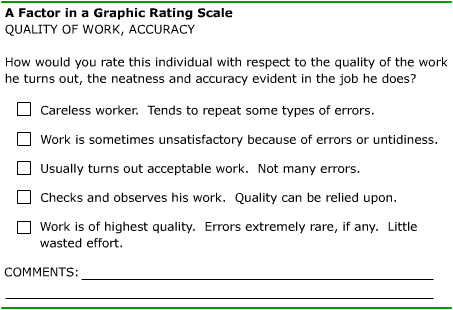
Factors. The factors or criteria used in the Graphic Rating Scale are usually those that are organizationally important in determining performance. A single Graphic Rating Scale is typically used for a variety of jobs within the organization, so the criteria/factors are organizational instead of job-related.
At best, the factors/criteria are outcomes (quantity of work) or behaviors (adaptation to change). At worst they are personal characteristics (good personality).
The degree statements can also range from descriptions (such as those in the example above) to simply a scale from "Most" to "Least" with no explanation of what these terms mean.
Advantages. The Graphic Rating Scale has the advantage of being applicable to most employees in an organization. When well designed, the Graphic Rating Scale provides a clear definition of the criteria the organization considers to constitute "good" performance. This definition enables managers to discuss the relative performance of an employee against a known standard.
Memory Jogger
A Graphic Rating Scale is which type of scale?