
Looking to Benchmark Pay?
Stacked Ranking
A major variation of employee-comparison systems is stacked ranking, sometimes referred to as forced ranking or distribution. Here the rater distributes all employees among finite performance categories, so a prescribed percentage of employees are in each category.
An example of a typical distribution:
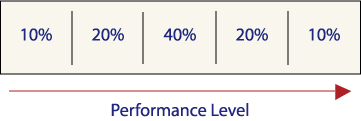
Stacked ranking systems can be set up in various ways. The following is a sample of the way some companies have used the system:
- Top performers – 10%; Middle – 80%; Bottom – 10%
- 1-5 rankings, with most employees between 2.5 – 4.5
- 1-5 rankings (5 is highest ranking) with 15% ranked 5; 5% ranked 1; and various percentages for the 2, 3, and 4 rankings
- Rankings A-C (no ranking lower than a C) with 10% A's, 80% B's, and 5% C's
Stacked ranking may be done globally or for a number of factors. This system assures that employees form a normal distribution in terms of their performance.
Advantages. Stacked ranking is simplistic and accurate in that it is easier to make relative judgments than to make a comparison against a standard. Stacked ranking takes advantage of, instead of resisting, a rater's tendency to make a global judgment.
Disadvantages. Like most employee-comparison systems, stacked ranking falls short in many areas, so much so that many companies have eliminated this practice altogether due to:
- lack of information
- employee comparability
- raters' knowledge
- large organizations
- supervisory expectations
- employees compete against each other
- lawsuits
Lack of information. Other than the ranking itself, there is a definite lack of information to provide a basis for discussion with the employee. Where a global ranking is used, there is no agreement as to what the appropriate criteria are. Stacked ranking provides a standard, but it is the group average. This offers little help to the manager, who needs to discuss performance with an employee.
Employee comparability. A disadvantage shared by all employee-comparison systems is that of employee comparability. This has two aspects:
-
Are the jobs sufficiently similar?
-
Are employees rated on the same criteria?
It is likely that one employee rates high for one reason, and another rates low for an entirely different reason.
Raters' knowledge. Raters do not always have sufficient knowledge of the employees being rated. Normally the immediate supervisor has this knowledge, but oftentimes in large ranking systems, supervisors two and three levels removed have to do the rating.
Large companies. The size of the organization poses a problem. The larger the employee group to be ranked, the harder it is to do so. However, a larger employee group makes a normal distribution more logical.
Supervisor expectations. If a manager knows that some employees must be rated below average, he/she may start thinking of those employees that way. This leads to a self-fulfilling prophecy: the manager now treats the employees as if they cannot do well, and the employees respond by not doing well.
Employees compete against each other. Rather than working cooperatively, stacked ranking encourages employees to work against each other even to the extent that they sabotage each other’s efforts.
Lawsuits. Employees of Microsoft, Ford, and Conoco filed lawsuits alleging that the forced-ranking systems used by their companies were biased against certain groups. In each case, the disaffected employees represented a different group of workers: U.S. citizens at Conoco, African Americans and women at Microsoft, and older workers at Ford.
Exercise Question
Employee comparison systems reduce: