
Looking to Benchmark Pay?
Performance-Reward Connection
For pay-for-performance to be effective, there must be a connection between pay and performance. This is easy to say, but difficult to achieve. Organizations are complex social systems whose members are subject to many influences on their performance at any one time. To isolate a simple pay-performance connection is not possible. A number of these influences increase the complexity of the connection. For example:
- multiple goals
- employee perception
- performance appraisal
- employee acceptance
Multiple goals. Compensation programs try to achieve a number of things at the same time and these different goals are often in conflict with one another, such as revenue growth and profitability attainment.
Employee perception. Even if the program does connect pay with performance, employees must perceive the connection. A simple, well-designed, well-managed, transparent, and well-communicated program will increase the employees’ perception and trust of performance management within an organization.
Performance appraisal. Pay-for-Performance is only as good as the organization’s underlying performance management program that defines "good performance.” A perception that the program is biased or does not appraise actual performance destroys the connection for the employee. (We’ll discuss reliable performance appraisal methods later in this course.)
Employee acceptance. Management and employees may not agree on performance ratings or even stack rankings. Companies take pride in hiring the best candidates in the labor market. Yet, they then create a forced distribution curve, or stack rank, to weed out employees. This creates a serious complication. In fact, many companies are eliminating stack rankings, and some are even eliminating performance ratings altogether since they can inappropriately label employees.
Normal Distribution Example: Organizations often evaluate employee performance on a normal distribution bell-shaped curve. In the normal distribution below, the bulk of employees have average performance and fall in the middle of the curve.
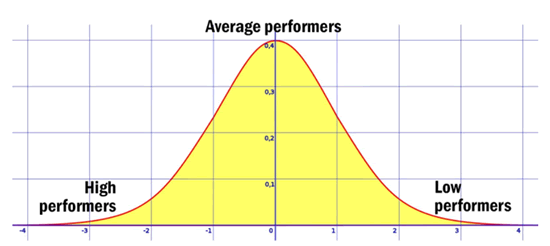
Normal Distribution
Yet oftentimes, employees believe their performance is much higher. In a high-performing organization with best-in-class employees, it can be challenging to manage to a bell-shaped curve. In fact, many will manage to realistic performance ratings of the workforce, very slightly skewed to recognize higher performance.
Highly Skewed Distribution Example: A highly skewed distribution curve represents an over evaluation of team members.
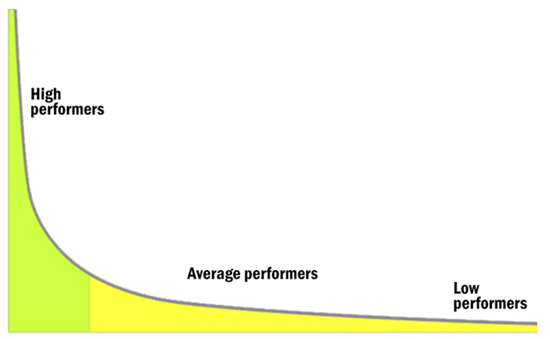
Skewed Distribution
Performance-Effort Connection
Employees must perceive that their efforts are reflected in their performance ratings.
A pay-for-performance program assumes that performance varies among employees and that this difference is observable. But in many jobs, variation is impossible or is so little that it is unrealistic to try to measure it for pay purposes. Even if there are differences, measuring or attributing the differences to employee effort may be difficult. For instance, it may not be possible to separate the efforts of an individual in a group project from the efforts of the other members of the group. Employees may not feel that they control the important measures of performance. Teachers, for example, realize that for them the important measure is student learning, but teachers feel only minimal control over that variable.
Pay-for-Performance Won't Solve All Problems
Pay-for-Performance is not a solution for all motivation and performance problems in organizations. Pay-for-Performance can be extremely effective where the requirements of expectancy theory are met. The program should be reviewed each year to ensure it continually meets the organization’s needs.
Memory Jogger
The fact that most people feel that their performance is above average becomes a problem when establishing: