
Looking to Benchmark Pay?
Multiplying Fractions
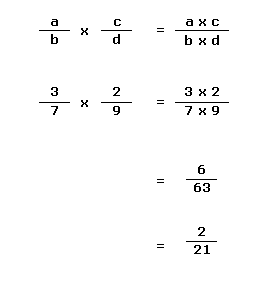
Multiplying fractions is simpler than adding and subtracting as there are no requirements regarding equal denominators. All that is required is multiplying the numerators and multiplying the denominators.
Multiply 3/7 by 2/9:
Compound interest
The compounding of interest refers to the common savings account approach, which permits the following increases:
- Year 1: Interest is earned on the sum deposited. For example, at a 4% annual return rate, $10,000 would earn $400 in interest the first year.
- Year 2: If the interest is left in the same account, then interest is earned on the original sum deposited (i.e., $10,000) and on the previous year's interest (i.e., $400 more). At 4% annual return rate, the $10,000 would still earn $400 in the second year, and the $400 interest from the previous year would earn an additional $16. This makes a total of $416 in interest earned in the second year (compounding of interest). You would have a total of $10,816 at the end of the second year.
- Year 3: This process continues, indefinitely provided the accumulated interest is left in the same account. In the third year, the $10,816 would earn 4% interest.
Future value
Future Value (FV) computation can be used to calculate compound interest:
FV = P x (1 + r)n
Where P is the principal or initial investment, r is the interest rate, and n is the number of years since the initial investment.
FV = ($10,000) (1 + 0.04)2
FV = $10,816
Therefore, if you make an investment of $10,000 today, the interest rate is 4%, and this interest is compounded annually, you can expect to receive $10,816 in principal and interest at the end of the second year.
Example
Currently (2011), and the average BA starting salary is $30,000.* You predict these starting salaries will increase at a rate of 3% per year. Determine the starting salary for a BA 13 years from now.
FV = P (1 + r)n
FV2025 = $30,000 (1 + 0.03)13
FV2025 =$30,000 (1.03)13
FV2025 =$30,000 (1.47
FV2025 = $44,100
The estimated starting salary for a BA graduate would be $44,100 in 2025.
*Value used for illustration purposes only.
Memory Jogger
You are considering a project that will require an initial investment of $250,000. You expect the project to have an annual return rate of 22%. What would be the value of this project at the end of 6 years? Assume that all proceeds are re-invested.