
Looking to Benchmark Pay?
Statistical Tests
A common problem for statistical inference is to determine, in terms of probability, whether observed differences between two samples signify that the two populations sampled are themselves different. A statistical test allows you to deduce the reality from a limited amount of data. It provides a mechanism for making quantitative decisions by testing a hypothesis.
There are two basic types of tests: parametric and nonparametric tests.
Parametric tests
These tests utilize assumptions that a sample's observations display:
- Homogeneity of variance (data within each of the populations have approximately equal variance)
- Independence (data randomly and independently sampled from the population)
- Normal distribution (no extreme outliers)
By definition, parametric tests can’t use nominal or ordinal data.
Nonparametric tests
These tests make no assumptions about the distribution of the parameters - the data distribution is not normal - but DO make assumptions about the observations.
These tests utilize assumptions that a sample's observations display:
- Homogeneity of variance (data within each of the populations have approximately equal variance)
- Independence (data randomly and independently sampled from the population)
Graphically, statistical tests can be illustrated as shown below:
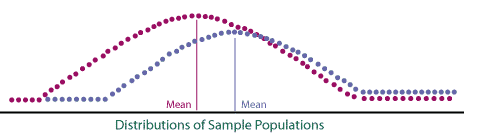
Q. Are the means and distributions of the two samples similar?
A: The parametric test used to test the equivalence of two means assumes that the populations are both normal AND have equal variances. If the distributions are not similar, a parametric test in many cases CANNOT detect mean differences when, in fact, they exist.
Example of statistical tests
Q: Would you expect a salary survey to be normally distributed?
A: No! There are always underlying minimums. For example, supervisors are always paid more than those they supervise. Also, there may be high salaries that are anomalies.
Memory Jogger
Which type of test assumes that a sample's observations are normally distributed?