Looking to Benchmark Pay?
Populations
In surveys or analyses, the universe of observations of interest to a Human Resources manager is generally called a population. The characteristic that defines the population is called the parameter.
Example: In a survey, we might be interested in a population of all jobs in all companies in an industry. The parameter with which we would be concerned might be salary.
Any summary measure of a population is called a parametric value. For instance, the average salary for all clerks in the industry: "clerks' average salary" is a parametric value.
Since administrators are concerned with the general applicability of their findings, they are concerned with statements they can make about a total population. For example, only 4 of 10 companies may have agreed to participate in a survey. This would have a great deal of impact on the applicability of the results to the entire population.
Making valid inferences about populations is the highest order of generalization possible.
In most cases, however, a population CANNOT be examined in its entirety:
- The population may be infinite.
- It may be such a large finite population that it is impractical to handle all possible observations.
- You may not receive the necessary cooperation.
The researcher then must take a shortcut consisting of approximating the population by studying a sample of observations from that population.
Samples
Sampling consists of obtaining observations on a restricted number of events that comprise the entire population.
| Sample | A finite portion of the population. |
|---|
There are a number of ways in which samples may be obtained.
Random sampling. The most common form is random sampling. Random sampling is the process that assures that no single observation selected for inclusion in the sample is favored over any other observation. Each observation in the population has an equal chance of being included in the sample. When one or another observation is favored for inclusion in the sample, the sample is no longer considered random and is not representative of the population; it is then said to be biased.
Sampling constitutes the essence of survey methodology.
A good sample will have zero or low bias and a quantifiable degree of random error.
Other sampling methods include:
- Cluster sampling: The population is divided into groups (usually natural or logical) Entire groups are selected and sampling is done on each group (e.g., neighborhoods).
- Snowball sampling: Each person surveyed provides the next set of names.
- Convenience sampling: Only the most available (or most accessible) people are surveyed.
These methods tend to be biased.
Example of sampling
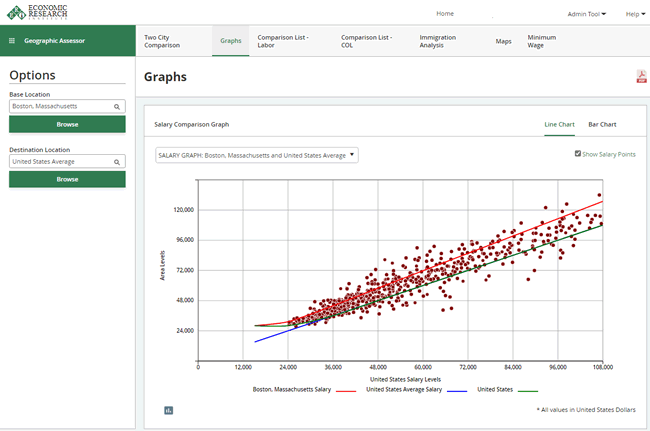
An example of a collection of samples can be found in ERI's Geographic Assessor® software, as shown below. This software calculates salary comparisons and cost-of-living comparisons based upon your selection of two cities within the U.S., Canada, Europe, Asia, Oceania, or Latin America. It is useful for setting branch office pay and planning facility relocations. The scattering of dots below represents positions surveyed by the U.S. Government's OEWS surveys. If you float your mouse over a dot, the source data will be revealed. You can see how trend lines can be drawn based upon this sample data.