
Looking to Benchmark Pay?
#6: What is the Margin of Error?
All techniques or measures have some error or, as it is called, a margin of error.
Since you cannot be 100% certain that any one observation represents the "true" value, statisticians develop a confidence interval. In other words, a range is computed for the observed value that should include the "real" value 90 - 95% of the time.
To determine this range or confidence interval, the standard deviation of the value must first be computed.
| Standard deviation | A measure of dispersion of a set of data from its mean. The standard deviation is defined as the square root of the variance. |
|---|
The standard deviation tells you if the difference in measurements that you are looking at is small or large. If the difference is large, that means there is a lot of variability in that set of data, and it may not be reliable to use.
Standard deviation (s) is defined as:
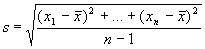
Another way to write the above equation would be:

| x1, xn, and xi | observations |
| μ | mean of the population |
| n | sample or population size |
To learn more about computing standard deviations, see ERI Distance Learning Center Course 49: Regression Analysis Used in Compensation Administration.
O*NET reports no standard deviation
O*NET does not publish, by occupation, the standard deviation of its work measurements.
Is there a known or potential rate of error?
This is one of the four questions asked in a Daubert challenge in court to determine the reliability of a technique. Without a measure of the standard deviation this question cannot be answered.
eDOT reports standard deviation online
Unlike the old DOT, eDOT contains a record of the "margin of error" for each job characteristic measure.
Required specifically by Daubert Court challenges, this rate refers to the standard deviation from the collection of job analyses data at the field audit level.
Example: 10 field auditors measure the same job:
- 7 state a job requires heavy lifting 2/3 of the time
- 2 record 1/3 of the time
- 1 reports "none"
In this case, the standard deviation is 0.70 for a reported measure of 2/3.
x̄ = [7(3) + 2(2) + 1(1)]/10 = 2.6
n = 10
s = [(7(3 -2.6)2 + 2(2 - 2.6)2 + 1(1 - 2.6)2)/9] 1/2
s = [(7(0.4)2 + 2(-0.6)2 + 1(-1.6)2)/9] 1/2
s = [(7(0.16) + 2(0.36) + 1(2.56))/9]1/2
s = [(1.12 + 0.72 + 2.56)/9]1/2
s = [4.40/9]1/2
s = [0.4889]1/2
s = 0.6992
The eDOT software will report the standard deviations, means, and modes for each recorded measure.
Because eDOT makes its raw data available to the public and because its standard deviations can be reproduced, its findings should hold up in court.
Exercise Question
Which of these 3 sources publishes a standard deviation useful in a Daubert Challenge?