
Looking to Benchmark Pay?
eDOT measures are based on the DOT
Because eDOT uses most of the same measures as the original DOT, its construct has been tried and tested in thousands of court cases since 1939.
eDOT:
- always measures the job, not the incumbent
- asks for specific job requirements
- uses traditional defined DOT scales throughout
- uses simple and direct descriptors
Example: In eDOT, strength is described in "pounds of force," a measure that most of us understand and appreciate.
Finally, unlike O*NET, eDOT never skips measures. If they are not required, eDOT rates them as Level 0.
Let's compare...
Perhaps the best way to understand the difference between the O*NET and eDOT measures is to compare them directly.
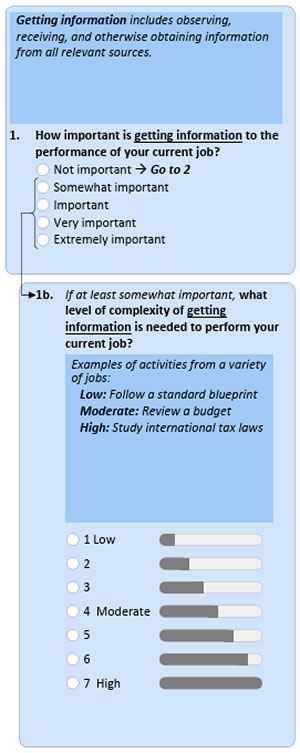
For reading comprehension (reading in this question being just one of several possible ways to get information), the O*NET asks:
| 1. Getting Information |
Observing, receiving, and otherwise obtaining information from all relevant sources. |
|---|
eDOT, on the other hand, uses this question:
Reading Vocabulary - What level best typifies the reading vocabulary you need to learn and/or perform the essential job functions or duties of your job?
- Reading is not needed to perform the duties of this job.
- Education sufficient to read and understand at a vocabulary level approximately 2,500 two- or three-syllable words. Reading speed of 95-120 words per minute, limited vocabulary. (horse exerciser, show girl, dining room attendant, cook's helper, tree planter, sandblaster, general laborer, assembler production line)
- Education sufficient to read and understand at a vocabulary level approximately 5,000 to 6,000 words. Reading speed of 190-215 words per minute. Examples of level are adventure stories, comic books, instructions for assembling model cars and airplanes etc., looking up unfamiliar words in dictionary for meaning, spelling, and pronunciations. (secretary, mail clerk, roofer, dock hand)
- Education sufficient to read and understand at a vocabulary level which involves a variety of materials at a level equivalent to encyclopedias, methods and procedures in mechanical drawing and layout work, instructions in the use and maintenance of shop tools and equipment, novels, magazines, atlases, and safety rules, etc. (videotape operator, tug boat captain, word processing machine operator, payroll clerk, telephone operator, farm equipment mechanic)
- Education sufficient to read and understand at a vocabulary level which involves a variety of materials at a level equivalent to periodicals, journals, manuals, dictionaries, thesauruses, and encyclopedias. (drafter, manager land survey, dental hygienist, budget analyst, art appraiser, airplane pilot, secretary)
- Education sufficient to read and understand at a vocabulary level which involves a variety of materials at a level equivalent to: scientific and technical journals, abstracts, financial reports, legal documents, and literature, books and play reviews. (electrical engineer, chemist, computer programmer, school psychologist, dentist, pharmacist, school principal, technical writer, investment analyst, city manager)
- Education sufficient to read and understand at a vocabulary level which involves a variety of materials at a level more advanced and complex than the previous statements. (architect, mathematician, surgeon, lawyer)
eDOT then makes its rating on the following scale of General Education Development (GED):
| 06 | Same as Level 5. |
|---|---|
| 05 | Reading: Read literature, book and play reviews, scientific and technical journals, abstracts, financial reports, and legal documents. |
| 04 | Reading: Read novels, poems, newspapers, periodicals, journals, manuals, dictionaries, thesauruses, and encyclopedias. |
| 03 | Reading: Read a variety of novels, magazines, atlases, and encyclopedias. Read safety rules, instructions in the use and maintenance of shop tools and equipment, and methods and procedures in mechanical drawing and layout work. |
| 02 | Reading: Passive vocabulary of 5,000-6,000 words. Read at rate of 190-215 words per minute. Read adventure stories and comic books, looking up unfamiliar words in dictionary for meaning, spelling, and pronunciation. Read instructions for assembling model cars and airplanes. |
| 01 | Reading: Recognize meaning of 2,500 (two- or three-syllable) words. Read at rate of 95-120 words per minute. |
| 00 | Unable to Read, not necessary to read. |
Exercise Question
In comparing O*NET measures to those of eDOT, you will find that: