How to Design a Total Rewards Strategy

Designing a Total Rewards Program to Retain Top Employees

We all know that attracting top talent and retaining the best employees is vital for your business to grow and have long-term success. With everyone competing for top talent, it is important to make your organization stand out and appeal to the right employees. One way to do this is to design a robust total rewards program that attracts, retains, and motivates employees to do their best 

A total rewards program refers to the complete package of both monetary and non-monetary compensation and benefits that an organization can offer to their employees in exchange for their skills, expertise, and contributions. Some incentives that you can offer employees include competitive compensation, career growth opportunities, benefits, work-life balance, and a positive work environment.  

Benefits of Building a Total Rewards Compensation Package 

Providing a competitive total rewards package heavily influences whether a potential employee takes the job or not. Building a robust total rewards package has many benefits: 

  • Attract highly qualified employees: When an employee decides whether to accept a new job, they look not only at compensation, but also at the benefits, development, and work environment offered. A total rewards package that meets the needs of employees will appeal to a broader demographic and lead you to the right hire. 
  • Stay competitive: A robust total rewards package makes organizations more competitive within their industry, allowing them to find the best employees.  
  • Cultivate a positive and engaged workplace: An effective total rewards package enables an organization to improve business performance by building a motivated and engaged workforce. Employees are more likely to stay long-term and do more for the company if they feel like they are recognized and valued. 
  • Reduce recruitment and training costs: The more robust your rewards package is, the more you can attract highly qualified employees, reducing the need for additional recruitment efforts and initial training. 
  • Maintain a high employee retention rate: With careful planning, an effective total compensation package can reduce turnover. When a compensation package is up to an employee’s standards, the employee is more likely to stay at the company longer. 
  • Remain flexible: One benefit of building your own rewards program is that it can be completely customized to your organization’s needs, and benefits can vary depending on employees. For instance, earning a commission does not apply to all roles. Usually someone on the sales team may earn commission if they make a sale. 

What to Include in Your Total Rewards Package

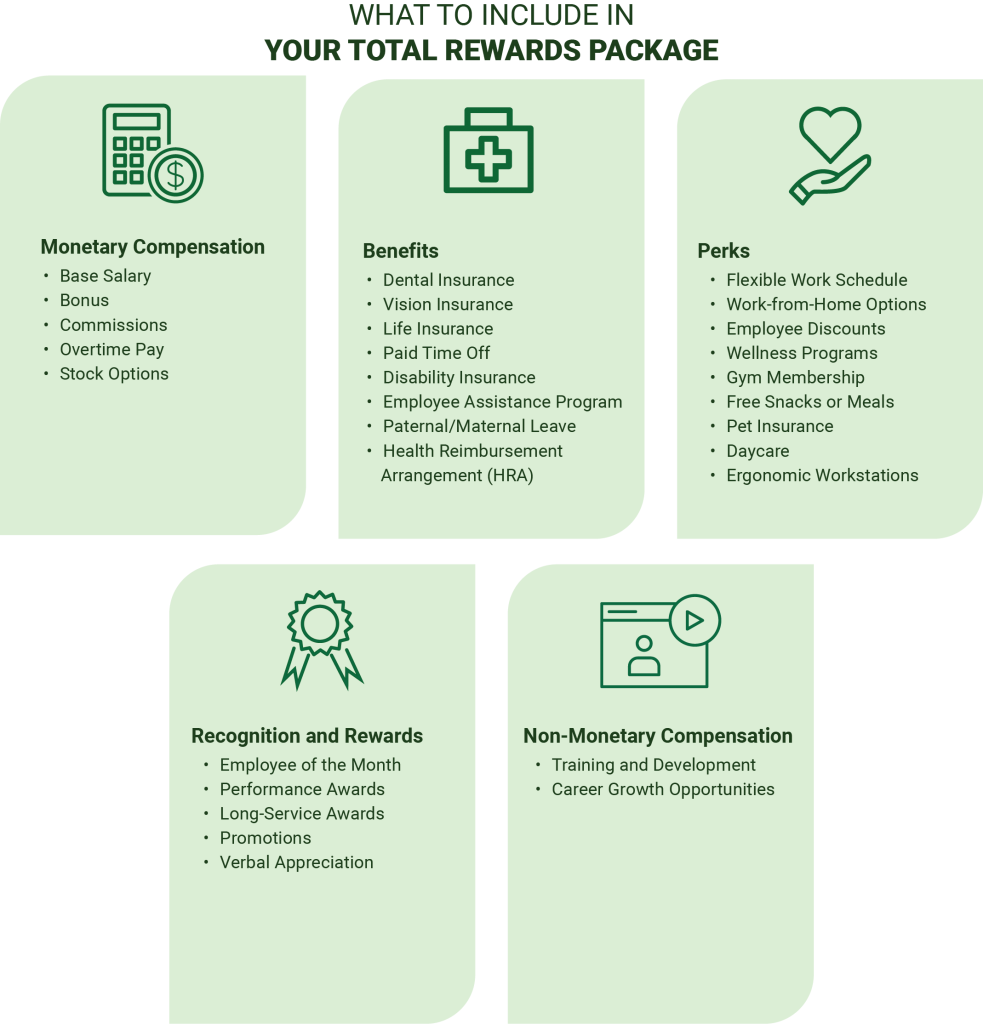
An employee total rewards package is the combination of both monetary and non-monetary compensation and benefits. Customize the package based on your organization’s goals and employee’s needs. It can include a combination of the following 

Benefits 

According to the Affordable Care Act, if you are an employer with more than 50 or more full-time employees, including full-time equivalent employees, you are required to provide health insurance.  While health insurance is the most popular benefit, providing a range of benefits is an effective way to retain employees.  

  • Dental Insurance  
  • Vision Insurance  
  • Life Insurance  
  • Paid Time Off  
  • Disability Insurance  
  • Employee Assistance Program  
  • Paternal/Maternal Leave 
  • Health Reimbursement Arrangement (HRA)

Perks

Since the pandemic, people are seeking job opportunities that have a good work-life balance. Including perks such as flexible schedules, remote work options, or more unique perks, such as employee discounts and free meals, will attract more candidates and encourage motivated employees. 

  • Flexible Work Schedule 
  • Work-from-Home Options  
  • Employee Discounts 
  • Wellness Programs 
  • Gym Membership 
  • Free Snacks or Meals
  • Pet Insurance
  • Daycare
  • Ergonomic Workstations 

Recognition and Rewards  

Employees want to feel valued and appreciated. Providing awards and employee recognition programs that fit your organization can be an effective way to give back to your employees.  

  • Employee of the Month  
  • Performance Awards  
  • Long-Service Awards 
  • Promotions 
  • Verbal Appreciation 

Non-Monetary Compensation 

Providing opportunities for employees to gain professional growth through continued education and proper training is a valuable way to grow the company. Employees can learn current trends and best practices that can help the company succeed. 

  • Training and Development  
  • Career Growth Opportunities 
What to Include in Your Total Rewards Package

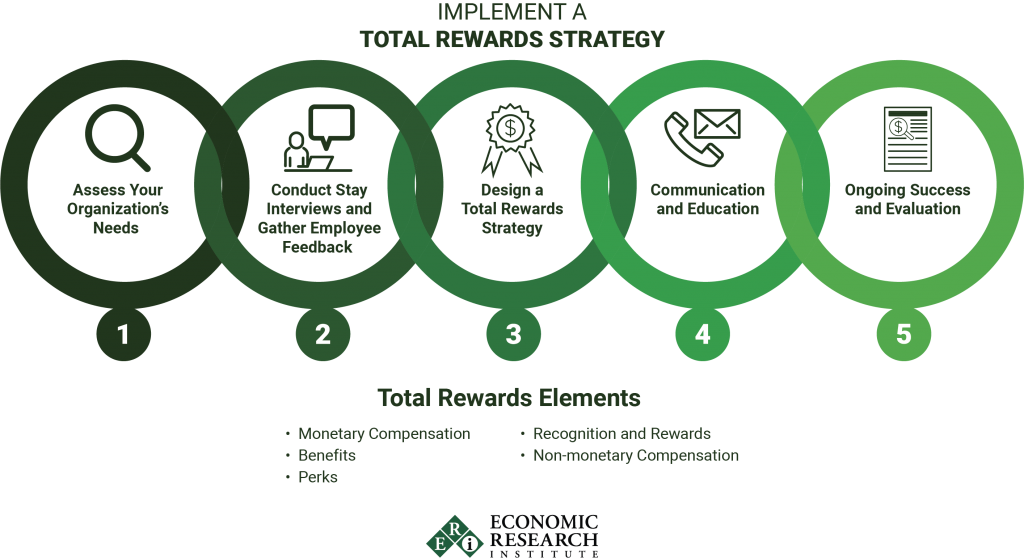
Implement a Total Rewards Strategy 

1. Assess Your Organization’s Needs 

Before designing a total rewards program, you need to understand your organization’s goals and objectives. Conduct a comprehensive analysis to identify key factors, such as business goals, industry benchmarks, employee demographics, budget, and competitor practices. To streamline the compensation portion of your program planning, ERI can help you properly set base pay, bonuses, and commissions, as well as analyze pay equity, all within our Assessor Platform. 

 2. Conduct Stay Interviews and Gather Employee Feedback 

Conduct stay interviews or employee engagement surveys to understand employees’ needs and increase retention. Discuss with your employees all areas of your total rewards package, including compensation, benefits, development, and work environment. Develop questions that will help you understand what will help your employees stay motivated and engaged. 

3. Design a Total Rewards Strategy

Once you know your goals and gather feedback, it is time to evaluate your current benefits and rewards program to help create a total rewards strategy. Find out what is currently working and what is not to allow areas of improvement. When deciding which benefits to include in your total rewards package, consider your budget, goals, and employee’s needs. Ensure that your total rewards strategy has good ROI over the long term, but also keep in mind that you can update your strategy as needed. 

4. Communication and Education

After developing the total rewards program, execute a comprehensive communication plan to educate managers and employees about the program’s components, their value, and how they can be utilized. Use multiple channels, such as town hall meetings, intranet portals, and personalized benefit statements, to ensure maximum reach and engagement. 

5. Ongoing Success and Evaluation

To ensure that your total rewards program has lasting success, set key performance indicators (KPIs) aligned with your program objectives and regularly assess and evaluate their impact. You can monitor metrics, such as employee satisfaction, turnover rates, productivity, and overall organizational performance, to gauge the program’s success and identify areas for future improvement. 
Why Use ERI in Your Total Rewards Strategy? 

Designing a robust total rewards program can seem daunting, but it is important in the process of attracting, motivating, and retaining top talent. By understanding the concept of total rewards, aligning them with organizational needs, and leveraging ERI’s compensation planning software, you can create an effective program for your organization. To streamline the compensation portion of your program planning, we can help you properly set base pay, merit increases, and incentives, as well as evaluate pay equity, using ERI’s Assessor Platform. 

How to Calculate Compensation Cover Image

How to Calculate Total Compensation Packages

Total compensation packages consist of all forms of compensation that an employee receives in exchange for work. Total compensation encompasses not only base pay/salary, but also the employer-paid costs of benefits, such as medical, dental, vision, 401(k) matching contributions, life insurance policies, holidays, paid time off, and more. Rewards statements can be a useful marketing tool, providing a frame of reference when comparing against external offers. On the surface, external offers may seem quite attractive; but perhaps they are not as enticing once all rewards are considered. Many employees don’t think about or fully understand the value of all the benefits offered – they are often taken for granted. Certain benefits may be more valuable depending on the employee. Retirement benefits may not take top priority for a new college graduate who is just starting a career but may be very significant to a person closer to retirement age. Health and welfare benefits may be very important to an employee with a young family or someone with a chronic health condition. Whatever the case may be, articulating the value of the benefits provided as part of the total compensation package is a key component of the overall compensation strategy.

Calculating the total compensation package consists of creating a list of all the benefits applicable to the job, which may vary depending on the job. For example, senior-level leaders may receive additional at-risk compensation and perquisites (e.g., auto allowance, gym membership) in addition to the standard list that all employees receive. The annual cost of the benefit (premiums) that is borne by the company is applied to each.

In the total compensation package example below, the employee earns an annual base salary of $125,000:

  • Included in that salary are two weeks of paid time off, eleven paid holidays, and one week of sick time.
  • Health coverage premiums are $11,628 annualized – employees share in the cost at a rate of 18.5% or $2,152; the employer portion is 81.5% or $9,476.
  • Dental and vision coverage is provided at no cost to the employee.
  • Basic life insurance and disability insurance are also provided at no cost to the employee.
  • Both employer and employee contribute to Social Security at a rate of 7.65%.
  • The employer contributes up to 3% matching to the employee’s 3% 401(k) contribution.
  • At this level, the employee receives a monthly auto allowance of $300 or $3,600 annualized.
  • Additionally, the employee participates in an annual incentive plan that pays up to a maximum 10% of base salary, depending on the goals achieved; the target payout for the plan is 5%.

The value of the total compensation package is $159,630 – that’s an almost 28% increase to the base salary!

Example of how to calculate a full employee compensation package with benefits with ERI.

Some generous benefits that many employers provide, beyond base salary, include the following:

  • Health
  • Dental
  • Vision
  • Basic life insurance
  • Supplemental life insurance**
  • Paid time off*
  • Sick time*
  • Tuition reimbursement
  • Professional association memberships
  • Short-term disability
  • Long-term disability**
  • Accidental death & dismemberment**
  • Long-term care**
  • Pet insurance**
  • Retirement pension contributions (defined benefit contributions)
  • 401(k) matching
  • 11 paid holidays*
  • Incentive bonus (variable pay)
  • Stock, other long-term incentives
  • Gym membership initiation fees
  • Professional development – classes, certifications, etc.
  • Flexible spending account – health & dependent care (pre-tax contributions)

*Included in base salary
**Typically paid by the employee, but pricing may be lower based on preferred employer group pricing

It’s wise and strategic for a company to be prepared to articulate the total compensation package. Equipping the talent acquisition team allows promotion of the organization beyond base pay, which can be especially important if base pay alone is not as competitive in comparison to another offer. However, when taking the broad view of what an organization can offer in addition to base pay, the candidate or employee has a wealth of information to help make an informed decision. For more information about how companies utilize compensation data to help plan business strategies, visit ERI.

Customer paying for coffee at cashier

How to Retain Minimum Wage Employees

Minimum wage jobs include such occupations as cooks, fast food workers, hosts, hospitality workers, dishwashers, cashiers, childcare workers, waiters, bartenders, and retail workers. Low wages and few, if any, benefits are typical. But with the pandemic, many workers have concluded that those conditions are no longer acceptable. A Georgetown University article reports, “The pandemic shook up what workers want and expect from a job. America cheered frontline workers during the early days of the pandemics…But these workers’ wages remain too low to cover rising housing, education, and health care costs.”

Organizations can make a positive impact on retaining minimum wage employees by developing focused plans to address typical issues that lead to turnover. Offering fair compensation is vital, and organizations must remain within their financial budgetary boundaries; however, addressing non-monetary issues is another key component.

Employee Engagement and Recognition

Gallup research indicates that having a “bad” manager compounds employee stress and impacts their well-being, affecting both home life and work. Managers can have a significant impact on employee engagement, with engagement defined as, “the emotional commitment, enthusiasm, and dedication the employee has to the organization and its goals” (see this Forbes article for further discussion). Employees who feel as though their managers are invested in them as people are more likely to be engaged and less likely to look for opportunities elsewhere. The best managers make a concerted effort to get to know their employees and help them feel comfortable talking about any subject, whether it is related to work or not. They motivate and build genuine relationships, which encourages a productive workplace where employees feel safe enough to face challenges, to share information and new ideas, and to support each another.

Most, if not everyone, enjoys recognition for a job well done. Some prefer quiet, low-key recognition, while others want to be celebrated front and center. Appreciation is an effective means of honoring the hard work and efforts of teams and individuals. Small non-monetary gifts can be quite effective, as are small bonuses or gift certificates.

Development and Benefits

The desire to learn and grow is a basic employee need. Many minimum wage employees are students, working to advance to better paying jobs by continuing their education. Others are interested in working their way up to management or technical careers. Companies that offer mentoring, formal coaching, development opportunities, or tuition reimbursement demonstrate a willingness to invest in the employee as a person, encouraging loyalty and positive branding of the organization. Leaders should continually invest in learning and development opportunities for all employees.

Many minimum wage employees are interested in individual and family benefits, such as health care, dental, vision, and life insurance. Often minimum wage positions do not offer any such benefits. If a company can find the sweet spot to offer these to employees at a reasonable cost-sharing level, this is another way to foster loyalty and retention, beyond wages.

Onboarding

Developing an effective onboarding plan – first impressions – is a crucial step in retaining employees. Taking the time to acclimate employees to the company culture and ensuring they know where to find simple things, such as the breakroom and supplies, can eliminate needless frustration and help new employees experience a sense of productivity quickly. Orienting them to the history of the organization, the leaders, strategy, and goals tells employees what is expected of them and that they are part of something bigger than themselves.

Wages

The federal hourly minimum wage is $7.25; California is $14. Addressing a living wage in the time of COVID-19 is tantamount to getting low wage employees back to work. Some are vaccine avoidant, while the fear of contracting the virus (and its variants) is an ongoing issue among others, creating a complex environment to attract and retain low wage workers. Many companies are getting creative with wages, recognizing that a monetary boost may be the only way to entice typically low wage employees back to work. Amazon recently reported increasing the starting hourly pay rate to $18 to hire over 100,000 employers to support the increase in business. Some Amazon locations are increasing the rate to $22.50 and offering health, vision, and dental insurance, 401(k) plans, up to 20 weeks of paid parental leave, and college tuition reimbursement. The company is one of many increasing average wages in a bid to entice workers, with many retailers forecasting a busy holiday season ahead, which will be hard to navigate with the current labor shortage. Other industries, such as restaurants, are experimenting with paying the full minimum wage instead of the minimum for tipped employees plus tips, adding a 20% service charge to every check, and sharing the tips with entire staff, including those who do not typically share in the pot. For more information on benchmarking wages and help with determining pay rates, visit ERI’s blog post about compensation planning.

Positive Work Environment

Fostering a positive work environment is a simple non-monetary strategy that all organizations can create. Turnover may be inevitable in some jobs, but showing appreciation, celebrating, having fun, coaching, and mentoring, showing care and concern, and getting to know employees leaves a lasting positive impression that goes beyond money, fostering job satisfaction, productivity, and motivation.

How to Use Compa Ratios to Guide Compensation Decisions

When evaluating how competitive and equitable pay is within your organization, a very familiar pay metric can be used to identify potential trouble spots: compa ratios.  A compa ratio compares an individual employee’s salary to the midpoint of a given salary range. This simple metric can be utilized in many ways to guide compensation decisions when used thoughtfully and consistently.

Using Compa Ratios to Help Calculate Salaries and Make Business Decisions

As discussed in Merit Matrices: What Are the Compa Ratio and Market Index?, “compa ratio is the relationship of base pay to the salary grade midpoint and is expressed as a percentage.” It is calculated by dividing the actual salary by the midpoint of the corresponding salary range.

For example:  If an Accountant earns an annual salary of $80,000, and the salary midpoint for the position is $80,000, then the compa ratio is 1.0 or 100% expressed as a percentage ($80,000/$80,000).  This reveals that the employee is paid at the range midpoint; values higher or lower indicate how salaries compare relative to midpoint.

The compa ratio can reveal many things about how the employee is paid.  If the salary range midpoint aligns with market data at the 50th percentile, then it means that the employee is paid at the same rate as others in the relative market.  This assumes that an individual with the same level (years) of experience, skills, knowledge, and education can expect a salary at the same rate.  Someone with less can expect to be paid lower in the range (with a lower compa ratio that is less than 100%) and a seasoned professional would most likely be paid at the higher end of the range (with a higher compa ratio that exceeds 100%). 

Establishing Pay Rates

This is useful information when determining candidate job offers.  A compa ratio of 100% indicates that the salary in question is paid at the market rate that one can expect to pay for fully competent, experienced incumbents.  A compa ratio less than market is appropriate for incumbents still learning, with relatively few years of experience (perhaps a new college grad), or those new in the role.  A compa ratio greater than 100% is usually reserved for those who are highly experienced, have been in the role for several years, or perhaps have some niche skillset. Salary adjustments can be made to the salaries of existing incumbents as information is gathered about the salary needs of current candidates.

Annual Compensation Review

Compa ratio formulas and calculations can be used to get a bird’s-eye view of where positions fall in relation to the external market.  This will show where salaries align to the market, to internal salary structure, and to others in the position.  This data may reveal a need to adjust the ranges. Once the pay inequities and salary adjustments have been identified, pay adjustments can be calculated.

Performance-Based Merit Increases

Many companies use a compa ratio performance matrix, or a merit matrix, to determine increases based on performance and market comparisons.  An employee’s progression through the pay range may be directly related to performance. A merit matrix provides guidance on how to match performance ratings to compa ratios when determining merit pay increases. A merit matrix is a two-factored table that considers performance rating and some measure of relative salary placement, typically compa ratio.  It is designed to provide a framework to help managers equitably navigate the allocation of merit increases across their employee population and should be structured to fairly reward high-performing employees similarly across the company to reduce the risk of salary-increase inequality. Since pay increases are most frequently made as a percent of salary, that would mean that high-performing employees receive the same percent increases across the organization, independent of the position.

Compa ratio is a common statistical compensation tool, though it is not meant to be taken at face value in every situation.  ERI’s Salary Assessor utilizes compa ratios to help calculate and benchmark salaries. An investment of time to know the company’s pay structure, its jobs and niche talent market, as well as the compensation strategy allow the use of this tool to begin a conversation about the meaning of the results.  A low compa ratio in a company that pays higher than most for a group of jobs is not necessarily a bad thing to be remedied immediately.  Many companies with union-represented positions have pay ranges that reflect the negotiated pay ranges, which may be higher than the broader market. It is important to use the tools consistently that work best for supporting the overall company strategy.