Top 10 Highest-Paid CEOs at Nonprofits 2024

Nonprofit organizations operate under a distinct set of principles compared to for-profit organizations. They exist to serve a public or mutual benefit, and their financial resources often come from donations, grants, and other forms of charitable funding. This mission-driven nature impacts every aspect of their operations, including executive compensation.

Executive pay at nonprofits can be a controversial topic. Some believe nonprofit executives should be paid minimally to keep overhead costs low and allocate more resources for the nonprofit’s mission. Others recognize the difficulties of maintaining adequate staffing and attracting the necessary top talent to keep the organization running effectively and efficiently. In either case, CEOs tend to be the highest-paid executives at any organization.

Below is a list of the Top 10 highestpaid CEOs at nonprofits for the most recent complete form year (2022). 

CompanyNameTitleSalaryAll Other
Pga Tour IncMonahan Joseph WCommissioner$ 14,960,274$3,660,583
Kaiser Foundation Health Plan IncGregory AdamsChairman & CEO$ 13,841,691$      -
Providence St Joseph HealthRod F Hochman MdPresident/CEO$ 11,209,100$ 859,189
Sentara HealthHoward P KernPres/CEO/Ex-Effic Dir (Thru 9/22)$ 10,168,793$       -
Ochsner Clinic FoundationWarner L ThomasPres/CEO/Board Member (End: 11/2022)$ 10,003,805$ 17,031
Montefiore Medicine Academic Health System IncPhilip O Ozuah Md PhdPresident & CEO$ 9,856,588$ 49,625
Inspirational Network IncCharles David CerulloDirector / President & CEO$ 9,459,442$ 34,065
Highmark HealthDavid HolmbergCEO, President, & Ex Officio Director$ 9,417,154$ 59,704
Bon Secours Mercy Health IncJohn Starcher Jr JdChief Executive Officer$ 9,282,330$ 2,298,438
The New York And Presbyterian HospitalSteven J CorwinPresident & CEO/Trustee$ 8,933,522$4,958,678

It should be noted that salaries in the high millions for CEOs are not the norm, with typically only the largest of organizations paying executives in that vicinity. Average nonprofit CEO salary for the year was much lower, coming in at $152,119. 

Of interest in this list is the high percentage of health care and health-related organizations represented here. ERI wrote a white paper analyzing CEO pay at nonprofits, which found health care to be one of the highest paying nonprofit industries as a whole. All this compensation information and more can be found in ERI’s Nonprofit Comparables Assessor.

Looking for more information?

Detailed nonprofit executive compensation data, including historic data and links to source documents can be found in ERI’s Nonprofit Comparables Assessor.

ERI Economic Research Institute compiles the most robust salary, cost-of-living, and executive compensation survey data available, with current market data for more than 1,000 industry sectors.

ERI’s Assessor Series® – Solutions for every compensation decision

Try a FREE Demo Request a Guided Tour

Social Security Administration Announces 2024 Payroll Tax Increase

Social Security Administration Announces 2024 Payroll Tax Increase

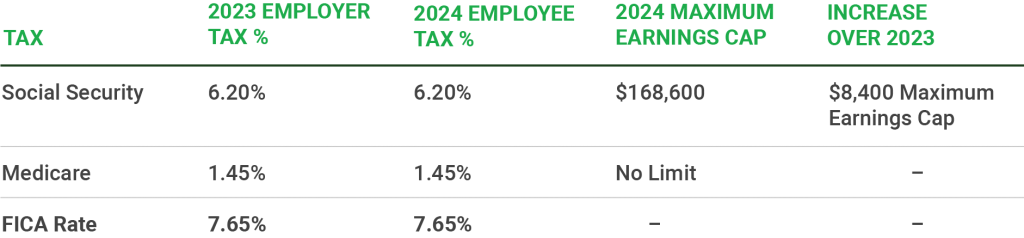
Effective January 1, 2024, the U.S. Social Security Administration will increase the maximum earnings subject to the Social Security payroll tax by $8,400 (from $160,200 in 2023 to $168,600 in 2024).

Note: Additional 0.9% Medicare tax withholding on FICA wages greater than $200,000 ($250,000 for married couples filing jointly) in a calendar year (paid by the employee).

Source: U.S. Social Security Administration

Social Security Fact Sheet

The Internal Revenue Service has announced 2024 retirement plan contribution limits, as well. Learn more about them by looking at our post highlighting the major changes.

Salary Assessor

Retain employees and attract new talent. Know how much to pay.

Try a FREE Demo

About ERI

ERI Economic Research Institute compiles the best salary, cost-of-living, and executive compensation survey. Learn more about new compensation updates, rules and changes and how they affect business planning at ERI.

Top 10 Highest-Paid Medical Professionals at Nonprofits 2021

ERI recently published a white paper analyzing why nonprofits in the health care industry pay higher than any other industry, bar none. The results showed that the highest-paid positions in the health care industry were both legal and medical professionals. But just how much do the highest-paid medical staff members make? To answer that question, below is a list of the top 10 highest-paid medical professionals at nonprofits for the most recent complete form year (2019).

  1. Joseph Levine – Chief Electrophysiology, St Francis Hospital
    • $6,992,643 in salary. $49,511 in additional “other” pay.
  2. Sheeraz Qureshi – Associate Attending Physician, New York Society for the Relief of Ruptured & Crippled Maintaining
    • $6,122,573 in salary. $57,008 in additional “other” pay.
  3. Richard Shlofmitz, MD – Chairman Cardiology, St Francis Hospital
    • $5,763,984 in salary. $48,053 in additional “other” pay.
  4. Bryan Kelly – Member/Surgeon-In-Chief, Associate Attending Physician, New York Society for the Relief of Ruptured & Crippled Maintaining
    • $ 5,267,261 in salary. $77,214 in additional “other” pay.
  5. Robert Michler MD – CHAIR-Surg/Cardiothoracic Surg , Montefiore Medical Center
    • $3,869,857 in salary. $46,514 in additional “other” pay.
  6. Eduardo Marban MD – Director-Heart Institute, Cedars-Sinai Medical Center
    • $ 3,759,190 in salary. $230,090 in additional “other” pay.
  7. Vipul Patel MD – Physician, Florida Hospital Medical Group Inc
    • $ 3,670,706 in salary. $25,593 in additional “other” pay.
  8. Answorth Allen – Attending Physician, New York Society for the Relief of Ruptured & Crippled Maintaining
    • $ 3,583,093 in salary. $69,284 in additional “other” pay.
  9. Frank Schwab – Attending Physician, New York Society for the Relief of Ruptured & Crippled Maintaining
    • $ 3,506,409 in salary. $63,964 in additional “other” pay.
  10. Tristan L Hartzell MD – Physician, Faith Regional Health Services
    • $ 3,505,242 in salary. $11,200 in additional “other” pay.

It’s worth noting here that, although some top medical staff members receive multimillion-dollar pay, the average wage for the top medical positions in 2019 was significantly lower, at $348,353 in salary. For a more in-depth analysis of nonprofit pay in the health care industry, see ERI’s recent whitepaper, “Health Care – The Nonprofit Anomaly July 2021.”

Looking for more information?

Detailed nonprofit executive compensation data, including source documents and historic data, can be found in ERI’s Nonprofit Comparables Assessor.

ERI Economic Research Institute compiles the most robust salary, cost-of-living, and executive compensation survey data available, with current market data for more than 1,000 industry sectors.

nonprofit executive compensation

Nonprofit Executive Compensation: How Much Is Too Much?

An investigative report about the Goodwill Industries affiliate in Omaha in a local paper started by looking at high compensation levels for the Omaha executives, but then continued to look at the payment of hourly rates for disabled workers less than the minimum wage.  Then the issues of conflict of interest between board and staff, nepotism, and even the repackaging of foreign-made goods sold under “Made in America” labels were revealed.  As community support waned, there was serious discussion of withdrawing the county-granted organizational exemption from property tax. 

These revelations have dramatically changed the way Goodwill Omaha functions, and the charity will be heavily scrutinized for years to come.  The property tax exemption was just extended, but time will be needed to rebuild community trust.

Now the search is on for a new executive, and the charity should be carefully following the IRS prescribed procedures. These are detailed in ERI’s recent Guide to Setting Nonprofit Executive Compensation.

To summarize here, the IRS wants a charity to pay “reasonable compensation” – that is, “an amount as would ordinarily be paid for like services by like enterprises under like circumstances.”   So what does that really mean?  The IRS definitions follow:

  • Like services:  Jobs with substantially similar duties and responsibilities (e.g., the number of employees managed, the size of the budget or assets managed, hours worked, and geographic scope).
  • Like enterprises:  Organizations similar in size (based on such factors as annual budget, assets, number of employees, or number of persons served).  Equally important, organizations similar in services provided or purpose (e.g., universities compared with universities, day care centers with day care centers, etc.)   If the charity can show that tax-exempt and for-profit entities compete for the same pool of specialized talent, then the for-profit data can be used for some, but not all, of the comparative data.
  • Like circumstances:  All forms of compensation included in the comparison (consider expense or housing allowances, plus other financial benefits). A review of geographic differences might call for adjustments.  Also if sufficient comparable data are not available for the geographic area, then comparables from a larger geographic region might be necessary, in addition to potential cost-of-living adjustments.

The IRS has decided that compensation will be presumed reasonable, unless proven otherwise, if the organization follows a set of standard procedures, creating what is termed a “rebuttable presumption of reasonableness.” This presumption puts the burden of proving that compensation is not reasonable on the IRS, not the organization.  The IRS requires these criteria for establishing the rebuttable presumption:

  • Approval by the authorized body of the organization (usually the full Board of Directors), but with no participation by anyone who might be affected by the decision on compensation.
  • Use of “appropriate data” to determine comparability prior to making a decision.  That means looking at what nonprofit employers with similar missions, and similar budget sizes, located in the same area, or a similar geographic region, pay their executives.
  • Documentation of the basis for the salary decision (who was involved with reviewing comparable data and his/her “independence,” the process used, etc.), all to demonstrate that comparable data were actually used when approving the compensation. 

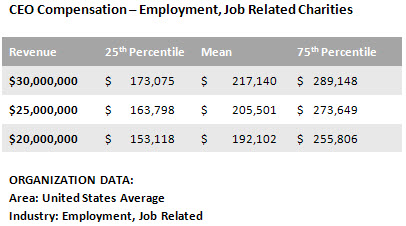
A first look at comparable data is easily obtained using ERI’s Nonprofit Comparables Assessor.  With criteria that fit the search for a new CEO at Goodwill Industries Omaha (job title CEO, annual revenue size of $25 million, and nonprofit organization type of “Employment, Job Related”), the table below generated by the Nonprofit Comparables Assessor shows that the average annual compensation for this job in comparable organizations is expected to be around $206,000 per year.  This is considerably less than the compensation paid to the CEO that just left the position.

When the geographic criteria in the Nonprofit Comparables Assessor was changed to Nebraska, there were too few observations to create a table, since there are not that many large (for Nebraska) employment organizations in the state.  Recruitment for this position is likely to be national in scope, so the US average seems to be the most relevant for analyzing the market rate for this position. 

The Omaha charity knows that regaining the trust and support of the public is an issue now and that many eyes will be focused on the compensation of the new CEO.  Using comparable data to justify reasonable compensation levels as required by IRS rules and regulations is a significant first step in that process.

executive compensation

How to Determine the Salary for a Nonprofit Executive

All salary negotiations need to begin with research—both employer and employee need to collect meaningful data, not just anecdotes, about typical pay for genuinely comparable positions before beginning compensation discussions.  This approach not only makes sense for employers and the executives—it is what the IRS and charity regulators require.  See ERI’s Guide to Setting Nonprofit Executive Compensation for a detailed discussion.

For any given job, the level of pay is influenced most by where the job is donethat means (1) the size of the organization; (2) the type of organization; and (3) the geographic location.  In the nonprofit sector, the IRS focuses on preventing “excess compensation” and defines “reasonable compensation” as “an amount as would ordinarily be paid for like services by like enterprises under like circumstances.”

Using ERI’s Nonprofit Comparables Assessor, let’s research what is reasonable compensation for the CEO of a foster care agency in Baltimore, MD, with annual revenues of $10 million.  The goal is to find salaries for people who are working in similar organizations with similar responsibilities in order to determine the market rate for the position.  The Nonprofit Comparables Assessor database of IRS Form 990 compensation information filed by almost all US nonprofits can be searched selecting the following criteria:

  • Job Title:  CEO
  • Type of Nonprofit Organization:  Children’s/Youth Services (where a person with the requisite skills and background and similar responsibilities might be working)
  • Location:  All US and then a selection of the states of MD, PA, VA, plus the District of Columbia (all places where potential candidates might be working and also places where potential candidates for CEO of a Baltimore-based foster care organization might be employed)
  • Size:  Annual revenues of between $5 million and $15 million (creating a range around the actual revenues of the organization seeking the market rate for its CEO)

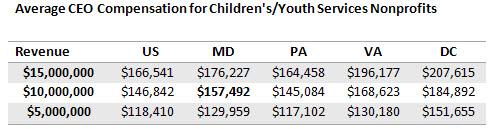
Those criteria are chosen with an eye to the labor market for that CEO positionwhere would such a person be working with responsibilities for procuring and administering state contracts, recruiting and training foster care parents, dealing with a similar number of staff people, etc.?   The idea is to collect compensation for those with similar titles (CEO) in organizations providing similar services (children’s/youth services), and in a similar geographic location (MD and surrounding areas, where the organizations might compete for talent).  The search only takes a minute with ERI’s Nonprofit Comparables Assessor and yields the following table.

The table reveals that a reasonable salary for the CEO of this $10 million nonprofit might range from $150,000 to $160,000, but there are many other factors that may enter into determining a final compensation number. Although the national average for the job is lower (around $147,000), the Mid- Atlantic geographic area where potential candidates might come from has a higher average, with the exception of Pennsylvania.  To attract someone from DC or VA, the organization might have to pay more, while perhaps someone in PA would be attracted to the job, as average CEO pay in similar organizations is lower there.  Other factors that should be considered include the experience level of the candidate or current CEO, the stability and/or growth outlook for the organization (their ability to pay), the compensation philosophy of the organization (some pay top dollar to get the best and the brightest, while others try to find less-experienced or less-qualified people and pay them less).  Underpaying people tends to lead to turnover, as the CEO leaves to get the market rate.

Having information on CEO compensation levels in comparable organizations can prepare both the potential employer and the potential CEO for meaningful salary negotiations, in line with the IRS and state charity regulators’ rules and regulations. Using ERI’s Nonprofit Comparables Assessor easily provides that valuable market data.

ERI Economic Research Institute compiles the most robust salary, cost-of-living, and executive compensation survey data available, with current market data for more than 1,000 industry sectors.

ERI’s Assessor Series® – Solutions for every compensation decision

Try a FREE DemoRequest a Guided Tour