Learn Compensation Terms and Formulas by Downloading ERI white papers

Common Compensation Terms & Formulas – Updated July 2024

ERI Economic Research Institute is pleased to provide an expanded and updated glossary of commonly used compensation terms and formulas for your ongoing reference, effective July 1, 2024. The following is a sample of terms and formulas from the latest glossary, with an index of the complete reference provided below. Visit ERI to learn more about common compensation terms and stay updated on new and emerging HR terms and definitions.

Download Download Common Compensation Terms and Formulas updated for July 2024

Compensation Benchmarking

Compensation benchmarking is best defined as the process of applying external market data to make fair and competitive compensation decisions. It may even influence the compensation strategy, policies, and practices. When compensation benchmarking is effectively used, companies can then attract top talent and pay competitive compensation rates while maximizing their budget.

Salary Range

A salary range represents the minimum, midpoint, and maximum rates that a business is willing to pay employees performing a job. Typically, the midpoint or control point is set to provide market competitive, fair, and equitable salaries based on the competitive marketplace for a business. Salary ranges can be determined using compensation software such as ERI’s Salary Assessor. 

Salary Range (Employee Placement)

Salary Range (Employee Placement)

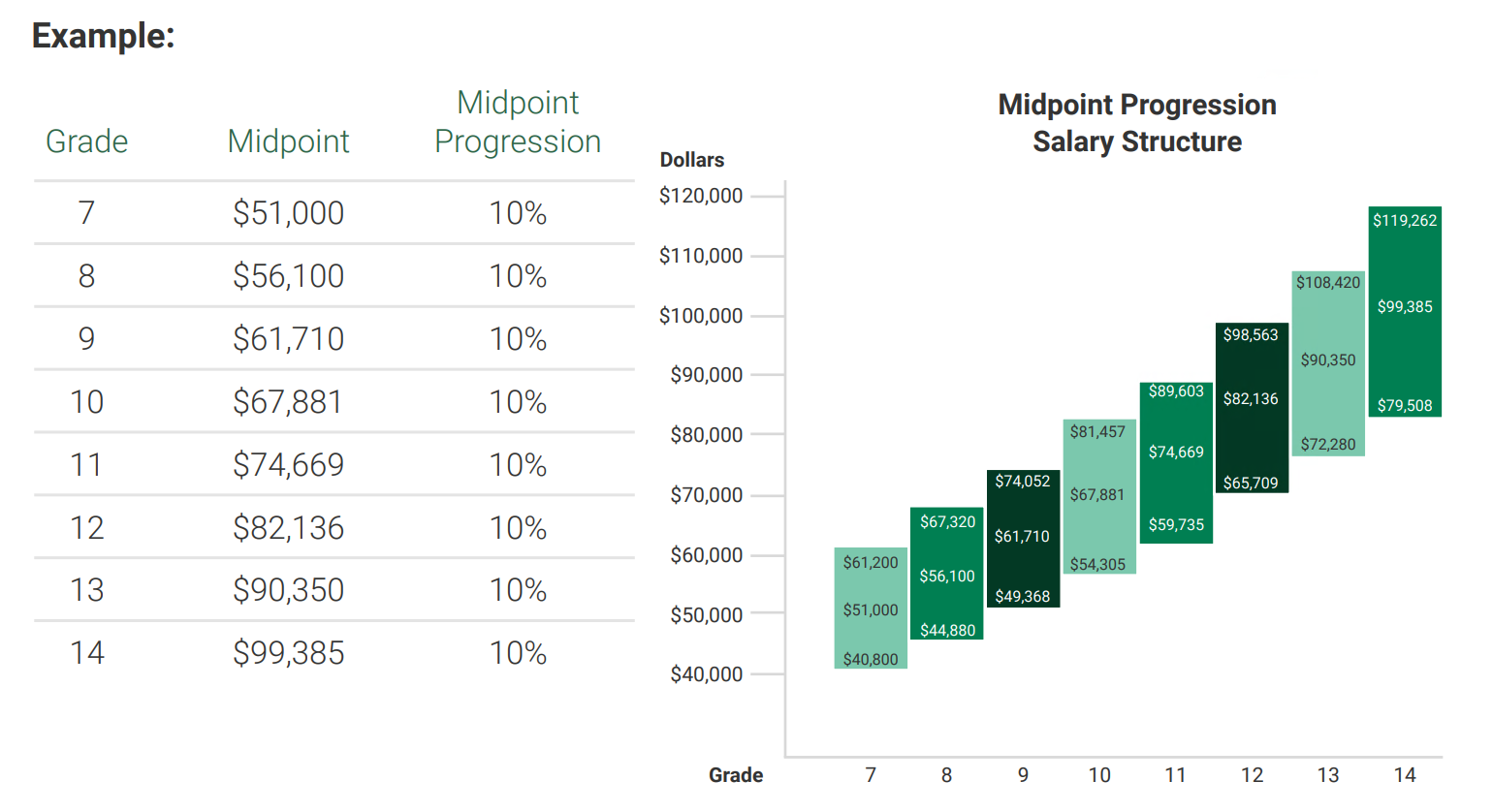
Salary Range Midpoint Progression

It is common to see salary range midpoint progressions (the percent difference between midpoints) within a salary structure as follows:

Administrative/Operative:  5-10%
Professional/Management:  10-15%
Executive:  15-20%
Salary Range Midpoint Progression

Salary Range Spread

It is common to see salary range spreads (the percent difference between the minimum and maximum) within a salary structure as follows:

Administrative/Operative:  40% +
Professional/Management:  50%+
Executives:  50-65% +

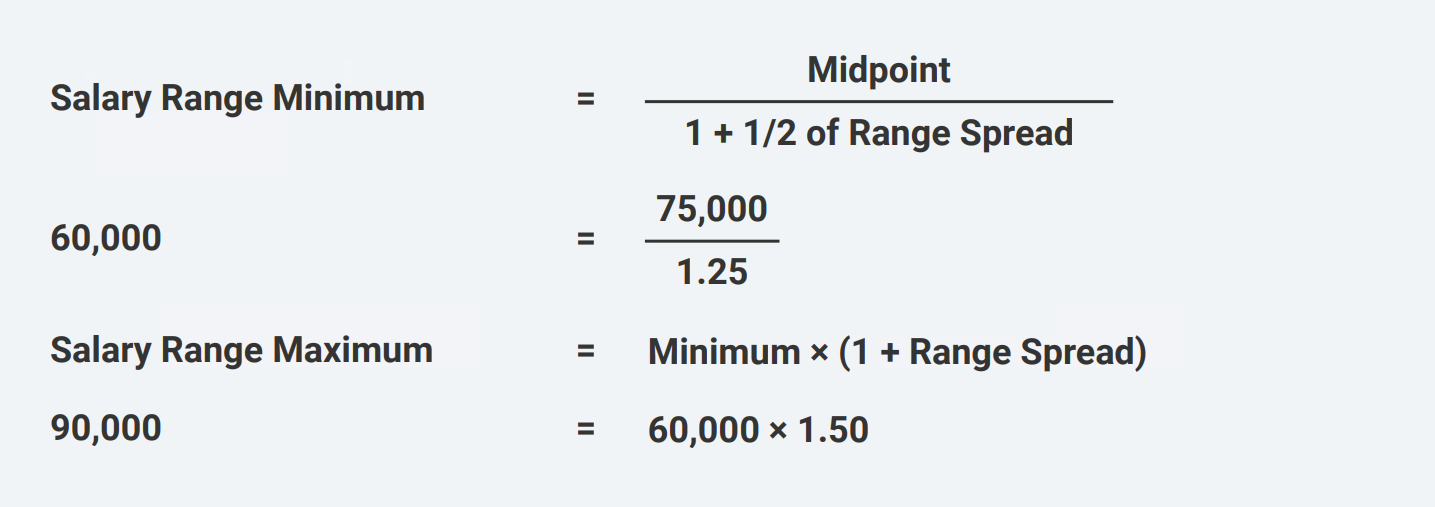
Salary Range Minimum and Maximum Formula

To calculate the salary range minimum and maximum from the salary range spread and midpoint (assumes a 75,000 midpoint and a 50% range spread):
Salary Range Minimum and Maximum Formula

Salary Range Overlap

To calculate the salary range overlap:

Salary Range Overlap Formula

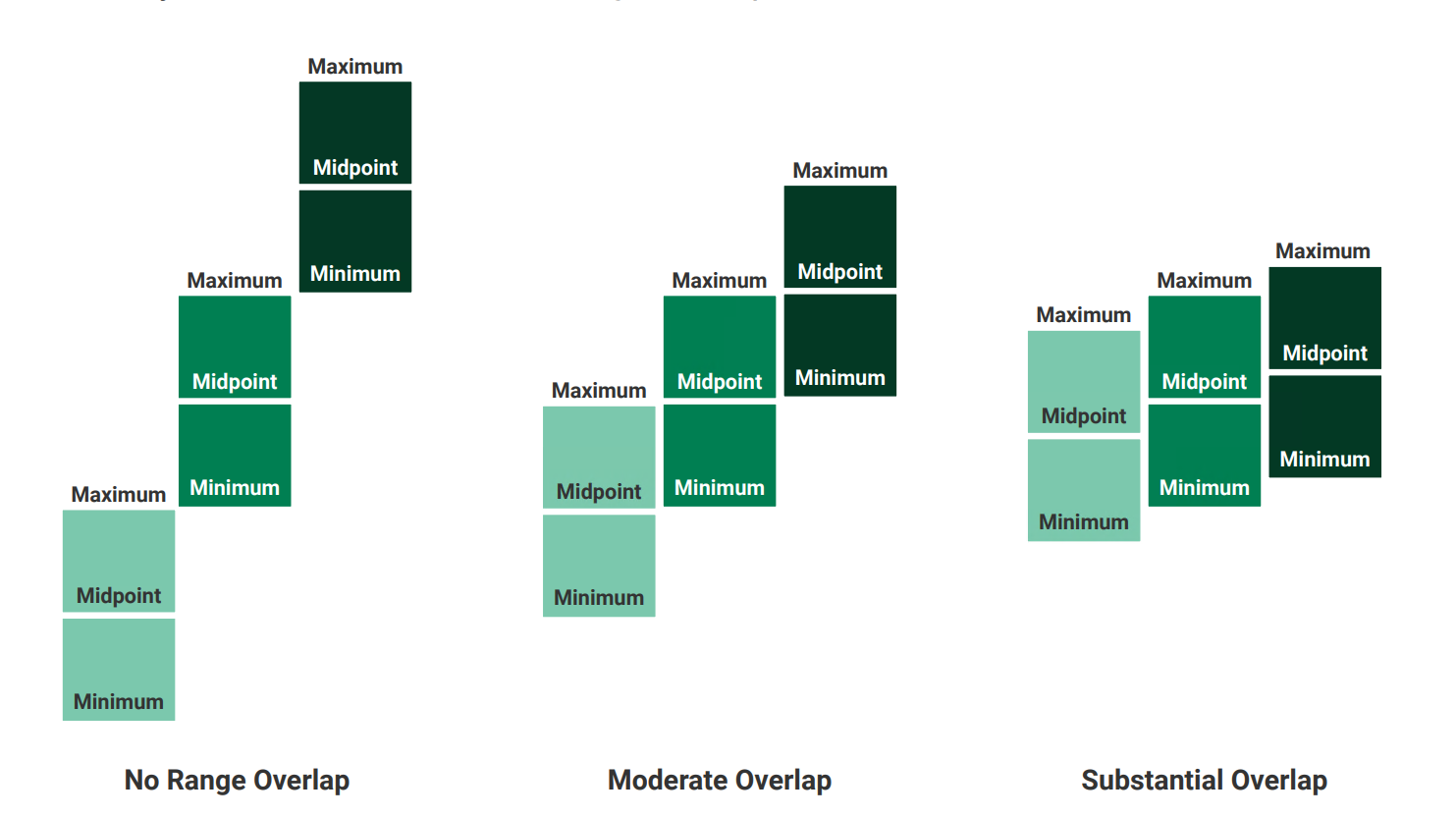
Here are three examples of salary range overlap: 

In the first example, a 0% overlap will not work unless it is a step structure. 

In the second example, a 50-60% overlap is moderate. This should be the goal of a typical salary structure. 

The last example shows substantial overlap. This would occur if there are too many salary grades or too little difference in market rates between salary grades. Pay equity issues may occur when a substantial range overlap occurs. 
Salary Range Overlap

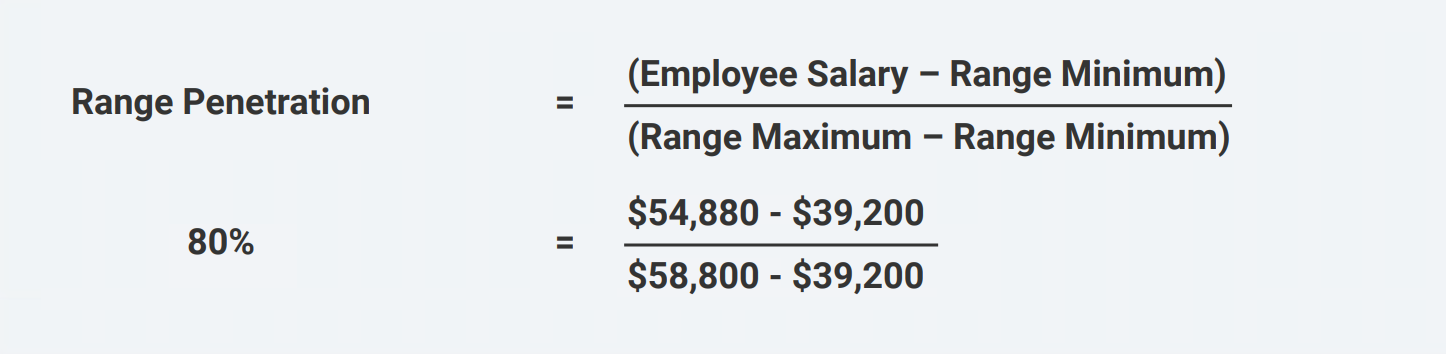
Salary Range Penetration

Salary Range Spread

To calculate the salary range spread from the maximum and minimum of a salary range:

Salary Range Spread

To calculate the salary range spread from a minimum percent and maximum percent:

Salary Range Spread

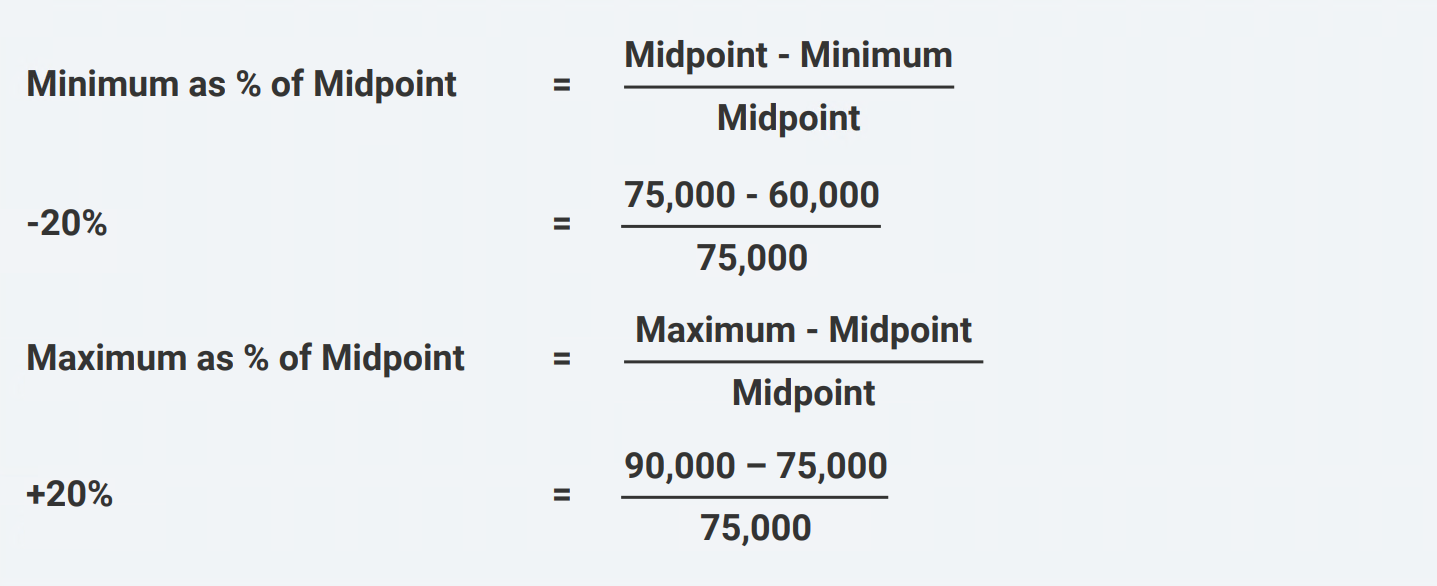
Salary Range Spread on Either Side of Midpoint

To calculate the salary range spread from the minimum to midpoint and the midpoint to maximum:
Salary Range Spread on Either Side of Midpoint

Shift Differential 

A Shift Differential is used to provide supplemental pay to employees who are regularly assigned to work shifts other than the regular day shift (e.g., M-F 8:00 a.m. to 5:00 p.m.). When a company operates with a first, second, and third shift, the second and third shift would typically be eligible for a shift differential (either as a percentage of pay or an amount per hour).  

Most companies pay shift differentials to hourly paid employees, whereas less than half of companies pay shift differentials to salaried employees. Hourly employees are paid shift differentials as a flat amount per hour ranging from 50 cents to $1.25 per hour or as a percent of their hourly base rate ranging from 5% to 15%. The higher the job level or the later the shift, the higher the amount or percentage of shift pay. Salaried employees may receive a shift differential, and, when paid, it is typically between 5% and 15% of the salary depending on the shift worked. In lieu of paying shift differentials, some companies compensate employees for working undesirable shifts with additional paid time off.

The updated and expanded Common Compensation Terms & Formulas white paper includes definitions and formulas for the following terms: 

  • Aging Salary Survey Data 
  • Annual Incentive Plan
  • Benchmark Jobs 
  • Black Scholes 
  • Bonus 
  • Broadbands 
  • Budgeting – Promotional Increases 
  • Career Levels 
  • Coefficient of Determination 
  • Compa-Ratio 
  • Compensable Factors 
  • Compensation Benchmarking 
  • Compensation Mix 
  • Cost of Labor 
  • Cost of Living 
  • Cost-of-Living Increase 
  • Consumer Price Index (CPI) 
  • Curvilinear Regression 
  • Defined Benefit Plan – IRS Limit 
  • Defined Contribution Plan – IRS Limits 
  • Demotion 
  • European Works Council 
  • Excel Pivot Chart – Displaying an Equation 
  • Excel Rate Formula 
  • Fair Labor Standards Act Final Overtime Rule 
  • FICA Taxation 
  • Foreign Income Exclusion – IRS 
  • Gender Pay Gap 
    • Adjusted Gender Pay Gap 
    • Unadjusted Gender Pay Gap
  • General Increases 
  • Geographic Pay 
  • Grandfathering 
  • Gross Up 
  • Hours of Work 
  • Individual Retirement Account (IRA) – IRS Limits 
  • Internal Equity 
  • International Local Market Practice 
  • Job Architecture 
  • Job Code / Job Profile 
  • Job Evaluation – Market Pricing 
  • Job Family 
  • Job Leveling 
  • Lag the Market 
  • Lateral Transfer 
  • Lead Differential 
  • Lead-Lag the Market 
  • Lead the Market 
  • Linear Regression Analysis 
  • Long-Term Incentive Plan 
  • Lump-Sum Merit 
  • Market-Based Salary Structures 
  • Market Pricing 
  • Market Index 
  • Market Ratio 
  • Maximum 
  • Mean 
  • Median 
  • Merit Carve Out 
  • Merit Increase 
  • Mileage (IRS Standard Mileage Rate) 
  • Minimum Wage 
  • Mode 
  • On-Target Earnings 
  • Pay Equity 
  • Pay Grade / Salary Grade 
  • Pay Transparency 
  • Percentile 
  • Position in Range 
  • Promotion 
  • Promotional Budgets 
  • Prorating Merit Increases 
  • Pure Market Pricing 
  • Quartiles 
  • R Squared 
  • Range 
  • Range Penetration 
  • Range Spread 
  • Red-Circled and Green-Circled Employees 
  • Restricted Stock 
  • Salary Range 
  • Salary Range – Employee Placement 
  • Salary Range Maximum 
  • Salary Range Midpoint Progression 
  • Salary Range Minimum 
  • Salary Range Minimum and Maximum Formula 
  • Salary Range Overlap 
  • Salary Range Penetration 
  • Salary Range Spread 
  • Salary Range Spread on Either Side of Midpoint 
  • Salary Structure Adjustment 
  • Salary Structure Design 
  • Salary Structure Strategies 
  • Salary Structure Types 
  • Salary Survey – Annual 
  • Salary Survey – Crowdsourced 
  • Salary Survey – Evergreen 
  • Sales Compensation 
  • Sales Compensation – Clawback 
  • Sales Compensation – Leverage 
  • Sales Compensation – Pay Mix 
  • Sales Compensation – SPIFF or SPIF 
  • Shift Differential 
  • Standard Deviation 
  • Standard Error 
  • Step Rate 
  • Stock Options 
  • Total Rewards Statement 
  • Traditional Graded Salary Structure 
  • Transparency 
  • Turnover 
  • Weighting Survey Data 
  • Years of Service 

ERI Economic Research Institute compiles the most robust salary, cost-of-living, compensation terms and executive compensation data available, with current market data for more than 1,000 industry sectors using the best salary survey data around.

ERI’s Assessor Series® – Solutions for every compensation decision

Try a FREE Demo Request a Guided Tour

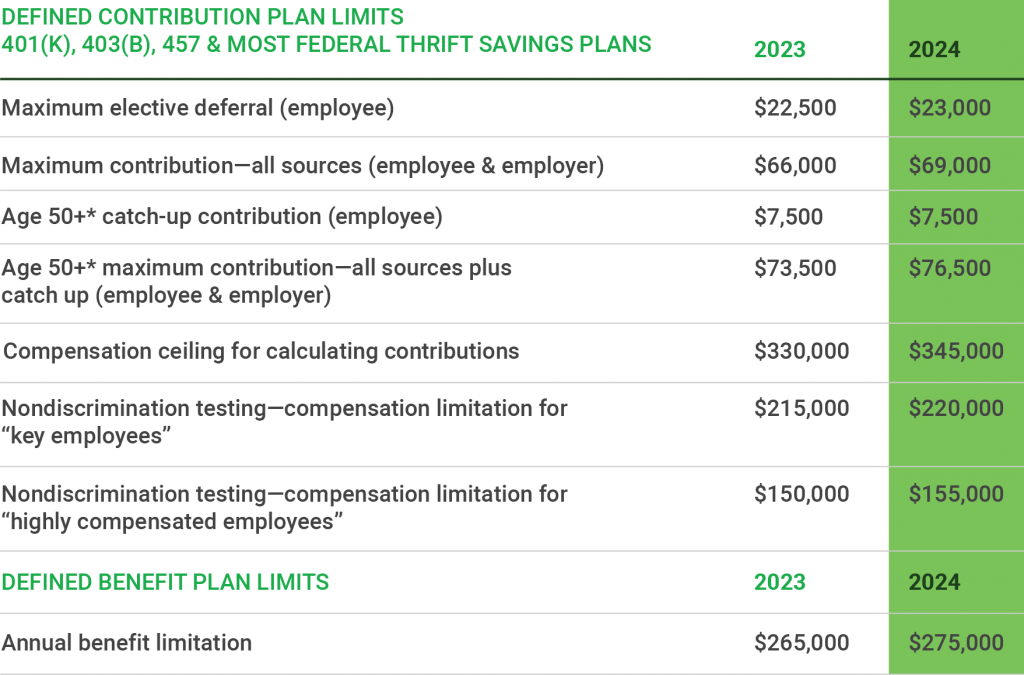
Find the maximum 401(k) retirement contribution limits, including IRA limits for the 2024 tax year.

IRS Announces 2024 Maximum Retirement Plan Contribution Limits

It’s that time of year once again when the U.S. Internal Revenue Service has announced its 2024 limitations on retirement plans for the 2024 tax year.

The 401(k) retirement maximum contribution limit has been raised from $22,500 to $23,000 for elective deferrals in 2024, with the maximum contribution increasing from $66,000 to $69,000 for all sources (employee and employer). Human resources and payroll should update their systems and employee communications, as appropriate, reflecting changes effective January 1, 2024.

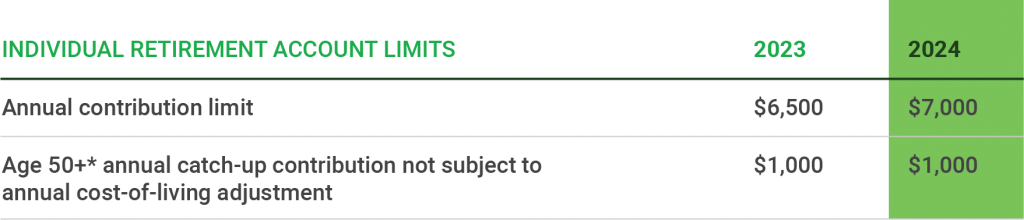
The IRS has also announced the Individual Retirement Account (IRA) limits effective January 1, 2024. The IRA retirement annual contribution limit for 2024 increases from $6,500 to $7,000. If you are over 50, the annual catch-up contribution not subject to annual cost-of-living adjustment is $1,000. For additional information about retirement plans as a component of total compensation, please visit ERI.

Find the maximum 401(k) retirement contribution limits, including IRA limits for the 2024 tax year.

*If age 50+ by year-end

Additional information and technical guidance may be found in the IRS source documents below:

IRS Announces 401(k) Limit Increases to $23,000 and IRA Limit Rises to $7,000
IRS Notice 23-75

Why Are Salary Surveys Important for a Business

Why Are Salary Surveys Important for a Business?

Here are eight reasons why salary surveys are important for a business: 

1. Obtain reliable market data from the beginning

A start-up organization is in a unique position to develop fair, consistent, and market-competitive human resources programs from the start. This is a perfect time to shape the business culture and develop the business strategy, as well as the human resources and total rewards strategies and compensation programs. They are all carefully linked. High-quality salary survey data can support your business in making informed decisions to establish its short- and long-term compensation strategy.

2. Cost of labor requires reliable market data

The cost of labor is typically the highest expense in most companies. It is a critical expense that needs to be proactively managed by all businesses. The sooner the expense is managed through credible salary surveys and external market data, the more likely the business will develop the right total rewards programs and practices to support its short- and long-term growth. Your competitors are most likely already using reliable market data!

3. Minimize subjectivity through a quality salary survey

Without external market data, new hire and existing employee compensation decisions will commonly be based on subjective decisions. These decisions form the framework for future compensation practices and programs. Investment in people, capital equipment, and technology should all be supported with quality insight and analytics. Without reliable market data, staffing and pay practices can be based on managers’ prior experiences, recruiters’ observations in the marketplace, or even applicants’ pay history or expectations. In this era of pay equity, a company should avoid asking or making pay decisions based on an applicant’s salary history.

4. Quality market data can influence productivity, turnover, and recruitment expenses

The use of quality salary surveys can help influence fair, equitable, and market-competitive pay decisions that can affect a company’s growth and success. Uncompetitive compensation programs can cost an organization substantial money due to employees’ lack of productivity and engagement, as well as high turnover and recruitment expenses. On the other hand, compensation that is too high is usually challenging to reduce once implemented. Overly competitive compensation programs can also create a lack of turnover. Healthy turnover is the “sweet spot” that allows an organization to evolve, exiting lower performers and bringing in capable, high-performing talent to support in the future success and growth of the organization.

5. Attain a market-competitive program

A market-competitive program can be attained over time with the support of quality external market data. A company that needs to closely manage revenue and costs also needs to actively manage its cost of labor. Strong, industry-focused market data and analytics will support your organization in making informed compensation decisions.

A market-competitive review will provide the required data for your business to identify its current position relative to the marketplace for each employee, job, department, and the entire business. Using this information, a business can establish its annual salary increase budget and future goals in relationship to the marketplace. For example, should a company pay its professional/management employees at the 40th, 50th, 60th, or 75th percentile of the software industry with a $25 million in revenue? An analysis of external market data can help answer this question by allowing businesses to compare their compensation to that of similar competitors.

6. Be cautious of crowdsourced market data

Employees today have easy access to market salary data for their jobs. Online survey data prepared for the masses are referred to as crowdsourcing. This type of data is not always reliable and can be inflated since it is self-reported. Employees raising issues over their compensation have become quite common. In fact, many companies now ask employees to submit an outline of their research and the methodology used before they can make an argument that they are underpaid.

So be cautious and keep in mind that crowdsourced data providers may also receive revenue from the sale of advertising. They typically have a broad customer base, and integrity of data may not be their highest priority.

7. The right compensation mix

Quality salary surveys help establish the right compensation mix for base pay and total compensation for each job, level, and function. A business can then make informed decisions based on market-competitive base salaries and incentives for similar jobs within its industry. The compensation mix is a critical component of providing a competitive compensation package to retain a high-performing, engaged workforce.

8. Paying for market data is a smart investment

Initially, a subscription to a well-regarded salary survey may appear to be a costly expense. It will quickly pay for itself as informed compensation decisions are made based on reliable market-competitive data. Whether the information is used to establish your compensation strategy or make decisions for new hires, existing employees, salary increase budgets, incentives, geographic differentials, pay equity analyses, relocation packages, or communication and transparency, etc., the salary survey data will soon be viewed as a valuable resource to support your business in managing its goals and objectives.

Why Use ERI Economic Research Institute’s Salary Survey Data?

ERI Economic Research Institute was founded over 30 years ago to provide high quality, up-to-date compensation applications for private and public organizations. Our talented team of professionals is among the best in the industry. Most of the Fortune 500 and thousands of small and medium organizations rely on ERI data and analytics for key compensation decisions. We provide high quality, in-depth compensation data for over 14,000 positions in more than 1,000 industries and over 9,000 locations to support our subscribers in making reliable pay decisions. An added benefit is the wealth of resources available to ERI customers.

ERI’s Assessor Series® – Solutions for every compensation decision

Try a FREE DemoRequest a Guided Tour

Learn more about our products at www.erieri.com or email us at [email protected].

Social Security Administration Announces 2023 Payroll Tax Increase

Effective January 1, 2023, the U.S. Social Security Administration will increase the maximum earnings subject to the Social Security payroll tax by $13,200 (from $147,000 in 2022 to $160,200 in 2023).

Social Security Administration Announces 2023 Payroll Tax Increase


Note: Additional 0.9% Medicare tax withholding on FICA wages greater than $200,000 ($250,000 for married couples filing jointly) in a calendar year (paid by the employee).

Source: U.S. Social Security Administration

Social Security Fact Sheet

The Internal Revenue Service has announced 2023 IRA contribution limits, as well. Learn more by taking a look at our post breaking down all of the major changes.

IRS Announces Optional Standard Mileage Rates for July 2022

Effective July 1, 2022, the optional IRS standard mileage rates for operating an automobile (including vans, pickups, and panel trucks) for business, charitable, medical, or moving expenses have been updated as follows:

IRS Announces Mileage Rates July 2022


Also effective July 1, 2022, qualified active-duty members of the military are eligible for a new rate of 22 cents per mile for deductible medical or moving expenses. The standard mileage rates in service of charitable organizations remains unchanged.

These rates will remain in effect through December 31, 2022.

Please refer to the IRS Newsroom published on June 9, 2022, for additional details. Follow ERI’s blog for the latest compensation news and to stay updated on new and emerging compensation trends.

How to Initiate Pay Transparency in Your Compensation Program

How to Initiate Pay Transparency in Your Compensation Program

Compensation transparency is a goal of many companies, yet it can be a distant objective if it is not given priority within a company or among the C-Suite executives. How can you accomplish compensation transparency if the culture of the business includes minimal compensation communication?

So frequently, pay transparency is misinterpreted. We hear in the news of companies that openly communicate all employees’ compensation. Yet, this is an exception and not a common practice. Organizations with best practices communicate openly, legally, and transparently, but they do manage confidentiality carefully and are cautious in the dissemination of critical compensation information.

It is important to support your organization in developing a culture of trust and open communication in how it distributes pertinent information to employees. A great place to start is developing a compensation planning strategy that communicates key goals and the objectives of the compensation program, including pay equity and transparency.

Here are some important questions to consider in the process:

Are your new hire letters accurate and complete, displaying a warm welcome to the organization? Do the new hire letters include the job title, pay, incentive opportunity at 100% target, job tier, salary range, compa ratio (equivalent to pay divided by the midpoint), exemption status, and next review date?

Are your job descriptions up to date and posted on the company’s intranet site? They should be available to all employees and are excellent for employee transparency. Even better, posting career ladders, as well, provides valuable information on developmental career opportunities within the organization.

Does your organization have job tiers (aka salary grades) and pay ranges to support in establishing the hierarchy of the organization? A fair, equitable, and market-competitive salary structure is important to establishing pay equity within an organization. Employees should be knowledgeable of their job tier, pay range, and compa ratio.

A company-wide, annual, short-term incentive plan target percent eligibility should be consistently managed based on job-tier level. This supports competitive market practices while creating trust and fairness within an organization.

Does your Human Resources Information System (HRIS) offer employee access to update and review their personal information? Do managers have access to the HRIS for decision-making purposes?

When employees receive a pay change, does Human Resources develop communications for each employee confirming the change, including former and new pay, salary range, and compa ratio, with a special thank you from the applicable executive? Ideally, the communication will be forwarded to the responsible manager to send to the employee. When Human Resources provides this documentation to managers, it provides consistent and thorough messaging to employees.

When employees receive annual incentive plan payouts, is a communication sent with a message from the president and CEO confirming the earned payout, the company objectives attained, and a sincere thank you? Again, Human Resources prepares this message, the CEO approves it, and then Human Resources distributes the message to each eligible employee through their applicable managers.

Do your discretionary bonuses include a written message from the deciding manager?

Are your compensation programs supported by plan documents that are simple to understand for eligible employees?

Are responsible steps being taken to establish pay equity within the organization? Fairness and equity go a long way towards establishing employee trust—even without broad-based communication. A simple compensation report can be part of the annual compensation plan for top-management approval and can support in identifying and resolving issues in pay equity.

Employees do not expect complete pay transparency, but they should be given the necessary information to be effective in their jobs and trustful of their organizations. Employees understand and respect confidentiality. Pay transparency and pay equity take time to accomplish. Taking a few steps each year will go a long way towards achieving important pay transparency and equity goals.

IRSAnnounces Mileage Rates 2022

IRS Announces 2022 Optional Standard Mileage Rates

Effective January 1, 2022, the optional IRS standard mileage rates for operating an automobile (including vans, pickups, and panel trucks) for business, charitable, medical, or moving expenses are as follows:

IRS Announces Mileage Rates for 2022

The standard mileage rates in service of charitable organizations remained unchanged from 2021, with increases of 2 cents per mile for medical or moving purposes for qualified active-duty members of the Armed Forces and 2.5 cents per mile for business use. Compare and learn more about how the new 2022 optional IRS standard mileage rates differ from the 2021 optional IRS standard mileage rates.

Please refer to the IRS News Release published on December 17, 2021, for additional details.

Tax Payroll Increase

Social Security Administration Announces 2022 Payroll Tax Increase

Effective January 1, 2022, the U.S. Social Security Administration will increase the maximum earnings subject to the Social Security payroll tax by $4,200 (from $142,800 in 2021 to $147,000 in 2021).

Note: Additional 0.9% Medicare tax withholding on FICA wages greater than $200,000 ($250,000 for married couples filing jointly) in a calendar year paid by the employee.

Source: U.S. Social Security Administration Fact Sheet

The Internal Revenue Service has announced 2022 retirement contribution limits as well.

Post-Pandemic Compensation: Employee Recognition Through One-Time Bonuses

A great work culture is so important to attaining high levels of employee engagement.  The Coronavirus (COVID-19) has presented many unique challenges in managing employee engagement and work culture.  As we transition to a post-pandemic environment, employees are now returning to the workplace and/or adapting to revised remote work schedules.  The stability of the business and employee safety due to COVID-19 are important factors that companies are embracing in the workplace.  Businesses are different, economies are uncertain, staffing can be challenging, and employee needs are unique, all of which will affect the workplace culture and employee engagement.  How do you maintain or improve the workplace culture and engagement during this time of transition?

Certainly, offering competitive pay and benefits will support in attracting and retaining a quality workforce.  Another way to contribute to a strong company culture is to reward and recognize your team through an annual incentive plan and one-time bonuses.  During this time of low base pay increase budgets, incentive pay is more and more important as companies adjust their compensation strategies.  Employers are increasingly updating their compensation strategies and pay mix – placing more emphasis on short-term incentives to reward for performance. 

This paper will focus on the use of one-time bonuses for new hires, employee referrals, spot bonuses, employee retention rewards, and enterprise-wide bonuses.  Here are just a few examples of how companies are using one-time bonuses in 2021:

Global consulting firm Accenture is rewarding its global workforce up through the associate director level with a one-time bonus to show appreciation for hard work throughout the COVID-19 pandemic.

According to the Australian Financial Review, an internal email was sent in March 2021 from CEO Julie Sweet revealing that the compensation would amount to one week of base pay for each employee.  “We are excited to announce that all our people up through the associate director level will receive a one-time ‘thank you’ bonus that equals one week of base pay,” Sweet commented in an email seen by AFR. “The contributions and impact that you have made during this difficult year are nothing short of extraordinary and we want to recognize that by sharing the success you helped to create.”

Raytheon Technologies is offering employees a monetary bonus if they get the COVID-19 vaccine, the company’s top executive said on April 7, 2021.  Raytheon has a commitment to vaccinate at least 80% of its 180,000 or more employees.  Raytheon Technologies CEO Gregory Hayes said at the Washington Virtual Economy Club Event, “In fact, there are small financial rewards for people to get vaccinated.”

According to a spokesman for the company, COVID-19 vaccination will earn employee points in the company’s wellness program. The program also rewards annual medical vaccinations, flu shots, exercise, and smoking cessation. After earning a certain number of points, the employee will earn a cash bonus of $200.

Raytheon is not the only company offering employees bonuses to get vaccinated. Aerojet Rocketdyne is offering employees $50 for vaccination, a spokesman for the company said.  The Kroger Family of Companies also issued a press release in February announcing that it will provide a one-time payment of $100 to all associates who receive the full manufacturer-recommended doses of the COVID-19 vaccine.

In addition to the new vaccine payment, the company also announced an additional $50 million investment to thank and reward associates across its 35-state footprint, including a $100 store credit and 1,000 fuel points loaded to loyalty cards for hourly, front-line grocery, supply chain, manufacturing, pharmacy, and call center associates. 

The one-time $100 vaccine payment will be offered to all associates who receive the full manufacturer-recommended doses of the COVID-19 vaccine and present appropriate proof of vaccination to their human resources representative. Associates who cannot receive the vaccine due to medical or religious reasons will have the option of completing an educational health and safety course to receive the payment.

This use of incentives reveals a lot about a company’s culture and employee engagement.  These companies have proactively taken steps to recognize and reward employees after a challenging year.

The Future of Remote Work: Thoughts from Executives

It has now been over one year since companies across the world have closed their offices indefinitely for their employees to work safely from their homes due to COVID-19.  The workplace has transformed to adapt to the pandemic, but perhaps it has changed forever.  In fact, about 72% of companies’ total global workforce is currently working remotely, according to a Reuter’s article summarizing the survey of CIOs by Enterprise Technology Research (ETR).

Many CEOs have expressed their thoughts on the future of work, with some supporting a continued remote workforce and others looking forward to their employees’ return to the workplace.  Executives are now asking themselves how remote work and hybrid jobs can be used as a competitive and strategic advantage.  What will be the purpose of the future workplace, and how much workspace will be needed?  How important is workplace flexibility to attracting and retaining talent?  How will compensation be impacted should employees live and work in lower cost-of-labor communities?  One thing we know for sure—gone are the days of the daily commute to the office.        

So, when will we be back to normal?  Gartner has surveyed executives on return-to-normal predictions in both December 2020 and January 2021.  Business leaders are split on when a return to the workplace will take place.  The majority of executives (52%) are predicting it will take place during the third or fourth quarter of 2021, although there is a growing trend (35%) predicting it will take place in 2022.

The percentage of workers permanently working from home is expected to double in 2021, according to the ETR survey.  By 2025, an estimated 70% of the workforce will be working remotely five or more days a month. Technology is leading the way in the decision to permanently provide remote work opportunities.  Erik Bradley, Chief Engagement Strategist at ETR said, “The productivity metric is proving that remote work is working. So, we all thought that there would be some increase in permanent remote work, but we didn’t expect that to double from pre-pandemic levels.” A Gartner CFO survey revealed that over two-thirds (74%) plan to permanently shift employees to remote work after the COVID-19 crisis ends.

Executives have strong opinions on remote work and returning to the office workplace, as stated in The Wall Street Journal, March 15, 2021:

Citigroup, Jane Fraser, Chief Executive Officer: “I certainly imagine everyone back in [the office].  I do think from a cultural point of view—apprenticeship, the sense of belonging—you are better together.”

Salesforce.com Inc., Brent Hyder, Chief People Officer: “We’re not going back to the way things were…I don’t believe we’ll keep every space in every city that we’re in, including San Francisco.”

Spotify Technology SA, Katarina Berg, Chief Human Resources Officer, on allowing employees to choose remote work while also keeping the company’s offices open from Stockholm to New York:  “The office plays a very, very big, and very important part of the culture.  And we want it to do that in the future, too.  So we will keep those [office] locations, and we want the culture to really appear and grow within that environment as an office.  But we also want to give that freedom and flexibility.”

CEOs provided their insights, reported in the Wall Street Journal, September 23, 2020, on what they think about remote work:

Apple, Inc., Tim Cook, CEO, speaking at a virtual conference hosted by the Atlantic in September 2020: “In all candor, it’s not like being together physically. And so I can’t wait for everybody to be able to come back into the office. I don’t believe that we’ll return to the way we were because we’ve found that there are some things that actually work really well virtually.”

Berkshire Hathaway, Inc., Warren Buffett, Chairman and CEO, speaking at the annual meeting in May 2020:  “The supply and demand for office space may change significantly. A lot of people have learned that they can work at home, or that there are other methods of conducting their business than they might have thought from what they were doing a couple of years ago. When change happens in the world, you adjust to it.”

BlackRock, Inc., Larry Fink, CEO, speaking at the digital Morningstar Investment Conference on September 17, 2020:  “I don’t believe BlackRock will be ever 100% back in office. I actually believe maybe 60% or 70%, and maybe that’s a rotation of people, but I don’t believe we’ll ever have a full cadre of people in [the] office.”

Facebook, Inc., Mark Zuckerberg, CEO: “I think we’re going to be the most forward-leaning company on remote work at our scale, for sure, but we’re going to do this in a way that is measured, and thoughtful and responsible, and in phases over time.”

Humu Human Resources Startup Chief Executive and former HR Chief Google, Lazlo Bock, on the state of remote work:  “There’s sort of an emerging sense behind the scenes of executives saying, ‘This is not going to be sustainable.’”

Marriott International, Inc., Arne Sorenson, CEO, at Wall Street Journal’s Future of Everything event:  “It’s a much harder way to work for anything that requires a personal relationship. And as a consequence, I think we’re going to find that we maybe [will] not go back to 100% in the office all the time. Because remote work clearly works for many things, but I think we’re going to find that being together delivers value in productivity and creativity and relationships that is irreplaceable.”

Microsoft Corporation, Satya Nadella, CEO, speaking at a virtual conference in June 2020:  “Even in the Seattle region, where we have now sent a lot of people home, we’re realizing that some people would rather have workspace at work once the COVID-19 crisis goes away because they want dedicated workspace with good network connectivity.”

Morgan Stanley, James Gorman, CEO, speaking on the bank’s earnings call in mid-April: “If you’d said three months ago that 90% of our employees will be working from home and the firm would be functioning fine, I’d say that is a test I’m not prepared to take because the downside of being wrong on that is massive.”

Netflix, Inc., Reed Hastings, Co-Chief Executive, on working from home:  “I don’t see any positives. Not being able to get together in person, particularly internationally, is a pure negative.”

Stifel Financial Corporation, Ronald J. Kruszewski, Chief Executive, on professional development while working remotely:  “I am concerned that we would somehow believe that we can basically take kids from college, put them in front of Zoom, and think that three years from now, they’ll be every bit as productive as they would have had they had the personal interaction [of work in offices].”

Future of Work – Impact on Compensation

With many companies supporting a flexible workforce and remote work on an ongoing basis, it is important to consider how remote work and employee-initiated moves to lower cost-of-labor communities will impact remote compensation in the future.  For example, if a technology company based in Silicon Valley pays 20% higher than the U.S. national average, and employees elect to move to lower cost-of-labor locations, should the company continue to pay the Silicon Valley compensation premium or adjust payments to the rate of the remote locations?  These are important decisions that businesses need to make when establishing their compensation strategy.  A Silicon Valley company could potentially reduce its compensation levels by 10-20% when employees elect to work remotely outside of the high cost-of-labor locations.

VMware has announced that it will reduce compensation levels when a remote employee moves from Silicon Valley to lower cost-of-labor locations.  Facebook and Twitter are considering or have implemented similar localization policies.

Best-practices organizations, such as Dell, Inc., have tremendous experience in remote work, with 25% of Dell’s workforce working remotely even before the pandemic began and the number of remote workers projected to grow.

“I think if you were skeptical about work from home, you probably aren’t now…And I think we’ve all learned a lot in the last few months here. I think that will flow through and create opportunities.”
Michael Dell, CEO of Dell

ERI’s Geographic Assessor is a powerful software solution and resource to support companies in making these critical compensation decisions.  The Geographic Assessor compares two or more locations based on cost of labor and/or cost of living.  It is able to capture this important data by country, state, city, postal code, and even customized locations for small to very large corporations.  ERI’s white paper, “How to Design a Geographic Salary Structure,” also provides guidance on the use and design of geographic salary structures.  ERI’s blog post about remote compensation also shows that there are different methods to tackle and determine pay for remote jobs.

Using the Geographic Assessor, the cost of labor can be captured in a comparison of the HQ location (e.g., San Jose, CA) to a customized list of locations at specific salary levels.  ZIP codes can also be used in the analysis of geographic differentials, and reports can be exported to Excel or PDF with ease.  Consider the sample below:

A cost-of-living comparison is also included in the Geographic Assessor.

The Geographic Assessor also provides a Two-City Comparison table that includes a base salary and cost-of-living comparison.  Consider this example below:

Last year sent shock waves throughout the world due to the Coronavirus, and the next twelve months bring hope that there will be a turning point in the global pandemic.  Now is the perfect time to address the future of work, return to a safe workplace, remote work, compensation strategies, and your 2022 compensation plan.  Will geographic pay be used within your organizations, and will pay be localized based on the employee workplace?  There are so many critical decisions to be made in 2021 affecting the future of work.