
Looking to Benchmark Pay?
Industry
Pay differentials for jobs vary by industry. The reasons include the skill mixes required by different industries, availability of skills, location of facilities, working conditions and status of the output produced by an industry.
Agricultural, industrial manufacturing, and services industries have significant differences in their cost structures. They move in a predictable pattern as a country evolves from being underdeveloped to developing and then developed. Underdeveloped countries are dominated by agriculture. As a country becomes more technologically advanced, manufacturing becomes the major economic activity. As further advancement takes place, service industries become the dominant employers. Service industries are the primary employers in the United States and Europe. These industry sector shifts have displaced many individuals with agricultural or industrial manufacturing skills over the past several decades.
Trends in the three main sectors of the U.S. economy for 170 years prior to 2010 are illustrated in the graph below.
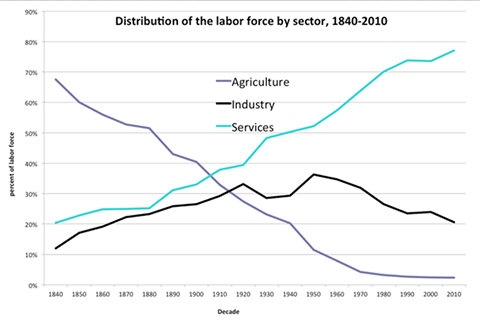
History Lessons: Understanding the decline in manufacturing
Notice that the agriculture and service sectors are negatively correlated whereas industrial manufacturing has less variation with dispersion between 20% and 25%. In 2010 the agriculture labor force represented less than 5% of U.S. workers whereas the services labor force represented nearly 80% of the workers. Industrial manufacturing showed less movement beginning at about 12% to slightly over 20% in the charted time period. As economies move toward services, pay dispersion widens and there are generally fewer middle-income jobs.
Notable trends as a result of structural changes in the labor market sectors are:
- Persistent patterns over time with transition from agriculture to industrial manufacturing to services.
- Industrial manufacturing sectors tend to be capital-intensive, with greater use of automation, requiring higher skills while demanding less labor, which is a major reason for the drop in manufacturing employment.
- High-paying industries are comprised of large organizations, more likely to be profitable and having highly developed internal labor markets.
- Global trade has led to offshoring and redefined geographic labor markets to be global.
- Organizations tend to pay more for jobs that are considered to be a strategic competency to their business operations.
Memory Jogger
Manufacturing industries in the United States: