
Looking to Benchmark Pay?
COMPENSATION TRENDS
Income Inequality
Since 1979, one of the most prominent features of the U.S. economy has been the increasing inequality between high-paid and lower-paid employees that has negatively impacted the middle class as shown in the graph below.
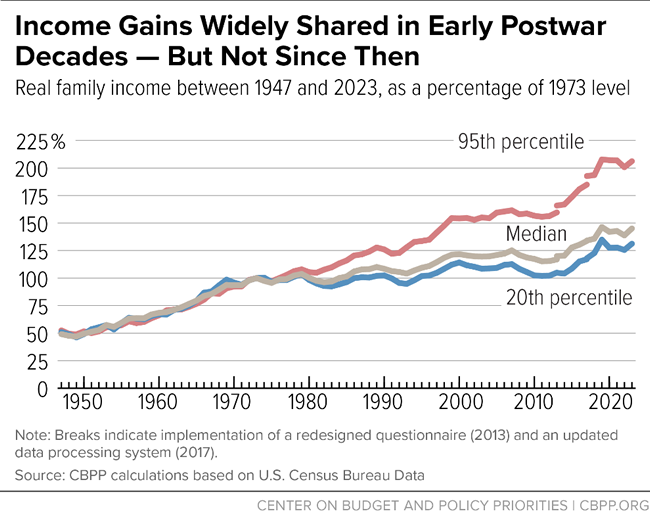
A Guide to Statistics on Historical Trends in Income Inequality
Pay inequality is common among nearly all sectors of the U.S. economy. It exists within and between states, industries and job categories. The phenomenon has been well studied by economists, but the reasons appear complex as there are a number of factors to consider such as the impact of technology, labor market institutions, offshoring, education, productivity, and labor market composition with women having entered the workforce in large numbers.
We will examine pay differentials beginning with an analysis of compensation increases relative to productivity increases.
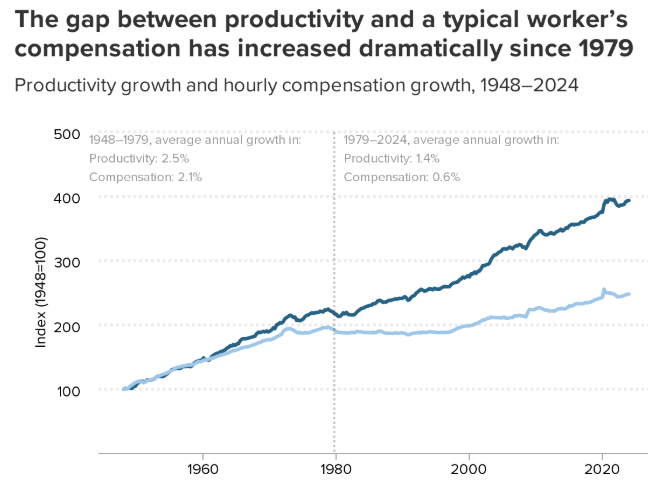
From 1948 to the early 1970s, productivity and compensation grew at a similar rate. In the late 1970s productivity began to grow at a faster rate whereas hourly compensation remained relatively flat with a slight decrease in the late 1990s. Between 1979 and 2024, productivity grew 80.9%, while hourly compensation grew just 29.4%. Productivity has grown 2.7 times faster than typical worker compensation.
The widening gap between productivity and wages in the U.S. has been attributed to a stagnant minimum wage, the decline of collective bargaining institutions, and globalization.
Productivity has increased on average only 1.4% each year since 1979, a period of stagnant wages for most workers with wages increasing on average only 0.6% per year over the same period. There was a spike to 2.6% in 2020 but it proved temporary as productivity has retreated to prepandemic levels. A 2023 McKinsey Global Institute report, Rekindling U.S. Productivity for a New Era, suggests that the U.S. needs to see annual productivity gains of at least 2.2% for there to be significant long-term gains in real income and a rise in the slumping labor participation rate.
Gender Based Pay Inequality
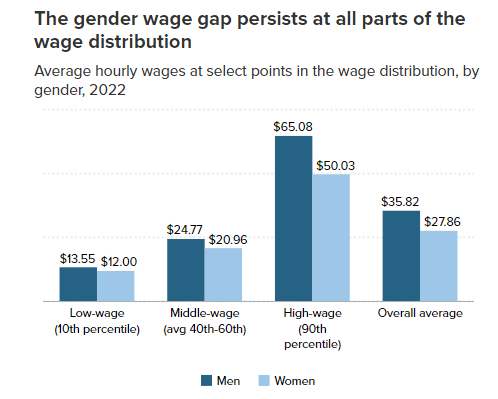
The gender wage gap persists with women on average making 84% of what men make. See DLC course 32, Eliminating the Gender Pay Gap, for a more complete analysis of gender pay inequality.
Memory Jogger
The greatest disparity in wages between women and men exists at: