
Looking to Benchmark Pay?
Labor Supply
The supply explanations mostly look at labor market demographics. Let's take a look:
The Baby Boomers. They entered the workforce in the 1970s in large numbers resulting in an excess labor supply which also led to diminishing returns on a college education during that era. There were simply more educated employees than jobs for a period of time.
The Baby Bust. After the baby boomers, the smallest age demographic, Generation X, impacted the labor supply. The returns on a college education increased as the supply of college graduates was less than the demand for them.
The Millennials. The next generation after Generation X, the Millennials have become the largest generation participating in the workforce. Compared to the two generations that came before them, they are better educated with a higher proportion going to college. However, of the three generations, they saw the least economic recovery from the Great Recession of 2008 and experienced the highest job losses in the 2020 Covid-19 recession.
Generation Z. Beginning to enter the work force, this is the “digital native” generation having had access to the internet and social media via mobile phones from a young age. This is the most well educated and diverse generation yet.
Women. There has been a considerable increase in the female labor-participation rate over the past 50 years. When the labor market is segmented into male and female occupations, it becomes apparent that female occupations became crowded, especially in the 1970s. This depressed pay levels in those occupations. However, the situation has changed as women have moved into other occupations. Since the major increases in female participation occurred in the 1970s, the later time periods show a gain for women in pay levels, although their pay still lags that of men. Today, more women than men get higher education degrees, and despite a drop in labor force participation during the pandemic, women are back in the labor force at pre-pandemic levels.
Immigration. Criteria for entering the U.S. as an immigrant has swung back to an emphasis on highly skilled workers who can fill positions that are going unfilled by U.S. citizens. These workers are at or near the top of the pay distribution. Immigration programs such as the H-1B visa are designed to bring in highly skilled employees in STEM occupations.
Education and Training. With productivity lagging, the workforce participation and college education rates down for men, not enough women going into STEM occupations, and a shortage of qualified workers for many STEM and skilled manufacturing jobs, there is a real need to find alternatives to traditional avenues to employment.
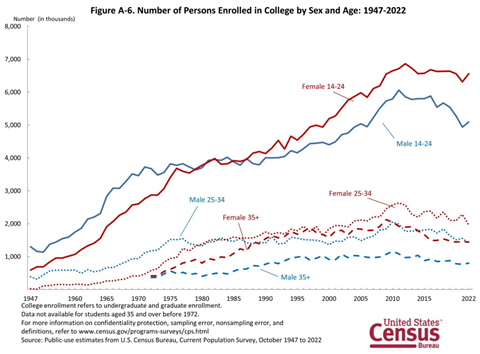
Meeting the current labor demand has a greater requirement for education and training. The recurring theme of STEM education and related skills continues to be part of the focus for the demand and supply side of the labor markets. The figure below illustrates the change in college enrollments from 1947 to 2022 segmented by age groups and gender. It shows the drop off in young male college enrollment and a leveling off for women, although in 2021 there is a jump in enrollment for both these demographics, perhaps as the result of the waning COVID-19 pandemic.
With the demand for skilled workers high and the labor market not able to meet the demand, there is a need for skills training that is more accessible than a four-year college degree. Community colleges are well established, but there needs to be more emphasis on on-the-job training, apprenticeships, and vocational education and training. It is important for new workers to get the right skills and for displaced workers to get reskilled (Source: 2023 McKinsey Global Institute, Rekindling U.S. productivity for a New Era). This will help to boost productivity and wages.
Apprenticeships. An alternative to traditional education is apprenticeships. The United States has pursued new apprenticeship programs aimed at training and development in high growth and emerging industries such as healthcare, advanced manufacturing, information technology, biotechnology, green energy, and homeland security. Apprenticeship training is a mechanism to address the issues of unemployment and a mismatch of skills between employers and employees.
The U.S. apprenticeship system is highly decentralized. Successful apprenticeships require a
coordinated effort of union and employer participation as well as public funding for related
college courses and apprenticeship programs. U.S. programs are operated on a voluntary basis
and are often supported by partnerships consisting of community-based organizations, educational
institutions, the workforce system, and other stakeholders. Community colleges are often the
organizers and facilitators of apprenticeship programs, serving as the main providers of
academic instruction for most programs. They are
a natural conduit for the majority of Career and Technical Education study programs that extend
from secondary into post-secondary institutions.
(Source: National Academies Board on Science, Technology, and Economic Policy - Building Apprenticeship Systems for Middle-Skill Employment: Comparative Lessons in Innovation and Sector-Based Strategies for Apprenticeships)
Registered Apprenticeship is a formal program in the U.S. that is comprised of a written plan designed to move an apprentice from a low or no skill entry-level position to full occupational proficiency and may be partnered with a labor organization through a collective bargaining agreement. Participants in these programs receive a portable, nationally recognized credential that certifies occupational proficiency providing a pathway to the middle class. Apprentices start working from day one with incremental wage increases as they become more proficient on the job. On-the-job learning and education provide workers with advanced skillsets that meet the specific needs of employers.
Apprenticeship growth continues to be strong. As of Fiscal Year (FY) 2024 (October 1, 2023, through
September 30, 2024), the U.S. Department of Labor reported 679,960 active apprentices (year over year growth of 6.5%) compared to 360,381
in 2015.
(Source: U.S. Department of Labor - ApprenticeshipUSA)
Vocational Education and Training. Among males in particular, a large increase in vocational education and training (VET) enrollment is expected as they reject four-year degrees, and demand remains high for skilled workers in some blue-collar occupations. With so much attention on AI and the workers it will displace, there is an even greater emphasis on these occupations having the jobs of the future. The U.S. Bureau of Labor Statistics is forecasting significant growth in blue-collar jobs.
For VET to be successful, there needs to be frequent dialogue between educational programs and likely employers in the area about current and projected skill needs. Likewise, VET programs need to be able to react quickly to changes in the workplace.
Apprenticeships, vocational education, and certifications are all training solutions for young people entering the labor force and to reskill older workers. Getting them to pursue these paths to a career is the challenge.
Memory Jogger
Generation X found that: