
Looking to Benchmark Pay?
THE LABOR MARKET
Let's begin with labor markets.
Q: How is the pay rate in the labor market determined?
A: Employees with specific skills that meet job requirements supply their services to employers that have a demand for those skills in exchange for an agreed upon pay rate.
The key labor market concepts are:
- demand
- supply
- labor market institutions
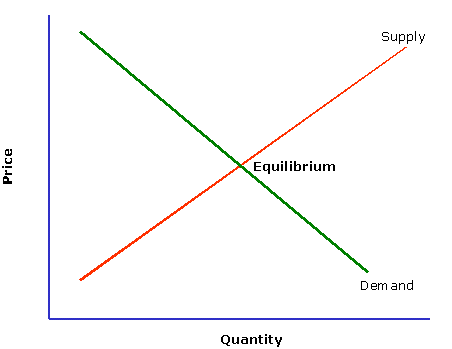
In labor markets, the pay rate would be where the demand for labor and the supply of labor intersect, establishing the equilibrium pay. Any increase or decrease in either factor would create a rise or fall in the pay rate reflected in the corresponding movement along the supply and demand lines. Equilibrium pay is illustrated in the graph below.
Let's take a closer look at these concepts…
Demand. The demand side consists of all employers. These employers:
- seek to maximize their profits primarily by minimizing labor costs
- have jobs or hire employees with the set of skills and productivity that is needed
- may relocate to where employees are located
- have sufficient information about the labor market
- make a choice to build an internal labor market specific to their organization's needs or to "buy" skills in the external labor markets
Supply. The supply side consists of employees who:
- seek to maximize their pay
- have required skills and productivity
- have sufficient information about the labor market
Labor market institutions. Labor markets are impacted by:
- unions
- government rules and regulations
Memory Jogger
Note: Memory Jogger questions are not scored. They serve only to help you remember some of the course material covered thus far. You must select the correct answer in order to proceed to the next section.
In a labor market: