
Looking to Benchmark Pay?
Market Strategy
Remember, a salary survey presents a picture of the labor market at the time the survey is conducted. Your compensation market strategy will help you determine what your competitive position will be relative to the marketplace.
Your organization's pay policy line represents your desired compensation levels based upon all jobs within your defined labor market. Your organization's market strategy will determine if you pay at, above, or below the labor market. The pay policy line can be adjusted to display the current point in time. It can also be adjusted to display the desired point in time.
| Pay policy line | A pay policy line is a "best fit" line of the array of pay rates in the organization from low to high. This line can indicate the organization's market strategy by comparing it to an equivalent line for the industry or geographic area. In an organization with pay grades, the pay policy line defines the midpoint of the pay ranges. |
|---|
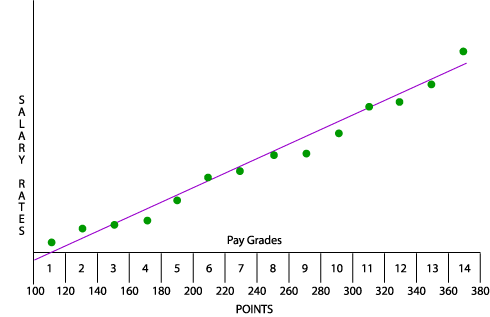
Example Pay-Policy Line
Let's take a look at 3 strategies for adjusting a salary structure.
| Lag the market | Under a lag strategy, the company will set its pay levels equal to the current market levels at the beginning of the plan year. The company will be below market at mid-year and at year-end. This is typically the least used approach. Companies who lack financial resources might fund at a lag approach. They may elect to hire less experienced employees and pay below market. |
|---|---|
| Lead-lag | A company selecting a lead-lag approach will set its pay levels equal to the market at mid-year. They will be above the market at the beginning of the plan year and will be below market at the end of the plan year. The vast majority of companies will choose to match the marketplace under a lead-lag approach, and this is a very effective approach for managing a compensation plan. |
| Lead the market | Under a lead strategy, the company sets its pay levels above the market at the beginning of the plan year, remains above the market at mid-year, and is equal to the market at year-end. This would be an above market paying employer that typically has the financial resources to pay at this level. |
These three strategies are illustrated in the figure below assuming a 10% market movement of salaries:
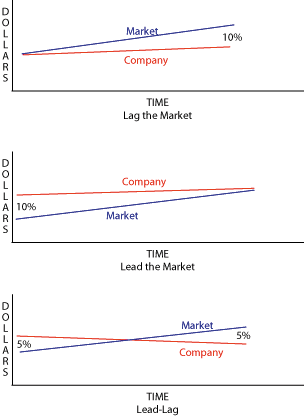
Pay Strategies
Memory Jogger
To be "at the market rate" at the end of the year, the organization should establish a pay policy of: