
Looking to Benchmark Pay?
Salary Increase Budgeting
To build on the Salary Increase Budgeting, the table below captures the calculation of a merit budget at 3% as well as the adjustments to minimum. In this table, the company is at .97 compa-ratio before the planned increases, and 1.00 compa-ratio after administering the 3% merit budget and adjustments to minimum.
The total annualized cost of the increases is $33,960. You will notice that base salary increases are $26,636 for merit increases as well as the $200 adjustment to minimum. Since the company has a bonus plan managed as a percent of base salary, any merit increase will result in an increase to the variable pay as well and must be budgeted.
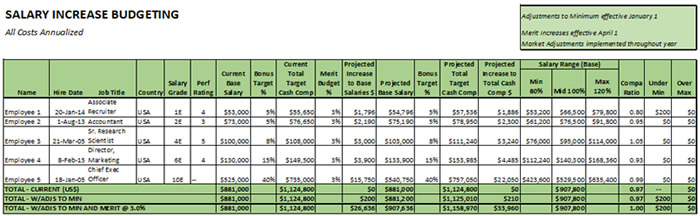
If the salary increases were to be implemented on July 1 instead of January 1, the costs for the year of implementation would be decreased in half.
Approaches to Budgeting
Whether your organization uses a bottom-up or top-down approach to budgeting, it is important to provide organizational guidance for salary increase budgeting. This may include:
- Company-Wide or Department System or Worksheets
- Information on Multi-National Salary Increase Budgets
- Merit Increase Guidelines
- Instructions for Budgeting
Typically, the recommended salary increase budget is calculated for all employees in each department within an organization. The department budget becomes the sum of all salary increase budgets for all employees within the department.
Bottom-up Budgeting
Under a bottom-up approach to financial budgeting, the organization asks each department to budget for the employee salary increases they recommend each year.
It is important that each department is provided adequate information to understand the budgeting process to ensure that appropriate and quality budget recommendations are submitted. Inconsistencies can run rampant throughout a company if not carefully managed.
These suggested changes are then reviewed up the organizational ladder for congruence with pay level and structure policies. The amounts are added together to find the total change in labor costs.