
Looking to Benchmark Pay?
Market Movement of Salaries
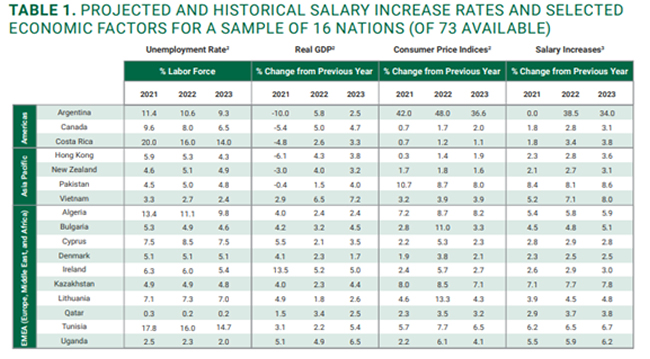
When developing a salary increase budget, the first step in the process is to determine the projected market movement of salaries for the next plan year. Two or three sources of survey data should be used for this information. ERI Economic Research Institute, WorldatWork, and the other major survey providers all have excellent sources of information. This will ensure highly reliable results for your defined marketplace. As you can see in the second table below, a multi-national company would assess the market movement of salaries by location since the market movement is different on a country-by country basis.
Example Only - Salary Increase Budgeting

Key Market Indicators
As the external market is reviewed for salary increase budgeting each year, it is important to also review key economic indicators along with the projected salary increase budgets. It is important to use trends in the economy to support your salary increase budgeting.
It is helpful to compare the historical and projected rate of inflation for a country to validate the projected market movement of salaries. Typically, a salary increase budget is 1 percent (in some cases 2-3%) over the projected rate of inflation. In robust economies, inflationary/deflationary periods, unstable economies, or developing nations, the percent relationship between inflation and the market movement of salaries may not apply. Also, the market movement of salaries tends to move more slowly than projected changes in inflation.
ERI Economic Research Institute Example - Multi-National Salary Increase Budgeting
Mandatory increases
It is important to budget and plan for costs in all mandatory increases such as adjustments to minimum wage. Consider the required effective date of change as well. Review requirements by country, state or province, and city where required.
Mandatory union increases, or other required country-specific increases and their required implementation date, should be considered when salary budgeting. For example, workers in Brazil and Italy traditionally receive mandatory contractual increases due to labor unions, and Belgium has a mandatory increase tied to inflation which all employees are eligible for.
Competitive position to the market
The salary planning exercise creates an opportunity to assess your company's current and projected position relative to the labor market each year. It is a chance to not only budget for and plan increases but also improve compensation issues that may occur in the organization. Companies who implement adjustments to the range minimum upon the effective date of their salary structure and who proactively manage compression issues will typically implement merit increases after these changes take place. These organizations will typically have fewer pay equity and compression issues as well.
Salary increase history
It is helpful to review the company's salary increase history and compare it to the market movement of salaries to determine if the company has kept up with the marketplace or has fallen behind the marketplace. A three-year salary increase history is helpful to reference.
Typically, minor changes to a salary increase budget will be easier to communicate to employees and management rather than significant changes to the budget year over year.
Company turnover rate
As plans are developed for the coming year, it is important to know the company turnover rate as compared to the market and any reasons for turnover that may apply to salary planning. Also, a stable company with low turnover will typically see rising average pay levels over time. Keep in mind, both high turnover and excessively low turnover are not always healthy for an organization. Reviewing turnover trends and causes provides an opportunity to correct specific issues in the organization which may lead to attaining more desired turnover rates.
Turnover can be calculated as follows:
T % = (L/((B+E)/2)) X 100
T = Turnover
B = number of employees at Beginning of Period
E = number of employees at End of Period
L = number of employees who Left Voluntarily between Beginning and Ending of Period
So, if you have 100 employees at the beginning of the period and 110 at the end of the period, the average number of employees is 105. If 18 employees left, the turnover rate is 17%.