
Looking to Benchmark Pay?
How to set salary grades
Before deciding on the number of salary grades, assess the number of jobs, number of employees, and number and types of business groups that will be affected. Also, assess the number of jobs in key job families to recognize key promotions throughout an organization (e.g., Research & Development or Sales).
The number and use of salary grades should be part of the long-term compensation strategy for an organization. As previously discussed, most organizations use 10-18 grades for a given salary structure. Larger organizations of 5,000 or more employees will use 16+ salary grades for their professional, management, and executive structure. Some structures, of course, contain more grades than others.
The salary structure progression from midpoint to midpoint is typically:
- 7-9% for administrative/operative jobs
- 10-12% for professional/management jobs
- 15-20%+ for executive jobs
A company should attempt to minimize employee relations issues as a result of a new compensation plan. Boundaries between salary grades help to reduce employee relations issues.
Approaches to salary grade development
There are a number of ways of grouping jobs into a formalized salary structure with salary ranges and/or grades. We will examine four of these approaches:
- cluster
- division
- midpoint-progression
- continuum
Cluster approach
One approach is to make a scatter plot of the organization's jobs, the same way the pay-policy line is established. When you do this, you can often observe that the jobs tend to cluster rather than scatter evenly. You can take advantage of this effect by encasing the families horizontally and vertically, as illustrated in the figure below.
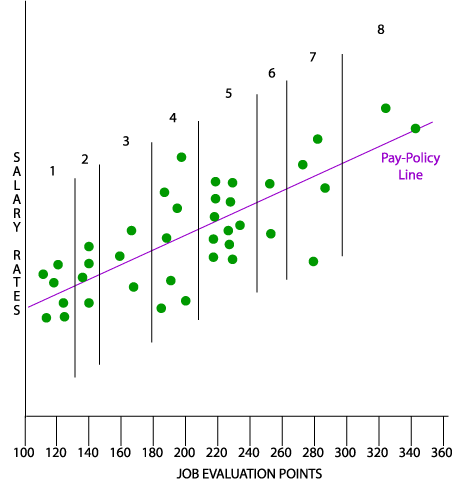
Clustering has the advantages of simplicity and flexibility. It can be changed each time the salary structure is adjusted. It tends to be used with ranking or classification job evaluation methods. Smaller organizations with limited resources are most likely to use this approach.
The disadvantage to the cluster approach is that it is very subjective and can result in inconsistencies in the salary structure. This may also have a negative impact on salary and career progression in the organization.
Division approach
Another relatively simple approach is to use a fixed progression of job evaluation points to determine the number of salary grades. Starting with the least number of points, you mark off the lines between adjacent grades. In the figure below, each salary grade is 40 points wide.
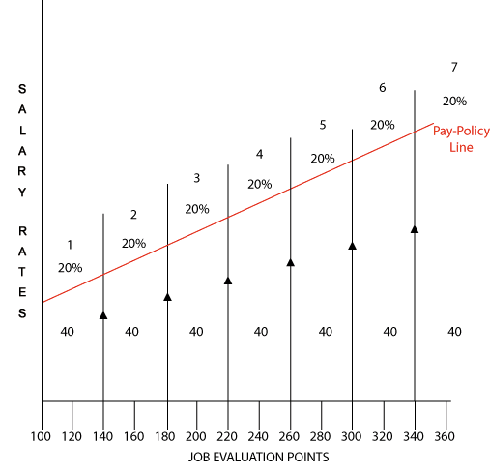
In the division approach, the market rate for each grade should be set by placing the range midpoint at the point where a vertical line from the point value in the middle of the grade meets the pay-policy line. For the figure above, this is 200 points for level 3.
An alternative to using the same number of points for each grade is to use an increasing number of points as you move up the scale. This typically will fit the market movement of salaries more effectively as well.
The division approach can be used with point factor job evaluation and can also be adapted to other systems, such as classification.
Midpoint-progression approach
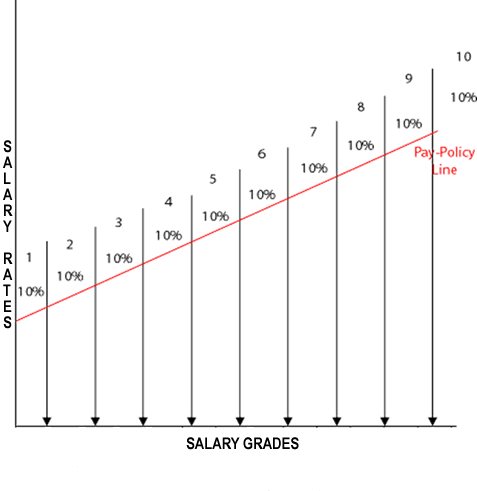
The midpoint-progression approach uses a fixed percentage between salary grades and complements compensation practices today.
Using this method, the number of salary grades is obtained by determining a set distance between the midpoints of adjoining grades. In the figure below, 10% is the distance used. Starting at the midpoint of the lowest grade, we determine the midpoint differential for each succeeding grade as 10% higher than the lower one. The dividing line between grades is halfway between the two midpoints. Although the percentage remains constant between grades, the compensation value will widen with each grade which is representative of today’s marketplace.
Continuum approach
The continuum approach produces an individual salary range for each job evaluation point. The pay-policy line constitutes the midpoints. A standard maximum and minimum, which are a set percentage above and below the midpoint, are defined.
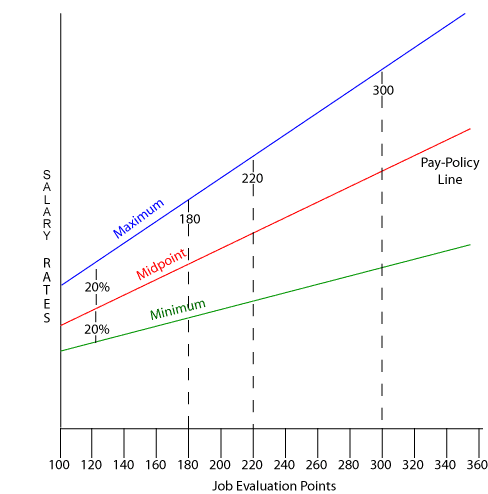
Occasionally, an organization may decide to use salary ranges within grades. In this example, the continuum approach is used, but salary grades are also established to manage the overall compensation program.
The continuum approach requires confidence in the job evaluation methodology and may be used with a point factor job evaluation program. This approach will likely place increased pressure on the job evaluation program over internal equity decisions.
Memory Jogger
The approach that maintains a standard percentage difference between grade midpoints is called the: