
Looking to Benchmark Pay?
Aging the market data
Salary survey data should be adjusted to the desired effective date of the salary structure you are building. You will need to adjust the data by multiplying the salary data by an aging factor, which is typically the market movement of salaries. The data will then be adjusted to the date of your desired market position based on a lead, lag, or lead-lag strategy.
Example: Market data is dated August 1, and the desired market position is a lead-lag strategy approach as of July 1. The data then needs to be aged from August 1 to July 1 of the following year (11 months).
Annualized Market Movement of Salaries = 3.0%
0.03/12 months = 0.0025 per month
0.0025 X 11 months = 2.75% Aging Factor
Market Rate of $50,000 X (1 + 2.75% Aging Factor) = $51,375 Aged Market Rate
Pricing a Job Structure
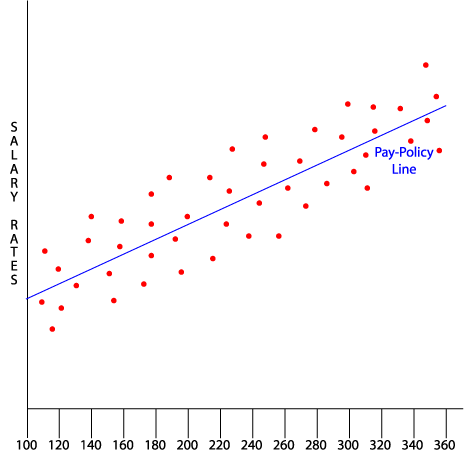
Once the internal hierarchy of jobs has been established (including grades, ranking, or job evaluation points) and the external market data has been summarized, you can create a salary structure. The first step is to plot these 2 sets of data on a grid, to create a scatter plot.
Vertical axis
The Y axis has the dependent variable. The external market value for each job will occupy the vertical axis. In this example, it is U.S. dollar values for a U.S. salary structure. Note: Internal pay rates could be used in lieu of the external pay rates on the Y axis.
Horizontal axis
The X axis has the independent variable. The internal organizational hierarchy is reflected on the horizontal axis. There are typically two possibilities for scale on the horizontal axis:
- pay grades (most common)
- job evaluation rates/ranking
Pay grades The horizontal axis will typically capture salary grades while the vertical axis reflects the external market data. The resulting formula will produce a market-competitive midpoint by salary grade.
Job evaluation rates/ranking. The horizontal axis can capture job evaluation points or ranking. In the graph above, the job evaluation scale placed the jobs into grades of 14 groups differentiated by 20 points each. Depending upon the method of job evaluation used, the scale may consist of a ranking of jobs from low to high, a series of classification levels, or a range of points.
The following job evaluation methods may be used to establish an internal hierarchy of jobs for an organization.
| REVIEW OF JOB EVALUATION METHODS | |
|---|---|
| Ranking | Rank the jobs in the organization from highest to lowest; pay grades have a number of ranks. |
| Classification | Define each level within an organization (e.g., intermediate professional) slot the organizations' jobs into each level; a pay grade consists of all jobs that are comparable to the level description. |
| Factor Comparison | Compare jobs on several factors to obtain a numerical value for each job; pay grade is a range of evaluated rates. |
| Point Factor | Rate each job on several compensable factors (e.g., skill, effort, responsibility, and working conditions) and then add the point value of each factor to obtain a total value for each job. A matrix will convert the hierarchy of points to pay grades. |
| Market Pricing | The market value of each job is used to support an organization in establishing the internal hierarchy of jobs. This is the most prevalent job evaluation method in use today. |
(These methods are examined in DLC Course 34: Using Job Evaluation in Your Organization
A Note About Market Pricing
Market pricing is a job evaluation methodology that creates a job-worth hierarchy based on the “applicable market rate” for benchmark jobs in the external marketplace that are relevant to the business.
Market pricing is the most prevalent of all job evaluation methodologies today. Market pricing can be an excellent methodology for being responsive to today’s highly competitive marketplace. Getting market pricing wrong can result in high labor costs or non-competitive rates that are too high or too low leading to employee morale issues and high turnover. But getting it right can be cost effective and support the creation of a highly motivated, engaged workforce with healthy turnover.
Mid-size and large companies frequently manage their organizations to formalized salary structures including pay grades and even, occasionally, broadbands. Market pricing can support this strategy.
Market pricing can also be a very effective strategy for a small organization. It can provide the organization with market guidance for the management team while effectively managing the cost of labor. It will also give an organization the ability to attract, retain, and motivate a high-performing workforce. A market range can easily be developed, even without pay grades, for each benchmark job in a small company. The non-benchmark jobs can then be slotted into the market-priced structure based on whole job comparison. Once the organization has grown and more sophisticated management tools are needed, then it may be appropriate to implement a more formal salary structure developed through regression analysis.
Negotiated rates. Where there is a union, the hierarchy of jobs may be a negotiated ranking based upon custom or the relative power of a group of unions.
Memory Jogger
In creating a job structure, external market rates are recorded on the: