The OIRA is part of the OMB and is an agency within the Executive Office of the President that reviews draft proposals and final regulations, in addition to other responsibilities. The OMB review is the final step before the proposed regulation is published in the Federal Register.
To follow the approval process of the proposed update to the FLSA overtime rule, see www.reginfo.gov/public/jsp/EO/eoDashboard.myjsp. Once on the website, scroll down to the Department of Labor section and review the following information and status for RIN 1235-AA20:
TITLE: Defining and Delimiting the Exemptions for Executive, Administrative, Professional, Outside Sales and Computer Employees
STAGE: Proposed Rule
ECONOMICALLY SIGNIFICANT: Yes
RECEIVED DATE: 01/16/2019
LEGAL DEADLINE: None
The Fair Labor Standards Act’s salary threshold of $23,660 “certainly needs to be updated,” Secretary of Labor Alexander Acosta said at the American Bar Association’s 11th Annual Labor and Employment Law Conference. But the $47,476 threshold originally recommended by the Obama administration in 2016 was litigated and never implemented. It “created a shock to the system, so we put out a request for information and are looking at the comments that were submitted,” continued Secretary Acosta. The general expectation is that the proposal will include a new salary threshold in the low- to mid-thirties range.
What happens next?
Once the proposed rule is published in the Federal Register (which now might take place in March 2019), formal comments on the proposal may then be submitted to the Department of Labor. The general public, companies, and nonprofits, as well as professional associations, are anticipated to be proactively submitting commentary on the proposed update to the FLSA overtime rule.
ERI Economic Research Institute compiles the most robust salary, cost-of-living, and executive compensation survey data available, with current market data for more than 1,000 industry sectors.
ERI’s Assessor Series® – Solutions for every compensation decision
There are many components of a fair, equitable, and market-competitive total rewards program. Supplemental pay practices through differentials, stipends, and even one-time bonuses can be under-estimated in their role in attracting, retaining, and motivating an engaged workforce. In many cases, supplement pay practices are implemented to recognize additional requirements related to a job.
Shift Differentials
With more and more companies running 24/7/365 operations, there are many challenges to attracting, motivating, and retaining employees. Companies recognize these employees by paying a premium to work their more undesirable shifts—typically the second or third shift.
A vast majority of companies pay shift differentials to their hourly-paid employees, where only one out of three salaried employees receive shift differentials. This practice is more common within the technology sector. Hourly employees will typically be paid either of the following:
A flat amount per hour between $0.50 and $1.25 per hour; or
A percent of hourly base pay (most frequently 5-15% of hourly rate of pay); and
Less desirable shifts typically receive the higher differential.
When paid, salaried employees normally receive an additional percentage of pay for working the second and third shifts:
Typically paid as a percent of salary (5-15%); and
Less desirable shifts typically receive the higher differential.
Some companies will provide additional time off in lieu of paying the shift differentials.
Lead Differentials
A lead role typically will provide oversight of people, projects, or functions for a business. Where a supervisor will have hiring, termination, and performance management responsibility, the lead does not. A lead may contribute to these processes but typically does not have final, decision-making authority in employment decisions.
It is relatively common to see lead roles being managed at the senior level of a career ladder. Exempt leads tend to be managed through their salary range.
Pay for Working Holidays
Some industries operate on a 24/7 schedule and, as a result, require employees to work on a federal holiday. This commonly occurs in retail, health care, services, and emergency support. Holiday pay for time not worked is typically not required, and most state laws do not require employers to observe holidays or to pay employees for holiday time off.
Overtime is paid based on hours worked over 40 per week (or the applicable state law, such as California’s law for over 8 hours in a day). Just as with paid leave, it is important to have clear, documented holiday pay policies, since state laws will enforce the written policy.
Companies commonly provide pay at time and a half for working on a holiday. Occasionally, a bonus or paid time off will be provided to recognize employees working on a federal holiday.
Remember, exempt employees, working any portion of a workweek commonly require payment in full for the entire week. It is always recommended to check both federal and state laws.
A vast majority of companies do not pay additional differentials for knowledge of a second or third language. Companies, though, tend to recognize the skill within the existing salary range.
Occasionally, it may be appropriate to recognize the skill with language pay. In this instance, the criterion needs to be well defined to ensure it applies only to an appropriate, eligible group. Otherwise, the program can be misused. See the following example.
Example: Call Center pays a foreign language premium of 10% of base pay when a second or third language is required to be used 50% or more of the work time on the job.
On-Call Pay
Always check both state and federal laws to determine when nonexempt employees are required to be paid for on-call time. Check to see if your state has its own standards for when employees must be paid for on-call time; many states have their own minimum wage and overtime laws which are separate from those of the federal government. Employers must follow the higher of the two laws—either state or federal.
In addition to on-call pay, consideration needs to be given to standby or waiting time, uncontrolled standby, controlled standby, and response and reporting time.
In addition, supplemental on-call pay for nonexempt employees, especially in a highly competitive marketplace and industry, is provided and administered as a flat amount per day, weekend, week, or holiday for on-call pay. When paid, the supplemental payment can range from $25 to $50 per day (holidays paid at the higher end of the range).
Exempt on-call pay is optional. In a highly competitive labor market and industry, companies will commonly provide exempt on-call pay. When used, companies typically will pay an additional flat amount per week for being on call—where $250 per week is a common rate. Occasionally, a company may design an exempt on-call program based on a daily, weekend, or holiday rate ranging from $75 to $200 per day (holidays paid at the higher end of the range).
Hazard Pay
Hazard pay means additional pay for performing hazardous duty or work involving physical hardship. Work duty that causes extreme physical discomfort and distress which is not adequately alleviated by protective devices is deemed to impose a physical hardship. The Fair Labor Standards Act (FLSA) does not address the subject of hazard pay, except to require that it be included as part of a federal employee’s regular rate of pay in computing the employee’s overtime pay. ¹
Hazard pay is optional and may be built into the overall compensation package or it may be managed as a separate stipend. It is important to consider the compensation strategy of the company and the labor market. It may even be part of a union contract or a strategy for union avoidance.
Hazard pay can be temporarily based on the occurrence or an ongoing premium to pay. It could be managed as a flat amount per hourly rate of pay or managed as a percent of pay. For example, $2.50 an hour for working in a mine; or $2.50 an hour when working in a mine.
In another example, a surveyor received a 20% hazard pay premium only when working out of a helicopter. In a different example, a power plant in Japan raised its hazard pay from $100 a day to $200 a day after the nuclear power accident
The U.S. State Department website is an excellent resource for guidance on danger pay by country. The BLS also publishes a news release on the most dangerous occupations each year.
Nonexempt Travel Time
Under FLSA, “home to work” and “work to home” is typically not considered to be travel time. It is always a good idea to ask, “Is the employee under an employer control or not,” when determining travel time. If the employee is under employer control, the employee is typically eligible for travel pay.
When non-exempt employees travel on company business, they are typically under “control” of their employer until they arrive at their destination, check into a hotel, and then are no longer under “control” once they get to their room and are free to do what they like.
A sample travel time policy pays hourly employees at a dual-rate. Minimum wage is paid for “travel time” in excess of their regularly scheduled hours of work per week rather than the employee’s regular rate of pay. A regular rate of pay is paid for all other work. Under a dual-rate program, nonexempt employees receive their regular rate of pay and then “minimum” wage for travel time for travel hours in excess of their weekly regular rate of pay. Always obtain legal counsel prior to implementation.
Spot Bonuses
Spot bonuses are used to recognize and reward one-time events, such as outstanding performance, perfect attendance, project completion, or other important achievements. Spot bonuses are most commonly used for non-executive employees. Maximum awards are commonly between $1,000 to over $5,000 before taxes and typically not grossed up.
A Tiered Recognition Program, as in the example below, provides different employee reward levels, which can be approved by different levels of management. A program like this can be budgeted and allows for immediate recognition in rewarding and recognizing special employee achievements.
Retention Bonuses
Retention bonuses are commonly used by companies to support a crucial business or production cycle such as an acquisition, divestiture, or a business relocation. The bonus aids in supporting employee retention during a challenging organizational transition. It tends to be tied to an important end date to incent the employee to stay with the company when he or she may be motivated to leave an organization for greater stability.
It is important to avoid overusing retention bonuses. Professional and management employees are commonly eligible, whereas non-exempt employees are not typically eligible.
Retention bonuses are commonly paid out as a lump sum, and most receive the retention bonuses as a flat dollar payment. It is less commonly managed as a percent of pay or paid at management discretion. When calculating retention bonuses, 10-20% of base pay is a typical retention bonus.
A Note about Supplemental Pay Practices
When implementing supplemental pay practices, it is a good idea to include three reviews:
labor law,
state and federal eligible time/pay/overtime requirements, and
state and federal tax withholdings.
Also, supplemental pay practices and bonuses will most likely be subject to an overtime payment calculation for nonexempt employees. Non-discretionary bonuses paid to nonexempt employees need to be accrued for and added to the employee’s “regular compensation” for overtime calculation purposes. This also applies to gift cards and meals provided. If it is promised or expected or a part of a compensation package, then it must be accrued for and becomes overtime-eligible.
Ensure the required tax withholdings are made on the supplemental pay.
Summary
Supplemental pay practices can be managed to complement a fair, equitable, and market-competitive total rewards program. Supplemental pay practices are commonly used to incent an employee to work under difficult conditions, under unique schedules, during a business transition, or even during key holidays. A fair program is important for these business requests and requirements. We suggest that supplemental pay practices be included in your ongoing competitive market review. They perform an important role in attracting, retaining, and motivating an engaged workforce.
ERI Economic Research Institute compiles the most robust salary, cost-of-living, and executive compensation survey data available, with current market data for more than 1,000 industry sectors.
ERI’s Assessor Series® – Solutions for every compensation decision
It’s that time of year once again when the United States Internal Revenue Service has announced its 2019 limitations on retirement plans for the 2019 tax year. Human resources and payroll should update their systems and employee communications as appropriate reflecting changes effective January 1, 2019.
Limits Defined Contribution Plans 401(k), 403(b), 457 & Most Federal Thrift Savings Plans
2018
2019
Maximum elective deferral (employee)
$18,500
$19,000
Maximum contribution – all sources (employee & employer)
$55,000
$56,000
Age 50+* catch-up contribution (employee)
$6,000
$6,000
Age 50+* maximum contribution – all sources plus catch up (employee & employer)
$61,000
$62,000
Compensation ceiling for calculating contributions
$275,000
$280,000
Nondiscrimination testing – compensation limitation for “key employees”
$175,000
$180,000
Nondiscrimination testing – compensation limitation for “highly compensated employees”
$120,000
$125,000
Limits Defined Benefit Plans
2018
2019
Annual benefit limitation
$220,000
$225,000
The IRS also announced the Individual Retirement Account (IRA) limits effective January 1, 2019:
Limits Individual Retirement Accounts
2018
2019
Annual contribution limit
$5,500
$6,000
Age 50+* annual catch-up contribution not subject to annual cost-of-living adjustment
$1,000
$1,000
*If age 50+ by year-end
Additional information on the 2019 limitations on retirement plans and further technical guidance may be found in the IRS source documents as noted below:
ERI Economic Research Institute compiles the most robust salary, cost-of-living, and executive compensation survey data available, with current market data for more than 1,000 industry sectors.
ERI’s Assessor Series® – Solutions for every compensation decision
Effective January 1, 2019, the U.S. Social Security Administration will increase the maximum earnings subject to the Social Security payroll tax by $4,500 (from $128,400 in 2018 to $132,900 in 2019).
ERI Economic Research Institute compiles the most robust salary, cost-of-living, and executive compensation survey data available, with current market data for more than 1,000 industry sectors. Find our most updated information, including our information on the 2020 Payroll Tax Increase.
ERI’s Assessor Series® – Solutions for every compensation decision
The requests to create new and creative job titles are never-ending. Today’s era of title inflation, new technologies, and hot skills places increased demands for new and creative job titling. Executive job titles are even becoming trendy and vague. Hot new skills are rapidly placing increased demand on compensation and new job families. These challenges may even result in new job titles, while others will not. But there is a balance between the creation of new and different job titles and the demand for these jobs and hot skill sets. The management of job titles is an important component in the attainment of market competitiveness, internal equity, and even pay equity throughout an organization.
Today’s era of creative job titling is at an all-time high. Some companies use job title creativity to complement their culture and brand. Some companies are very effective at this, while others create mayhem in their business and organizational hierarchy. The Staffing team frequently cannot recruit for these internal job titles and use secondary job titles for recruiting purposes. Also, these titles may have a different meaning from one company to another. When an employee needs to use a secondary term or title to describe his or her job, the titling standards aren’t working.
For accurate salary information on specific job titles, try ERI’s Salary Assessor for accurate compensation information.
The more creative a job title becomes, the further away it drifts from the common functional areas of business such as sales, marketing, finance and accounting, legal, customer care, human resources, information services, research and development, and operations. When “formal” job titles drift too far and become so unique and trendy, the roles become vague and misunderstood, both internally in the organization and externally in the marketplace. Is this the business culture that a company desires to present to its customers? When a company displays just one set of values throughout the organization for both customers and employees alike, it gains a powerful, competitive advantage in the marketplace.
When job titling is done consistently and well in a company, it promotes fairness and equity throughout the organization. Clarity in roles and job titles also supports pay equity compliance. Without role clarity, it is difficult to attain pay equity in an organization.
It’s important to not over-react to recent trends and buzz words when job titling. Some may be legitimate new titles, while others may not. Proceed cautiously before placing a product name or location in front of a job title. Many companies including salary survey providers proceed cautiously on the creation of new benchmark job titles especially when they may be incorporated into an existing job family over the long term. Hot skills may be more effectively-recognized through higher pay, a sign-on bonus, or even an equity grant.
In the perfect world, job titles will convey the level of authority as well as a descriptor of the primary purpose of the job. The level of the job is typically a noun where the descriptor is an adjective. Acronyms will be avoided. Effective job titling will follow these standards. Ideally, a job title will range from one to five words (one to three is even better).
Ideally, job titles should be well-received by the employees holding the position. For example, Starbucks very effectively uses the term “barista” to describe their customer-facing roles. “Barista” is derived from an Italian word (non-gender specific), for “bartender,” who normally works behind a counter, serving all types of beverages and snacks. The title has been so successful that it is now prevalent in the industry and included in salary surveys.
There’s an opportunity to coin the term “team member” in lieu of “employee” for company-wide communications. This is different from a creative job title. It’s a small but very respectful way to recognize team members, assuming the organization is managed as a team. “Googler” is effectively used by Google, and “Cast Member’ is effectively used by Disney theme parks.
It’s important to clarify the difference between Administrative Assistant and Office Assistant.
The term “clerk” is certainly outdated. Although the days of “clerk typist” are long over and have been replaced with Office Assistant, Office Associate, Department Assistant, even Clerical Associate, etc., it is eye-opening to see the number of clerk typist jobs currently available on Indeed.com. Higher-level jobs can include the term Specialist as the noun. It is important not to inflate the role with titles such as Administrative Assistant, which is a different and normally higher-level job in the marketplace.
Gender-specific job titles are also outdated and have been replaced with more appropriate gender-neutral titles. It’s also amazing to still see the number of “warehouseman” and “draftsman” job titles on Indeed.com, where a simple change to warehouse worker, warehouse associate, warehouser, or drafter are simple, more up-to-date titles.
So why would a company need or desire to change its receptionist job title to Director, First Impressions? The spiral of title inflation begins with one title change such as this one. Internal equity breaks down — especially as an organization grows. An organization’s hierarchy needs to be established based on internal equity and market competitiveness. Will the job be paid like a Director or just titled as a Director? What happens when the employee wants to be recognized as a Director in pay and benefits? What happens when other employees request a similar inflated title for their jobs as well? Although this example is extreme, a Manager who is given the HRIS title of Director may have expectations in pay and benefits (even equity compensation) immediately or down the road.
If a new standard in job titling is approved in an organization (such as Senior Director), a ripple effect can also quickly take place throughout an entire business. The term Director no longer has the same meaning when a Senior Director title has been approved in a company. Before a new, significant management titling structure is used, it is important to carefully assess the ramifications throughout a business. It can also influence external market competitiveness when expectations are created due to liberal or inflated job titling practices.
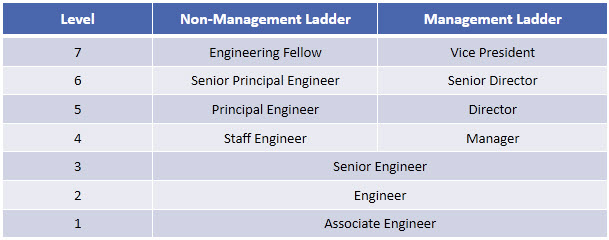
Career ladders can be of great value in the management of job families and the title hierarchy within a business. Defined career ladders are important programs in the attraction, development, and retention of critical employees. Ideally, career opportunities for R&D staff should provide comparable growth opportunities whether an individual contributor or management role is pursued. A career ladder will support in providing comparable growth opportunities for key individual contributors who elect to stay on an individual contributor career path. For example, If STEM individual contributors are all pursuing their MBAs, it may be a sign that the professional career ladder isn’t working effectively. As appropriate, recognizing and rewarding these talented employees for their technical expertise should include growth opportunities up to a Vice President level. A critical, high-performing Engineer, nationally or internationally recognized in his or her field of expertise, who is an important company resource with proven success in new product design and development, may be an excellent candidate for an Engineering Fellow — see career ladder example below:
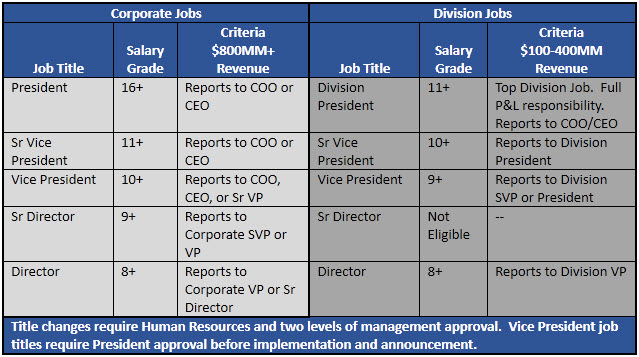
In some organizations, management job titles can become very political and place inappropriate pressure on advancement. These issues become more prevalent with acquisitions and smaller divisions when prior job titles are retained. Once the standard lowers within an organization for a management job title, a ripple effect can easily run through an organization. A job title policy, approved by top management, can create top management ownership to the job titling structure and help eliminate title negotiation, inflation, and inconsistencies for senior management job titles. Appropriate approval is needed along with a required reporting relationship, salary grade, and a minimum business revenue size.
Example – Job Title Policy
Although there are a lot of variations to these types of management job title matrices, they can provide tremendous guidance to an organization and support in attaining market competitiveness and internal equity.
Effective job design today also includes broader roles with flexibility for job enrichment opportunities. Job titles should follow this theme as well. Narrowly designed jobs should be implemented with caution. Millennials (as well as other generations) don’t want to be defined by their job title — they want workplace flexibility, career development, and a sense of purpose. Don’t we all want that? The ability to provide new, interesting assignments and work locations on a temporary, project or team basis can present new and interesting opportunities for employee development and engagement. This can even influence a reduction in employee turnover.
Jobs titles, whether unique or not, should have a specific purpose, value, and meaning. Take proactive steps to avoid title inflation. The next time a unique, creative job title is being considered, ask yourself if the decision really influences internal equity and employee engagement, makes the business a better place to work, and supports the company culture and brand.
ERI’s Occupational Assessor breaks down job analysis by reflecting an individual’s training, experience, and limitations to generate lists of jobs with requirements falling within these restrictions. Therefore, employees’ job titles clearly communicate the level and responsibility of their positions.
ERI Economic Research Institute compiles the most robust salary, cost-of-living, and executive compensation survey data available, with current market data for more than 1,000 industry sectors.
ERI’s Assessor Series® – Solutions for every compensation decision
Given recent economic trends, the reasons to justify raising U.S. salary increase budgets over 3% in 2019 are increasing.
The U.S. economy experienced a high pay growth period in the 1970s and 1980s in response to high inflation. But from the early 1990s to present, the Consumer Price Index (CPI) stabilized to 3% and below. Real salary increase, which measures the difference between wage growth and the increase to the CPI, has also reduced. Consider the following example:
Decade
Average Real Salary Increase*
1980s
2.12%
1990s
1.47%
2000s
1.22%
2010s
1.16%
* % Salary Increase Budget Less % Change in CPI = % Real Salary Increase 1
During 2017, the real wage increase reduced even further to 1.0%. In 2018, wage growth is projected to drop to 0.7% assuming budgets remain stable at 3%.
After the 2008 financial crisis, companies became very conservative in managing fixed expenses. It is understandable that the prevalence in variable pay increases and one-time bonuses increased after the 2008 financial crisis rather than increasing pay over 3%.
The January unemployment rate remained extremely low at 4.1% (same as December 2017).
The average hourly wages have risen 2.9% over last year.
As 2018 progresses, we may see the 2.9% increase in hourly wages rise over the 3% mark. Interest rates are also increasing, which is expected to influence healthy inflation. Although 2.1% was the former projected rate of inflation for 2018, increasingly more economists are predicting inflation rising to 2.5% based on more recent data.
The growth forecast for the United States has been revised up given stronger than expected activity in 2017, higher projected external demand, and the expected macroeconomic impact of the tax reform, in particular the reduction in corporate tax rate and the temporary allowance for full expensing of investment. The U.S. GDP growth forecast has been raised from 2.3 percent to 2.7 percent in 2018, and from 1.9 percent to 2.5 percent in 2019. 3
In advanced economies where output is close to potential, still-muted wage and price pressures call for a cautious and data‑dependent monetary policy normalization path. However, where unemployment is low and projected to decline further, such as in the United States, a faster pace of policy normalization may be required if inflation were to pick up more than currently anticipated.4
Although the reduction of the U.S. corporate tax rate from 35% to 21% is not a reason in itself to raise salary increase budgets, the President’s Council of Economic Advisers October 2017 Report estimates that corporate tax reductions will, in the medium term, boost average U.S. household income annually in current dollars by at least $4,000, conservatively. With more optimistic estimates, income boosts are over $9,000 for the average U.S. household. 5
Hundreds of companies have already responded to the U.S. corporate tax cut from the Tax Cuts and Jobs Act 2017 by announcing one-time cash bonuses, salary increases, as well as increases to the 401(k) contribution. The Americans for Tax Reform website is maintaining a list of companies who are paying bonuses, increasing pay, and/or 401(k) contributions as a result of the reduction in corporate tax rates. As of February 9, 2018, 340 companies are on their list. In addition to the above practices, companies are also increasing training opportunities for their workforce. Additional resources on the tax reform effects to corporate tax cuts are available through the President’s Council of Economic Advisers, as well as other major Human Resources consulting firms.
The new tax plan clearly will bring about significant tax savings to employers, which will likely result in expanded long-term capital investment, hiring, training, and may even ripple into added compensation. This year is a period of transition — companies are likely adjusting and planning under the new tax law. The law will also allow multi-national businesses to repatriate funds back to the United States with a 5.25% tax. Repatriation is substantially better than the former 35% tax. Although a significant improvement, this reform will still incur costs that calls for planning.
In recent years, there has been a trend of companies adding or increasing the use of variable pay in lieu of increasing fixed compensation beyond 3%. Managing one-time bonuses or adding or increasing variable pay can be effective for the short-term; however, it is important to recognize that employees bear the burden of increased fixed expenses due to inflation. As interest rates and inflation rise, employees’ spendable income will erode, and, in some cases, workers will seek out other companies and higher rates of pay to ensure their fixed living expenses are met. Lower paid employees will feel the erosion of their disposable income more significantly than higher paid employees. The labor market will respond by a gradual adjustment to salary increase budgets over time. Compensation will gradually follow increases to the rates of inflation, although it tends to move more slowly in the marketplace.
During 2018, it is important to observe the following factors within our organizations and labor markets:
Projected changes to salary increase budgets
Increasing rate of inflation
Economic health of our business and country
Unemployment rates
Turnover
Financial capability
Market rates for jobs
These economic indicators are important factors when determining the most appropriate salary increase budgets for 2019. This transition time is also an excellent opportunity to educate our management teams to ensure support of the rising U.S. salary increase budgets.
ERI Economic Research Institute compiles the most robust salary, cost-of-living, and executive compensation survey data available, with current market data for more than 1,000 industry sectors.
ERI’s Assessor Series® – Solutions for every compensation decision
The design of a total rewards strategy that appropriately complements an organization’s mission, culture, business strategy, management practices, and even the Human Resources strategy itself can be a daunting task in today’s unpredictable business and global environment.
A total rewards strategy should guide in the overall design of an organization’s total rewards program, including these programs:
Compensation
Benefits
Work-Life Balance
Recognition
Performance Management
Career Development
External factors such as geography, employee demographics, the economy, and world affairs also influence the total rewards strategy.
An effective total rewards strategy will complement an organization in the attainment of its short- and long-term goals and objectives.
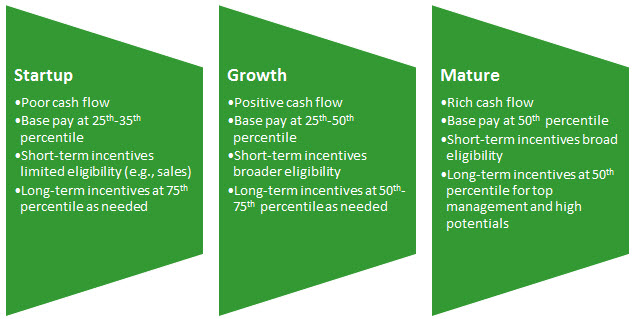
When considering a total rewards strategy for a business, it is important that it be designed with consideration of the company’s financial ability to fund its core total rewards programs. For example, a typical compensation model can be assessed based on the stage of its business maturity as follows:
A total rewards strategy may include a very broad-based statement or even more specific guidance on the types of programs and the desired competitive position by plan type as compared to the external marketplace. A strategy may also provide guidance on what programs will be used, how they will be implemented, and how they will be administered.
Following is a hypothetical example of a compensation strategy within the overall total rewards strategy:
XYZ COMPANY COMPENSATION STRATEGY EXAMPLE
The XYZ Company compensation strategy is designed to attract, motivate, engage, and retain a talented workforce capable of supporting the organization to meet and exceed its short- and long-term business objectives.
Pay Vehicles will include base salary and performance-based short- and long-term incentive plans for eligible employees.
Base Salary – all employees
Short-Term Incentive Plans – all employees
Long-Term Incentive Plans – top management and high potential employees
Job Evaluation Methodology is market pricing for all levels of jobs within the organization.
External Market Competitiveness:
The company will follow a lead-lag market approach as of July 1 of each year.
Base pay salary structures, target total cash compensation, and target total direct compensation market competitiveness will be designed based on the company’s ability to pay upon attainment of short- and long-term performance goals and objectives and its desired competitiveness to the appropriate labor market with whom the business competes for staff:
Executive – 50th percentile of applicable industry’s national marketplace
Professional/Management – 50th percentile of applicable industry’s or all industries combined regional marketplace
Administrative/Operative – 50th percentile of all industries combined local marketplace
Short-term incentive plan will be used to recognize achievements of short-term company goals and objectives (12 months duration). All employees are eligible and targeted cash bonuses (as of % of base pay) will be designated based on salary grade and market competitiveness. Annual payouts under the STIP will be as approved by the CEO.
Long-term incentive plan (LTIP) will be performance based and used to recognize attainment of challenging, long-term company goals and objectives. Top management and high potential employees as approved by the CEO are eligible to participate in the long-term incentive plan. LTIP awards will be delivered in cash or through equity awards as approved by the CEO.
Merit Increases will be delivered annually based on pay for performance and placement within the salary range. Should an employee be paid at the maximum of the salary range, a lump sum salary increase may be considered for top performers. Annual salary increase budgets will be based on the market movement of salaries for the national labor market.
Performance Management is part of the business culture and regular, ongoing communications is encouraged between the management team and employees.
Globally Managed Programs:
Global salary grades and job titles
Global short- and long-term incentive plans
Human capital management system
The compensation strategy and eligibility requirements shall be adapted by the total rewards team as needed when legally required within the labor markets XYZ Company operates.
Approvals – The design of annual compensation plan (base salary, short-term incentive plans, and long-term incentive plans and related costs as recommended by the Head of Total Rewards require the approval of the VP, Human Resources, CFO, and CEO.
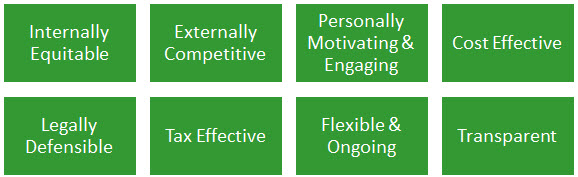
The Total rewards strategy should be responsive to the local labor markets, legal environment, and competitive requirements of your business. Most importantly, implementing a total rewards strategy that is right for your business ensures your company-wide practices have these characteristics:
The verdict is out on salary reviews. The vast majority of companies now manage a focal point review cycle, while others may desire to eventually transition to a focal point review cycle. Typically, business growth supports the change from an anniversary to a focal review cycle. For more information about how to plan salaries, read ERI’s whitepaper on how to plan salaries.
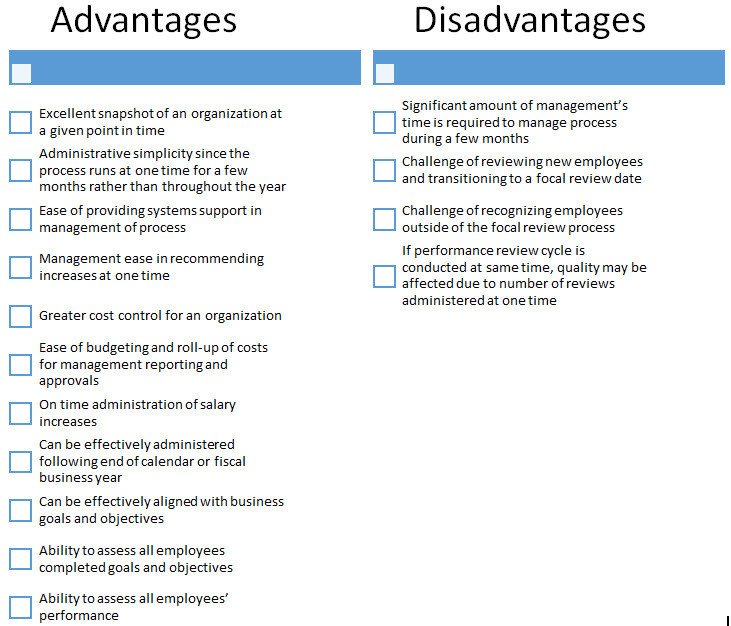
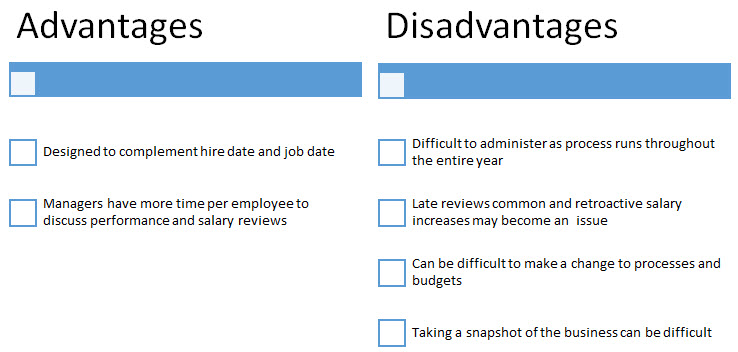
Focal reviews, also referred to as common date reviews, continue to gain popularity. There are advantages and disadvantages to each type of salary review cycle.
Focal (Common Date) Review Cycle
A focal salary review date is typically conducted at one, fixed date each year for all employees. Occasionally, the process is managed by segmenting employee groups by different focal review dates (e.g., all executive officers = February 1; all employees = April 1).
Anniversary Review Cycle
In the annual review cycle, salary increases are typically managed on the one-year anniversary for each employee from the date of hire or date in the job.
Focal Review Date
So when is the best focal review date? It is a good idea to consider the end of your business year and add two to four months as your focal review date. If your business year ends on December 31, it might be effective to use a March 1 or April 1 focal review date. This allows time for sales to end the business year, the assessment of year-end results, and roll out of the process after the New Year. Management will also appreciate rolling out a focal review process for an organization after the New Year.
Prorated Increases – Year of Implementation
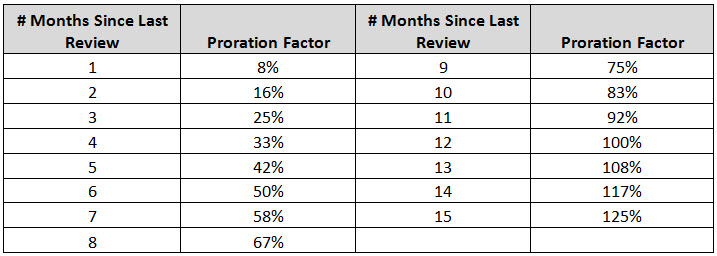
When transitioning from an anniversary review cycle to a focal review cycle, companies will frequently prorate salary increases during the year of implementation from the date of the last review. Sometimes the transition will require a proration over 100% when the last salary review is over 12 months. Keep your proration formula simple for ease of administration. As a best practice, avoid prorated increases by over 125%. A sample proration formula table follows:
Let’s use the table with a hypothetical example:
Emily was hired 1/15/2014 as an Accountant.
Her last increase was 1/15/2015.
Her company is planning to move to a focal review with an effective day of 03/01/2016.
Depending on the business implementation process, Emily may or may not be eligible for another increase until 03/01/2016.
If the company’s implementation process includes no 2016 increases until 03/01/2016, then Emily would be eligible for a salary review at that time, with a 14-month proration factor of 117%.
In this instance, a merit increase of 3% with a 14-month proration factor of 117% would then equal a 3.51% merit increase.
Timetable
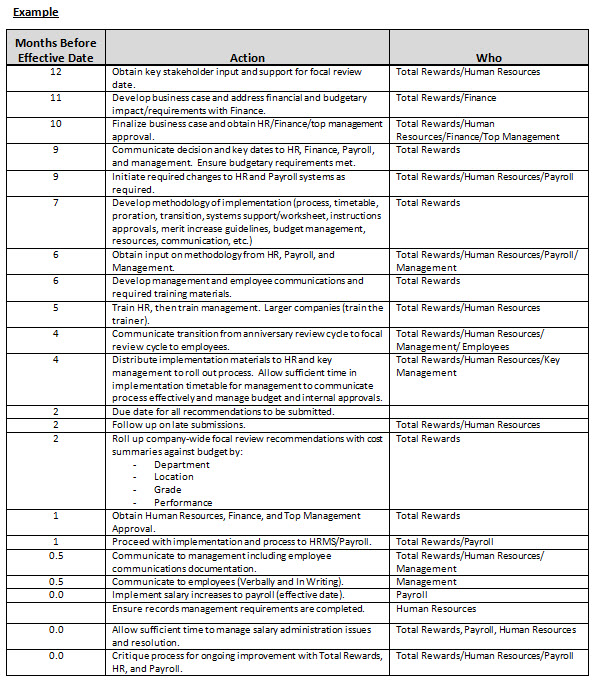
Depending on the size of the organization, the process to transition from an anniversary review cycle to a focal review cycle is time-consuming and may require additional systems support. The following timetable captures the typical steps required during the year of implementation:
Successful Implementation
The following steps are essential to a successful implementation:
Collaborating with key stakeholders.
Working closely with Finance to assess and budget for the cost of transition and any business issues required to be managed.
Ensuring that top management approves the program and required expenditures.
Confirming that your system and/or worksheet accurately calculates and tracks the increases and costs against budget.
Checking that your workflow is accurate.
Keeping your Human Resources, Payroll, and Finance teams involved in key decisions made and plans for implementation.
Communicating well in advance to management so that the required time is allocated to the process.
Confirming that there is a master communication plan to ensure timely management and employee communications.
Key to Success
Take the time to build a strong business case focusing on the impact to the business, management, and employees. Manage a well-designed process and timeline for a timely, effective focal review implementation. Ensure ample, relevant messaging as you communicate to your stakeholders at each stage of the implementation.
ERI Economic Research Institute compiles the most robust salary, cost-of-living, and executive compensation survey data available, with current market data for more than 1,000 industry sectors. Find our more about why certain businesses use salary surveys over at ERI.
ERI’s Assessor Series® – Solutions for every compensation decision