HR and compensation experts face the challenge of keeping track of many moving parts as compensation management encapsulates various complicated tasks and responsibilities, such as salary benchmarking, pay structure design, and compliance monitoring, to name a few. All these tasks that compensation specialists are responsible for work to ensure the successful implementation of an organization’s greater compensation philosophy and strategy.
As compensation teams grow, the scope of what they can achieve becomes realized through coordination made infinitely easier through smarter technology. Compensation management software, such as ERI’s Assessor Platform, was specifically developed to automate and integrate compensation tasks, allowing teams to shift from a reactive approach to a more strategic and streamlined process.
Using compensation management software, compensation specialists can move beyond outdated work processes, optimizing the time spent on manual and repetitive tasks to focus on more proactive responsibilities that require deeper deliberation. ERI’s suite of Compensation Management features help automate tasks by integrating reliable market data with features that take the tedium out of manual tasks – such as job description drafting and job matching – and improve pay accuracy. Instead of relying on bloated and outdated spreadsheets and sources, teams can use ERI’s Salary Assessor to quickly analyze compensation trends, evaluate internal pay equity, and build structured frameworks.
Why Does My Approach to Compensation Management Matter?
Compensation management drives business performance by aligning employee pay with company goals. When done effectively, compensation planning aids in controlling labor costs, reducing legal risks, and ensuring internal equity.
However, compensation planning has often been managed through manual and homegrown spreadsheets in Excel. Spreadsheets have long been a familiar tool for HR and compensation professionals as they are flexible, relatively easy to use, and widely accessible. But, as organizations grow in size and scale, spreadsheets that were once a reliable solution can begin to reveal significant limitations.
Why Do Manual Spreadsheets Fall Short for Compensation Management?
Here are a few issues and limitations that HR and compensation professionals could experience when relying solely on manual spreadsheets:
- Increased risk of errors: Besides being a tedious and laborious process, manual data entry and management could potentially introduce a high risk of human error. Misplaced numerical values and formulas could lead to inaccurate salary adjustments, budget miscalculations, or even compliance issues as these errors may go undetected.
- Limited scalability: With expansion comes the need to scale an organization’s compensation planning. Managing compensation for hundreds or thousands of employees across multiple locations, roles, and pay structures can be difficult to sustain in a spreadsheet-based system. Moreover, the complexity of compensation in a growing organization may become nearly unmanageable when relying on spreadsheets alone.
- Version control: In many cases, compensation management requires the involvement of multiple team members, including department managers, in a review process that requires managing different versions of spreadsheets, potentially causing problems. For example, there could be conflicting versions, inconsistencies, overwritten data, or unclear ownership, introducing confusion and slowing down the entire pay cycle.
- Security concerns: An organization’s compensation information is highly sensitive, and spreadsheets shared through email or stored on local drives can be vulnerable to unauthorized access.
How Does Automation Transform Compensation Management?
The shift from manual spreadsheets to automated compensation cycles is a tactical transformation. In short, automated compensation cycles refer to the use of specialized compensation management software platforms to manage an organization’s entire compensation process. These compensation management software platforms enable organizations to operate and manage compensation with greater efficiency and accuracy by centralizing data and streamlining workflows.
With automation comes the ability to easily integrate reliable market data directly into the compensation process, as achieved using ERI’s Salary Assessor. ERI’s compensation database houses over three decades of historical data, and salary data are continuously updated every six weeks to ensure market accuracy. Additionally, accurate salary benchmarking information allows organizations to make data-informed decisions, compare internal salaries against market rates, and justify compensation decisions at all structural levels.
What Are the Key Benefits of Automation in Compensation Management Software?
Here are a few of the seemingly endless benefits of automated compensation platforms:
- Improved accuracy and data integrity: Data syncing and system-supported calculations reduce the need for manual data entry and the input of complex formulas. Most compensation management software incorporates pay validation tools to ensure that compensation decisions are based on accurate and consistent data and formulas, minimizing the risk of costly errors and miscalculations.
- Real–time insights and analytics: HR and compensation professionals can access the most accurate and timely data at any point during a compensation cycle. As mentioned, ERI’s robust database is updated every six weeks to ensure that users can access and utilize ERI data to validate pay structures, benchmark roles, and conduct pay equity audits, as needed. This real-time visibility allows organizations to gain valuable insights rooted in market data.
- Streamlined workflows: Automated compensation platforms also enable organizations to design structured workflows with defined roles and permissions. For instance, ERI’s Salary Assessor supports manager/team collaboration through the Manager Audit Tool. A user can easily delegate certain tasks, such as assisting with setting performance evaluations for individual employees, to others within their organization.
- Enhanced compliance and auditability: Pay transparency and equity are prime concerns for all organizations regardless of size. Automated work systems provide documentation, audit trails, and reporting capabilities to ensure compliance on multiple levels.
- Scalability and flexibility: Compensation management software provides the ability for compensation structures to easily scale with the organization as they grow. Whether managing compensation for a small team or a global workforce, a compensation management system can accommodate varying levels of complexity and allow for customization based on an organization’s policies, compensation structures, and geographic considerations.
- Stronger data security: Centralized platforms also offer security features, access controls, encryptions, and secure cloud storage, ensuring that sensitive compensation information is protected under layers of security and only accessible to authorized users.
Most importantly, automated compensation cycles fundamentally change the scope of the role of HR and compensation professionals. As organizations move from manual spreadsheets to compensation management software, compensation teams can focus on higher-value tasks, such as compensation strategy development and data analysis.
The Salary Assessor as Your Compensation Management Solution
The foundation of ERI’s Salary Assessor has always been data, but this solution also provides essential tools that HR and compensation professionals can utilize for efficient and effective compensation cycles and work processes. With new AI capabilities, the Salary Assessor is a robust platform with innovative features created to support scalable compensation management and administration. Consider these valuable resources:
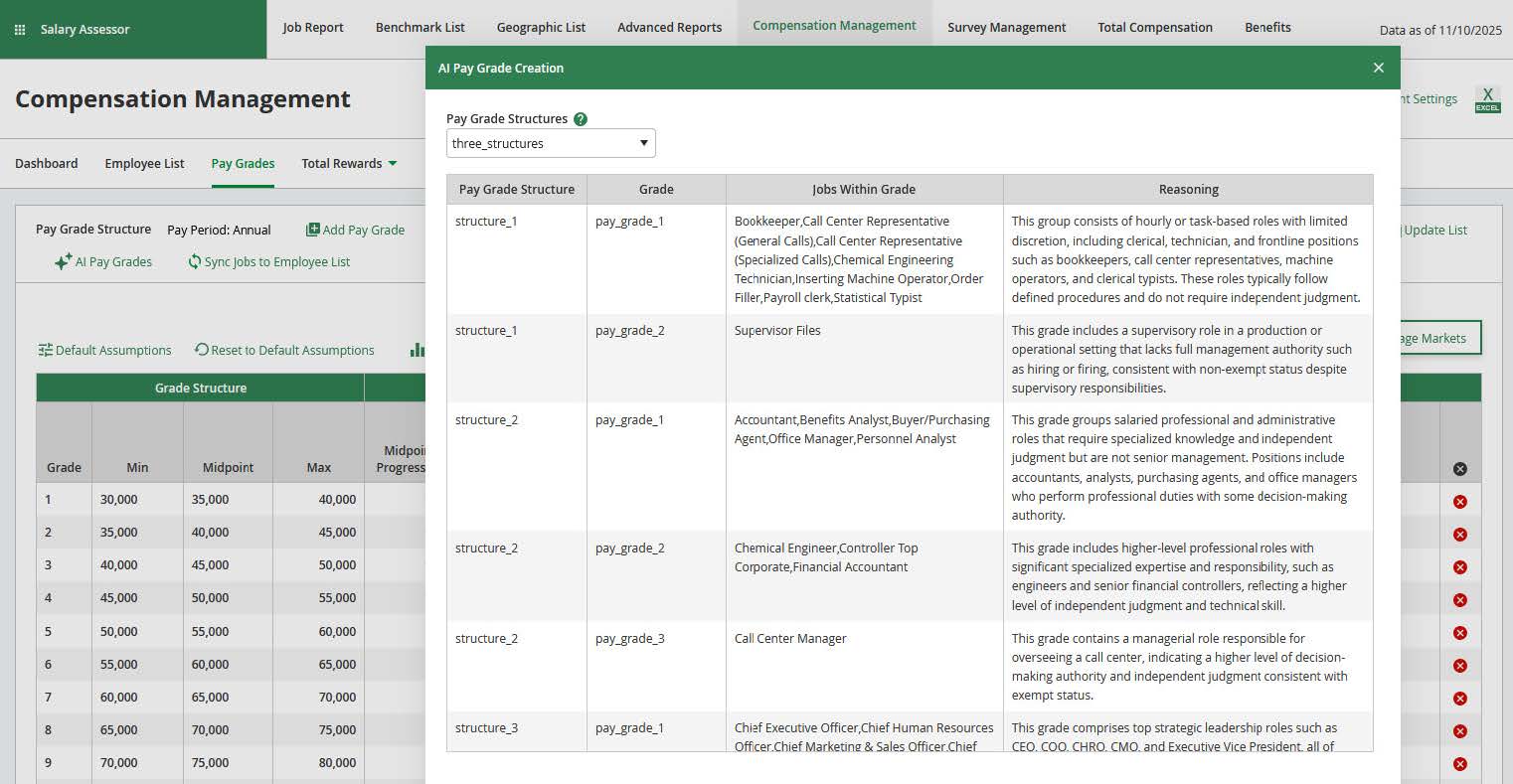
- Pay structure development: The Pay Grade feature in Compensation Management simplifies pay structure development, allowing users to upload and maintain their organization’s salary structures. It also enables the customization of pay grades, easily adjusting salary structures to continuously reflect market or organizational changes. The Pay Grade feature includes several charts to help the user view various pay grades and overlaps in the structure and also includes the option to add geographic markets to the pay grade structures and choose localization options for each market. Additionally, ERI’s AI Pay Grade Creation tool accelerates this process even further, generating complete and editable pay grade structures with jobs already assigned to corresponding grades or levels.
- Salary benchmarking: ERI’s salary benchmarking solution prioritizes data accuracy to ensure that every compensation decision is market-driven and defensible. Users can upload and compare multiple survey sources using the Survey Management feature to build competitive compensation packages based on data from all their survey vendors.
- Job Matching: Time-consuming job matching becomes exponentially easier with ERI’s new AI Job Matching tool. Users can instantly align internal job titles with ERI’s top five most relevant roles, leading to expedited and accurate salary benchmarking. Additionally, subscribers can quickly generate detailed job descriptions with the AI Job Description Writing tool, including comprehensive duties and responsibilities tailored to job titles, to improve and inform job matching decisions.
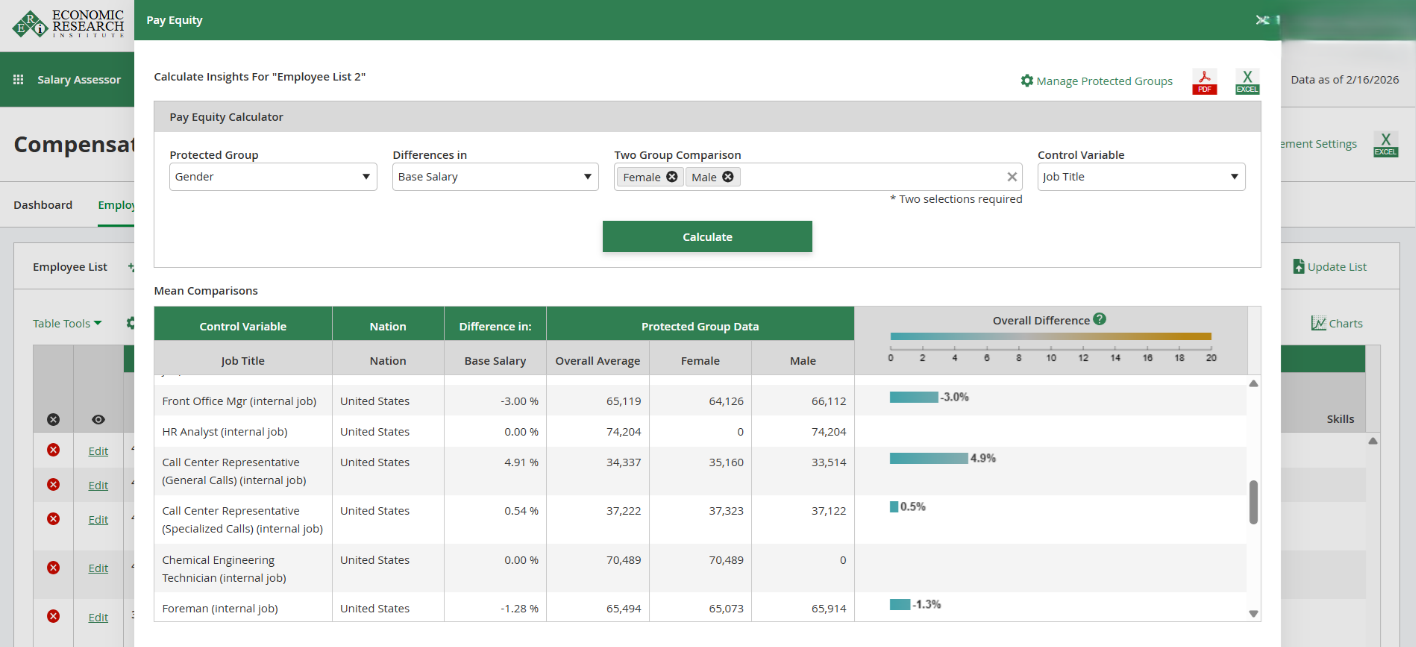
- Workforce Insights: Use the Pay Equity tool in Compensation Management to identify potential pay gaps between employees in protected groups. Additionally, address subordinate-versus-supervisor pay compression risks using ERI’s Compression Check feature.
- Coordination and compliance: The Manager Audit tool allows a coordinator to delegate tasks to other department managers for processes such as merit and pay reviews. Additionally, the Notifications Report alerts users to check any potential FLSA and minimum wage compliance issues.
- HRIS integration: Our secure HRIS integration process syncs ERI’s software with a user’s HCM/HRIS platform, pulling employee data and records to efficiently upload and update whole employee lists. This expedites importing employee information and ensures that you are always accurately pulling the necessary data straight from your original employee data repository.
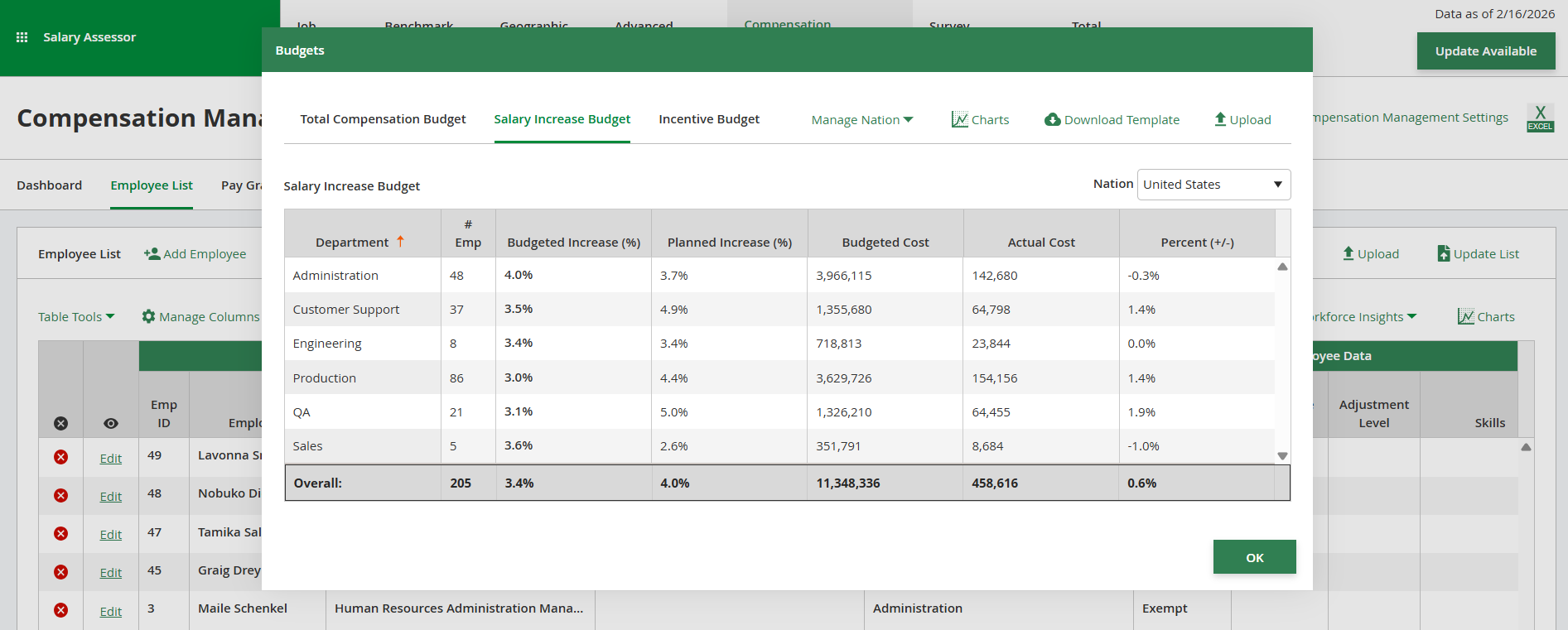
- Compensation budgeting and scenario modeling: The Budget feature in Compensation Management allows users to set department-level budgets for pay elements, such as salary increases or incentives, and then track actual compensation costs against those targets as information changes.
- Salary increases forecasting: Additionally, ERI’s homegrown AI Job Growth Model, CompAtlas, uses our proprietary transformer to forecast compensation changes over time, delivering granular insights on occupation-based salary increases to inform future pay decisions.
Are you interested in seeing how ERI can transform the way you approach compensation? Click here for a free demo to get started today!